
What you will learn in this chapter
- Explain the structure of a typical anther and the formation of pollen grains (microsporogenesis).
- Draw and label the structure of an anatropous ovule and a mature 7-celled, 8-nucleate embryo sac.
- Differentiate autogamy, geitonogamy and xenogamy, and describe outbreeding devices.
- Explain double fertilisation and the ploidy of zygote and primary endosperm nucleus.
- Describe the development of endosperm, embryo, seed and fruit.
- Explain apomixis, polyembryony and parthenocarpy with NCERT examples.
📘 Open this chapter on NCERT official website (ncert.nic.in) · The same NCERT chapter is taught in both CBSE and UP Board.
Sexual Reproduction in Flowering Plants — Notes
🖼️ Diagrams are now right inside the notes. Tap any picture to zoom and see the name and job of each part; 🧊 3D opens the 3D model.डायग्राम अब नोट्स के अंदर ही हैं। किसी भी चित्र पर टैप करें — ज़ूम करें और हर भाग का नाम व कार्य देखें; 🧊 3D से 3D मॉडल खुलता है।Diagrams ab notes ke andar hi hain. Kisi bhi picture par tap kijiye — zoom kijiye aur har part ka naam aur kaam dekhiye; 🧊 3D se 3D model khulta hai.
Revise these first (prerequisites)
- Basic parts of a flower — sepal, petal, stamen, pistil (Class 6–7 level)
- Mitosis vs meiosis: meiosis halves the chromosome number (2n → n)
- Meaning of haploid (n) and diploid (2n)
- Plant life cycle: seed → plant → flower → fruit → seed
Flower = the reproductive part of a plant
A flower is not just for looking beautiful — it is the reproductive organ of the plant. Its male part is the stamen (पुंकेसर) and its female part is the pistil (स्त्रीकेसर). Just as the kitchen is the place in a home where food is made, the flower is the place where seeds are made.
L.S. of a flowerपुष्प की अनुदैर्ध्य काट (L.S.)L.S. of a flowerNCERT Fig 1.1Four whorls from outside in: sepals, petals, stamens (anther + filament) and the pistil (stigma, style, ovary with ovules).बाहर से अंदर चार चक्र: बाह्यदल, दल, पुंकेसर (परागकोश + पुतंतु) और स्त्रीकेसर (वर्तिकाग्र, वर्तिका, बीजांड सहित अंडाशय)।Bahar se andar 4 whorls dekhiye: sepals, petals, stamens (anther + filament) aur pistil (stigma, style, ovules wala ovary).🧊 See in 3D: flower — cut open3D में देखें: फूल — कटा हुआ3D dekhiye: flower — cut karke dekhiye🧊 See in 3D: realistic China rose (Hibiscus)3D में देखें: असली जैसा गुड़हल3D dekhiye: realistic gudhal (Hibiscus) Pollen grain = the male 'packet'
Pollen grains are formed in the upper part of the stamen, the anther (परागकोश). Male gametes are formed inside each pollen grain. Think of it as a sealed courier packet: a tough outer cover (exine) with the actual contents (male gametes) inside.
Pollen grain (2-celled and 3-celled)पराग कण (2-कोशिकीय व 3-कोशिकीय)Pollen grain (2-celled and 3-celled)NCERT Fig 1.5Tough exine (sporopollenin) with germ pores, inner intine. 2-celled: big vegetative cell + small generative cell; 3-celled: 2 male gametes.कठोर बाह्यचोल (स्पोरोपोलेनिन) व जनन छिद्र, भीतरी अंतःचोल। 2-कोशिकीय: बड़ी कायिक + छोटी जनन कोशिका; 3-कोशिकीय: 2 नर युग्मक।Tough exine (sporopollenin) aur germ pores, andar intine. 2-celled: badi vegetative + chhoti generative cell; 3-celled: 2 male gametes.🧊 See in 3D: pollen grain3D में देखें: पराग कण3D dekhiye: pollen grain The egg inside the ovule
The swollen lower part of the pistil is called the ovary (अंडाशय). Inside the ovary are ovules (बीजांड), and inside each ovule is an embryo sac (भ्रूणकोश) containing the egg cell. This ovule later develops into the seed.
Anatropous ovule (megasporangium)प्रतीप बीजांड (गुरुबीजाणुधानी)Anatropous ovule (megasporangium)NCERT Fig 1.7dAnatropous ovule: funicle, hilum, two integuments, micropyle, chalaza, nucellus — and the embryo sac inside the nucellus.प्रतीप बीजांड: बीजांडवृंत, नाभिका, दो अध्यावरण, बीजांडद्वार, निभाग, बीजांडकाय — और बीजांडकाय के अंदर भ्रूणकोश।Anatropous ovule: funicle, hilum, 2 integuments, micropyle, chalaza, nucellus — aur nucellus ke andar embryo sac. Mature embryo sac — 7 cells, 8 nucleiपरिपक्व भ्रूणकोश — 7 कोशिकाएँ, 8 केंद्रकMature embryo sac — 7 cells, 8 nucleiNCERT Fig 1.8c7 cells, 8 nuclei: egg apparatus (2 synergids + egg) at the micropylar end, 3 antipodals at the chalazal end, 2 polar nuclei in the central cell.7 कोशिकाएँ, 8 केंद्रक: बीजांडद्वारी सिरे पर अंड उपकरण (2 सहायक कोशिकाएँ + अंड), निभागी सिरे पर 3 प्रतिमुखी, केंद्रीय कोशिका में 2 ध्रुवीय केंद्रक।7 cells, 8 nuclei: micropylar end par egg apparatus (2 synergids + egg), chalazal end par 3 antipodals, central cell mein 2 polar nuclei.🧊 See in 3D: ovule + embryo sac3D में देखें: बीजांड + भ्रूणकोश3D dekhiye: ovule + embryo sac Pollination = pollen reaching the stigma
Pollen has to travel from the anther to the stigma (top of the pistil) — this is called pollination (परागण). This is done by wind, water, insects or birds. A flower cannot move on its own, so it needs 'delivery partners'.
Kinds of pollinationपरागण के प्रकारKinds of pollinationNCERT Fig 1.9Autogamy = same flower, geitonogamy = another flower of the same plant, xenogamy = a flower of a different plant.स्वयुग्मन = वही फूल, सजातपुष्पी = उसी पौधे का दूसरा फूल, परनिषेचन = दूसरे पौधे का फूल।Autogamy = wahi flower, geitonogamy = same plant ka doosra flower, xenogamy = doosre plant ka flower. Fertilisation = fusion of male and female gametes
After landing on the stigma, the pollen grain forms a pollen tube that grows to the ovule. There, a male gamete fuses with the egg; this is fertilisation (निषेचन). Flowering plants have two fusions, not one, so the process is called double fertilisation.
Double fertilisation (syngamy + triple fusion)दोहरा निषेचन (युग्मक संलयन + त्रिसंलयन)Double fertilisation (syngamy + triple fusion)NCERT Fig 1.12e, 1.13aTwo fusions in one embryo sac: male gamete + egg = zygote (2n); male gamete + 2 polar nuclei = PEN (3n).एक भ्रूणकोश में दो संलयन: नर युग्मक + अंड = युग्मनज (2n); नर युग्मक + 2 ध्रुवीय केंद्रक = PEN (3n)।Ek embryo sac mein 2 fusions: male gamete + egg = zygote (2n); male gamete + 2 polar nuclei = PEN (3n). What forms later?
After fertilisation: ovule → seed (बीज), ovary → fruit (फल). The mangoes or peas you eat are the result of this process. Inside the seed, a tiny baby plant (embryo) stays peacefully 'asleep' until it gets the right season.
Dicot seed (bean)द्विबीजपत्री बीज (सेम)Dicot seed (bean)NCERT Fig 1.15aDicot seed: seed coat, hilum, micropyle, two cotyledons storing food, plumule and radicle.द्विबीजपत्री बीज: बीजचोल, नाभिका, बीजांडद्वार, भोजन संग्रह करते दो बीजपत्र, प्रांकुर और मूलांकुर।Dicot seed: seed coat, hilum, micropyle, khana store karne wale 2 cotyledons, plumule aur radicle. False fruits: apple and strawberryकूट फल: सेब व स्ट्रॉबेरीFalse fruits: apple and strawberryNCERT Fig 1.15bIn apple and strawberry the thalamus also grows into the fruit — that is why they are called false fruits.सेब और स्ट्रॉबेरी में पुष्पासन भी फल बनाता है — इसलिए ये कूट फल कहलाते हैं।Apple aur strawberry mein thalamus bhi fruit banata hai — isliye inhe false fruit kehte hain.🧊 See in 3D: seeds: bean & maize3D में देखें: बीज: सेम व मक्का3D dekhiye: seeds: bean aur maize
Quick check ✔
1. In which part of the flower are pollen grains formed?
2. What does the ovule develop into after fertilisation?
Basics clear? Now move on to Learn in Detail 👆
As per NCERT 2026-27 — every point you need for the board exam.
Parts of a flower
Stamen (पुंकेसर) = male part: anther + filament. Pistil / carpel (स्त्रीकेसर) = female part: stigma, style, ovary. Androecium = all the stamens, gynoecium = all the carpels.
L.S. of a flowerपुष्प की अनुदैर्ध्य काट (L.S.)L.S. of a flowerNCERT Fig 1.1Four whorls from outside in: sepals, petals, stamens (anther + filament) and the pistil (stigma, style, ovary with ovules).बाहर से अंदर चार चक्र: बाह्यदल, दल, पुंकेसर (परागकोश + पुतंतु) और स्त्रीकेसर (वर्तिकाग्र, वर्तिका, बीजांड सहित अंडाशय)।Bahar se andar 4 whorls dekhiye: sepals, petals, stamens (anther + filament) aur pistil (stigma, style, ovules wala ovary).🧊 See in 3D: flower — cut open3D में देखें: फूल — कटा हुआ3D dekhiye: flower — cut karke dekhiye🧊 See in 3D: realistic China rose (Hibiscus)3D में देखें: असली जैसा गुड़हल3D dekhiye: realistic gudhal (Hibiscus) Structure of the anther
A typical anther is bilobed and dithecous — 4 microsporangia. The wall has 4 layers: epidermis, endothecium, middle layers, tapetum (innermost; nourishes the developing pollen).
Stamen and 3-D cut section of antherपुंकेसर तथा परागकोश की 3-D काटStamen and 3-D cut section of antherNCERT Fig 1.2A stamen = filament + anther. The cut anther shows its 4 microsporangia (pollen sacs) — 2 in each lobe.पुंकेसर = पुतंतु + परागकोश। कटे परागकोश में 4 लघुबीजाणुधानियाँ (पराग कोष) — हर पालि में 2।Stamen = filament + anther. Cut anther mein 4 microsporangia (pollen sacs) dikhenge — har lobe mein 2. T.S. of a young antherतरुण परागकोश की अनुप्रस्थ काटT.S. of a young antherNCERT Fig 1.3aBilobed, dithecous anther in T.S.: 4 microsporangia at the corners, connective in the middle.द्विपालित, द्विकोष्ठी परागकोश की अनुप्रस्थ काट: कोनों पर 4 लघुबीजाणुधानियाँ, बीच में योजी।Bilobed, dithecous anther ka T.S.: corners par 4 microsporangia, beech mein connective.🧊 See in 3D: anther — 4 pollen sacs3D में देखें: परागकोश — 4 पराग कोष3D dekhiye: anther — 4 pollen sacs Microsporogenesis
Pollen mother cell (2n) → meiosis → microspore tetrad (n). Each microspore later develops into a pollen grain.
Microsporangium: wall layers & microsporogenesisलघुबीजाणुधानी: भित्ति परतें व लघुबीजाणुजननMicrosporangium: wall layers & microsporogenesisNCERT Fig 1.3bWall layers from outside: epidermis, endothecium, middle layers, tapetum (feeds pollen). Inside: sporogenous tissue → microspore tetrads.भित्ति की परतें बाहर से: बाह्यत्वचा, अंतस्थीसियम, मध्य परतें, टेपीटम (पराग को पोषण)। अंदर: बीजाणुजन ऊतक → लघुबीजाणु चतुष्क।Wall layers bahar se: epidermis, endothecium, middle layers, tapetum (pollen ko khana deta hai). Andar: sporogenous tissue → microspore tetrads. Pollen grain
Outer wall exine = sporopollenin (the most resistant organic material); sporopollenin is absent at the germ pores. Inner wall intine = cellulose + pectin. A mature pollen grain has a vegetative cell (large) + a generative cell (small). In over 60% of angiosperms, pollen is shed at the 2-celled stage.
Pollen grain (2-celled and 3-celled)पराग कण (2-कोशिकीय व 3-कोशिकीय)Pollen grain (2-celled and 3-celled)NCERT Fig 1.5Tough exine (sporopollenin) with germ pores, inner intine. 2-celled: big vegetative cell + small generative cell; 3-celled: 2 male gametes.कठोर बाह्यचोल (स्पोरोपोलेनिन) व जनन छिद्र, भीतरी अंतःचोल। 2-कोशिकीय: बड़ी कायिक + छोटी जनन कोशिका; 3-कोशिकीय: 2 नर युग्मक।Tough exine (sporopollenin) aur germ pores, andar intine. 2-celled: badi vegetative + chhoti generative cell; 3-celled: 2 male gametes.🧊 See in 3D: pollen grain3D में देखें: पराग कण3D dekhiye: pollen grain Ovule (बीजांड)
Attached to the placenta by the funicle; hilum = where the funicle joins the ovule body. Integuments, micropyle, chalaza, nucellus. The embryo sac lies inside the nucellus.
Anatropous ovule (megasporangium)प्रतीप बीजांड (गुरुबीजाणुधानी)Anatropous ovule (megasporangium)NCERT Fig 1.7dAnatropous ovule: funicle, hilum, two integuments, micropyle, chalaza, nucellus — and the embryo sac inside the nucellus.प्रतीप बीजांड: बीजांडवृंत, नाभिका, दो अध्यावरण, बीजांडद्वार, निभाग, बीजांडकाय — और बीजांडकाय के अंदर भ्रूणकोश।Anatropous ovule: funicle, hilum, 2 integuments, micropyle, chalaza, nucellus — aur nucellus ke andar embryo sac.🧊 See in 3D: ovule + embryo sac3D में देखें: बीजांड + भ्रूणकोश3D dekhiye: ovule + embryo sac Megasporogenesis + embryo sac
Megaspore mother cell (2n) → meiosis → 4 megaspores, only 1 functional. Monosporic development: 3 mitotic divisions → 7-celled, 8-nucleate embryo sac — egg apparatus (2 synergids + 1 egg), 3 antipodals, 2 polar nuclei in the central cell.
Megasporogenesis → embryo sac (step by step)गुरुबीजाणुजनन → भ्रूणकोश (चरणबद्ध)Megasporogenesis → embryo sac (step by step)NCERT Fig 1.8a, bFollow the steps: MMC → meiosis → 4 megaspores (1 survives) → 3 mitoses → 8 nuclei → 7-celled embryo sac.चरण देखें: गुरुबीजाणु मातृ कोशिका → अर्धसूत्रण → 4 गुरुबीजाणु (1 जीवित) → 3 समसूत्रण → 8 केंद्रक → 7-कोशिकीय भ्रूणकोश।Steps dekhiye: MMC → meiosis → 4 megaspores (1 bachta hai) → 3 mitosis → 8 nuclei → 7-celled embryo sac. Mature embryo sac — 7 cells, 8 nucleiपरिपक्व भ्रूणकोश — 7 कोशिकाएँ, 8 केंद्रकMature embryo sac — 7 cells, 8 nucleiNCERT Fig 1.8c7 cells, 8 nuclei: egg apparatus (2 synergids + egg) at the micropylar end, 3 antipodals at the chalazal end, 2 polar nuclei in the central cell.7 कोशिकाएँ, 8 केंद्रक: बीजांडद्वारी सिरे पर अंड उपकरण (2 सहायक कोशिकाएँ + अंड), निभागी सिरे पर 3 प्रतिमुखी, केंद्रीय कोशिका में 2 ध्रुवीय केंद्रक।7 cells, 8 nuclei: micropylar end par egg apparatus (2 synergids + egg), chalazal end par 3 antipodals, central cell mein 2 polar nuclei. Types of pollination
Autogamy (same flower), geitonogamy (another flower of the same plant — genetically similar to autogamy), xenogamy (a different plant — genetically different pollen). Cleistogamous flowers (Viola, Oxalis, Commelina) never open → assured seed set.
Kinds of pollinationपरागण के प्रकारKinds of pollinationNCERT Fig 1.9Autogamy = same flower, geitonogamy = another flower of the same plant, xenogamy = a flower of a different plant.स्वयुग्मन = वही फूल, सजातपुष्पी = उसी पौधे का दूसरा फूल, परनिषेचन = दूसरे पौधे का फूल।Autogamy = wahi flower, geitonogamy = same plant ka doosra flower, xenogamy = doosre plant ka flower. Agents of pollination
Wind: light, non-sticky pollen, feathery stigma (grasses, maize). Water: Vallisneria, Hydrilla, Zostera (sea grass). Insects: coloured, scented, nectar-rich flowers. Amorphophallus has the largest flower; Yucca–moth mutualism.
Pollen–pistil interaction: path of the pollen tubeपराग-स्त्रीकेसर संकर्षण: पराग नलिका का मार्गPollen–pistil interaction: path of the pollen tubeNCERT Fig 1.12Pollen lands on the stigma → tube grows down the style → enters the ovule through the micropyle → enters a synergid.पराग वर्तिकाग्र पर → नलिका वर्तिका में नीचे बढ़ती है → बीजांडद्वार से बीजांड में → एक सहायक कोशिका में।Pollen stigma par → tube style mein neeche badhti hai → micropyle se ovule mein → ek synergid mein. Outbreeding devices
Ways to prevent self-pollination: pollen release and stigma receptivity at different times, anther and stigma at different positions, self-incompatibility, unisexual flowers (castor, maize = monoecious; papaya = dioecious).
Artificial hybridisation
Emasculation (removal of anthers from a bisexual flower) + bagging (butter paper bag) → dusting of desired pollen → rebagging.
Artificial hybridisation: emasculation & baggingकृत्रिम संकरण: विपुंसन व बोरावस्त्रावरणArtificial hybridisation: emasculation & baggingThe 5 steps of artificial hybridisation: emasculation, bagging, dusting the chosen pollen, rebagging.कृत्रिम संकरण के 5 चरण: विपुंसन, बोरावस्त्रावरण, चुने हुए परागकण डालना, पुनः थैला।Artificial hybridisation ke 5 steps: emasculation, bagging, chosen pollen dalna, rebagging. Double fertilisation (दोहरा निषेचन)
The pollen tube releases 2 male gametes through a synergid. 1st male gamete + egg = syngamy → zygote (2n). 2nd male gamete + 2 polar nuclei = triple fusion → PEN (3n). Found only in angiosperms.
Double fertilisation (syngamy + triple fusion)दोहरा निषेचन (युग्मक संलयन + त्रिसंलयन)Double fertilisation (syngamy + triple fusion)NCERT Fig 1.12e, 1.13aTwo fusions in one embryo sac: male gamete + egg = zygote (2n); male gamete + 2 polar nuclei = PEN (3n).एक भ्रूणकोश में दो संलयन: नर युग्मक + अंड = युग्मनज (2n); नर युग्मक + 2 ध्रुवीय केंद्रक = PEN (3n)।Ek embryo sac mein 2 fusions: male gamete + egg = zygote (2n); male gamete + 2 polar nuclei = PEN (3n). Endosperm, embryo, seed
Endosperm forms first (it provides nutrition to the embryo). Coconut water = free-nuclear endosperm, white kernel = cellular endosperm. Dicot embryo: 2 cotyledons, epicotyl, hypocotyl. Monocot: 1 cotyledon = scutellum, coleoptile, coleorhiza. Perisperm = residual nucellus (black pepper, beet).
Embryo development in a dicot (embryogeny)द्विबीजपत्री में भ्रूण विकासEmbryo development in a dicot (embryogeny)NCERT Fig 1.13bZygote → proembryo → globular → heart-shaped → mature embryo. The endosperm forms first to feed it.युग्मनज → पूर्वभ्रूण → गोलाकार → हृदयाकार → परिपक्व भ्रूण। पोषण के लिए भ्रूणपोष पहले बनता है।Zygote → proembryo → globular → heart-shaped → mature embryo. Khana dene ke liye endosperm pehle banta hai. Typical dicot embryoविशिष्ट द्विबीजपत्री भ्रूणTypical dicot embryoNCERT Fig 1.14aEmbryonal axis with two cotyledons: epicotyl ends in the plumule, hypocotyl ends in the radicle.दो बीजपत्रों वाला भ्रूणीय अक्ष: बीजपत्रोपरिक का सिरा प्रांकुर, बीजपत्राधार का सिरा मूलांकुर।2 cotyledons wala embryonal axis: epicotyl ka sira plumule, hypocotyl ka sira radicle. L.S. of a grass (monocot) embryoघास (एकबीजपत्री) भ्रूण की अनुदैर्ध्य काटL.S. of a grass (monocot) embryoNCERT Fig 1.14bGrass embryo: one cotyledon = scutellum; coleoptile covers the shoot apex, coleorhiza covers the radicle.घास का भ्रूण: एक बीजपत्र = स्कुटेलम; प्रांकुरचोल प्ररोह शीर्ष को, मूलांकुरचोल मूलांकुर को ढकता है।Grass embryo: ek cotyledon = scutellum; coleoptile shoot apex ko, coleorhiza radicle ko dhakta hai. Dicot seed (bean)द्विबीजपत्री बीज (सेम)Dicot seed (bean)NCERT Fig 1.15aDicot seed: seed coat, hilum, micropyle, two cotyledons storing food, plumule and radicle.द्विबीजपत्री बीज: बीजचोल, नाभिका, बीजांडद्वार, भोजन संग्रह करते दो बीजपत्र, प्रांकुर और मूलांकुर।Dicot seed: seed coat, hilum, micropyle, khana store karne wale 2 cotyledons, plumule aur radicle. Monocot seed (maize grain) L.S.एकबीजपत्री बीज (मक्का दाना)Monocot seed (maize grain) L.S.NCERT Fig 1.15aMaize grain: fused pericarp + seed coat, big endosperm with an aleurone layer, small embryo with scutellum.मक्का दाना: जुड़े फलभित्ति + बीजचोल, एल्यूरोन परत सहित बड़ा भ्रूणपोष, स्कुटेलम वाला छोटा भ्रूण।Maize grain: pericarp + seed coat jude hue, aleurone layer wala bada endosperm, scutellum wala chhota embryo.🧊 See in 3D: seeds: bean & maize3D में देखें: बीज: सेम व मक्का3D dekhiye: seeds: bean aur maize Fruit
Ovary → fruit, ovule → seed. False fruit: the thalamus also contributes to fruit formation (apple, strawberry, cashew). Parthenocarpy = fruit without fertilisation (banana) — seedless.
False fruits: apple and strawberryकूट फल: सेब व स्ट्रॉबेरीFalse fruits: apple and strawberryNCERT Fig 1.15bIn apple and strawberry the thalamus also grows into the fruit — that is why they are called false fruits.सेब और स्ट्रॉबेरी में पुष्पासन भी फल बनाता है — इसलिए ये कूट फल कहलाते हैं।Apple aur strawberry mein thalamus bhi fruit banata hai — isliye inhe false fruit kehte hain. Apomixis & polyembryony
Apomixis = formation of seeds without fertilisation (Asteraceae, grasses) — useful for hybrid seeds. Polyembryony = more than one embryo in a seed (citrus, mango). Seed viability records: Lupinus arcticus ~10,000 years; date palm ~2000 years.
The concept in depth — the why and the how. Everything stays within the NCERT syllabus.
Why is the exine so tough?
The exine is made of sporopollenin — one of the most resistant organic materials known; it withstands high temperatures and strong acids/alkalis, and no enzyme can degrade it. This is why pollen is preserved even as fossils. Sporopollenin is absent at the germ pores — that is where the pollen tube emerges.
Pollen grain (2-celled and 3-celled)पराग कण (2-कोशिकीय व 3-कोशिकीय)Pollen grain (2-celled and 3-celled)NCERT Fig 1.5Tough exine (sporopollenin) with germ pores, inner intine. 2-celled: big vegetative cell + small generative cell; 3-celled: 2 male gametes.कठोर बाह्यचोल (स्पोरोपोलेनिन) व जनन छिद्र, भीतरी अंतःचोल। 2-कोशिकीय: बड़ी कायिक + छोटी जनन कोशिका; 3-कोशिकीय: 2 नर युग्मक।Tough exine (sporopollenin) aur germ pores, andar intine. 2-celled: badi vegetative + chhoti generative cell; 3-celled: 2 male gametes. Geitonogamy: functionally cross, genetically self
In geitonogamy, pollen goes to the stigma of another flower of the same plant. A pollinator is needed, so functionally it is like cross-pollination; but the pollen is from the same plant, so genetically it is the same as autogamy — no new genetic variation arises. Hence maize (monoecious) prevents autogamy but not geitonogamy; papaya (dioecious) prevents both.
Kinds of pollinationपरागण के प्रकारKinds of pollinationNCERT Fig 1.9Autogamy = same flower, geitonogamy = another flower of the same plant, xenogamy = a flower of a different plant.स्वयुग्मन = वही फूल, सजातपुष्पी = उसी पौधे का दूसरा फूल, परनिषेचन = दूसरे पौधे का फूल।Autogamy = wahi flower, geitonogamy = same plant ka doosra flower, xenogamy = doosre plant ka flower. Complete ploidy calculation
Megaspore mother cell 2n → meiosis → megaspore n → 3 free-nuclear mitotic divisions → all cells of the embryo sac are n. Egg (n) + male gamete (n) = zygote 2n. Two polar nuclei (n+n) + male gamete (n) = PEN 3n. Nucellus and integuments are maternal tissues, so they are 2n. If you remember this table, you can solve all ploidy questions.
Mature embryo sac — 7 cells, 8 nucleiपरिपक्व भ्रूणकोश — 7 कोशिकाएँ, 8 केंद्रकMature embryo sac — 7 cells, 8 nucleiNCERT Fig 1.8c7 cells, 8 nuclei: egg apparatus (2 synergids + egg) at the micropylar end, 3 antipodals at the chalazal end, 2 polar nuclei in the central cell.7 कोशिकाएँ, 8 केंद्रक: बीजांडद्वारी सिरे पर अंड उपकरण (2 सहायक कोशिकाएँ + अंड), निभागी सिरे पर 3 प्रतिमुखी, केंद्रीय कोशिका में 2 ध्रुवीय केंद्रक।7 cells, 8 nuclei: micropylar end par egg apparatus (2 synergids + egg), chalazal end par 3 antipodals, central cell mein 2 polar nuclei. Why does the endosperm form first?
Endosperm development begins before embryo development, because the endosperm provides food to the developing embryo — the lunchbox is packed first, then the baby grows. Coconut water = free-nuclear endosperm, and the white kernel = cellular endosperm. In non-albuminous seeds like pea and groundnut, the embryo uses up the endosperm; in wheat, maize and castor it persists (albuminous).
Embryo development in a dicot (embryogeny)द्विबीजपत्री में भ्रूण विकासEmbryo development in a dicot (embryogeny)NCERT Fig 1.13bZygote → proembryo → globular → heart-shaped → mature embryo. The endosperm forms first to feed it.युग्मनज → पूर्वभ्रूण → गोलाकार → हृदयाकार → परिपक्व भ्रूण। पोषण के लिए भ्रूणपोष पहले बनता है।Zygote → proembryo → globular → heart-shaped → mature embryo. Khana dene ke liye endosperm pehle banta hai. Use of apomixis in agriculture
Apomixis = formation of seeds without fertilisation (Asteraceae, grasses). Hybrid seeds must be bought afresh every year because characters segregate in their progeny. If hybrids are made apomictic, hybrid characters will not segregate and farmers can use the same seeds year after year — that is why scientists are working to understand apomixis genes. This concept is directly linked to Chapter 4 (segregation).
Seed dormancy and viability: a survival strategy
Seed dormancy protects the plant from unfavourable weather: the embryo stays inactive until suitable conditions are available. NCERT examples: a Lupinus arcticus seed germinated after ~10,000 years, and so did a ~2000-year-old date palm (Phoenix dactylifera) seed. This dormancy is also what makes seeds suitable for storage and transport.
Common confusions — cleared up
Syngamy vs Triple fusion
Syngamy = male gamete + egg → zygote (2n). Triple fusion = male gamete + 2 polar nuclei → primary endosperm nucleus (3n). Together they form double fertilisation.
Double fertilisation (syngamy + triple fusion)दोहरा निषेचन (युग्मक संलयन + त्रिसंलयन)Double fertilisation (syngamy + triple fusion)NCERT Fig 1.12e, 1.13aTwo fusions in one embryo sac: male gamete + egg = zygote (2n); male gamete + 2 polar nuclei = PEN (3n).एक भ्रूणकोश में दो संलयन: नर युग्मक + अंड = युग्मनज (2n); नर युग्मक + 2 ध्रुवीय केंद्रक = PEN (3n)।Ek embryo sac mein 2 fusions: male gamete + egg = zygote (2n); male gamete + 2 polar nuclei = PEN (3n). Pollination vs Fertilisation
Pollination = pollen reaching the stigma (transfer). Fertilisation = fusion of gametes, which happens inside the ovule after pollination.
Pollen–pistil interaction: path of the pollen tubeपराग-स्त्रीकेसर संकर्षण: पराग नलिका का मार्गPollen–pistil interaction: path of the pollen tubeNCERT Fig 1.12Pollen lands on the stigma → tube grows down the style → enters the ovule through the micropyle → enters a synergid.पराग वर्तिकाग्र पर → नलिका वर्तिका में नीचे बढ़ती है → बीजांडद्वार से बीजांड में → एक सहायक कोशिका में।Pollen stigma par → tube style mein neeche badhti hai → micropyle se ovule mein → ek synergid mein. Perisperm vs Endosperm
Endosperm is formed by fertilisation (3n). Perisperm is the remaining nucellus (2n), as in black pepper and beet.
Monocot seed (maize grain) L.S.एकबीजपत्री बीज (मक्का दाना)Monocot seed (maize grain) L.S.NCERT Fig 1.15aMaize grain: fused pericarp + seed coat, big endosperm with an aleurone layer, small embryo with scutellum.मक्का दाना: जुड़े फलभित्ति + बीजचोल, एल्यूरोन परत सहित बड़ा भ्रूणपोष, स्कुटेलम वाला छोटा भ्रूण।Maize grain: pericarp + seed coat jude hue, aleurone layer wala bada endosperm, scutellum wala chhota embryo. Parthenocarpy vs Apomixis
Parthenocarpy = fruit without fertilisation (seedless, e.g. banana). Apomixis = seed without fertilisation.
Video
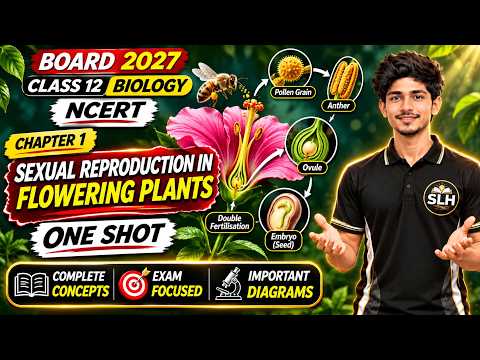
▶ Class 12 Biology Chapter 1 | Sexual Reproduction in Flowering Plants | NCERT One Shot · 28 min
Diagrams (tap & zoom)
All 18 diagrams of this chapter — tap one to open itइस अध्याय के सभी 18 डायग्राम — खोलने के लिए टैप करेंIs chapter ke saare 18 diagrams — kholne ke liye tap kijiye
 L.S. of a flowerपुष्प की अनुदैर्ध्य काट (L.S.)Fig 1.1
 Stamen and 3-D cut section of antherपुंकेसर तथा परागकोश की 3-D काटFig 1.2
 T.S. of a young antherतरुण परागकोश की अनुप्रस्थ काटFig 1.3a
 Microsporangium: wall layers & microsporogenesisलघुबीजाणुधानी: भित्ति परतें व लघुबीजाणुजननFig 1.3b
 Pollen grain (2-celled and 3-celled)पराग कण (2-कोशिकीय व 3-कोशिकीय)Fig 1.5
 Anatropous ovule (megasporangium)प्रतीप बीजांड (गुरुबीजाणुधानी)Fig 1.7d
 Mature embryo sac — 7 cells, 8 nucleiपरिपक्व भ्रूणकोश — 7 कोशिकाएँ, 8 केंद्रकFig 1.8c
 Megasporogenesis → embryo sac (step by step)गुरुबीजाणुजनन → भ्रूणकोश (चरणबद्ध)Fig 1.8a, b
 Kinds of pollinationपरागण के प्रकारFig 1.9
 Pollen–pistil interaction: path of the pollen tubeपराग-स्त्रीकेसर संकर्षण: पराग नलिका का मार्गFig 1.12
 Artificial hybridisation: emasculation & baggingकृत्रिम संकरण: विपुंसन व बोरावस्त्रावरण
 Double fertilisation (syngamy + triple fusion)दोहरा निषेचन (युग्मक संलयन + त्रिसंलयन)Fig 1.12e, 1.13a
 Embryo development in a dicot (embryogeny)द्विबीजपत्री में भ्रूण विकासFig 1.13b
 Typical dicot embryoविशिष्ट द्विबीजपत्री भ्रूणFig 1.14a
 L.S. of a grass (monocot) embryoघास (एकबीजपत्री) भ्रूण की अनुदैर्ध्य काटFig 1.14b
 Dicot seed (bean)द्विबीजपत्री बीज (सेम)Fig 1.15a
 Monocot seed (maize grain) L.S.एकबीजपत्री बीज (मक्का दाना)Fig 1.15a
 False fruits: apple and strawberryकूट फल: सेब व स्ट्रॉबेरीFig 1.15b
Detail: Stamens together form the androecium, and carpels together form the gynoecium. Pollen (male gametophyte) is formed in the anther; the embryo sac (female gametophyte) is formed in the ovules of the ovary. After fertilisation, ovule → seed and ovary → fruit.
Original SLH diagram · Labelled diagram: longitudinal section of a flower showing stigma, style, ovary with ovules, anther, filament, petal, sepal, thalamus and pedicel.
Detail: The nucleus of the functional megaspore undergoes 3 rounds of free-nuclear mitosis → 8 nuclei. When cell walls form, 7 cells result: egg apparatus (3), antipodals (3) and central cell (1, containing 2 polar nuclei). Hence a typical angiosperm embryo sac is 8-nucleate and 7-celled (monosporic development, Polygonum type).
Original SLH diagram · Labelled diagram of a mature embryo sac: filiform apparatus and two synergids plus egg cell at the micropylar end, two polar nuclei in the central cell, three antipodal cells at the chalazal end.
Detail: Syngamy forms the zygote (2n) and triple fusion forms the primary endosperm nucleus (3n). The central cell becomes the PEC (primary endosperm cell). Double fertilisation is a distinctive feature of angiosperms.
Original SLH diagram · Four-step diagram: pollen tube enters a synergid, releases two male gametes, one fuses with the egg forming a diploid zygote, the other fuses with two polar nuclei forming the triploid primary endosperm nucleus.
Detail: Wall layers (outside to inside): epidermis → endothecium → middle layers → tapetum. The tapetum nourishes the developing pollen. Each cell of the sporogenous tissue is a potential microspore mother cell (PMC); the PMC undergoes meiosis (microsporogenesis) to form a microspore tetrad, which develops into pollen grains.
Original SLH diagram · Labelled transverse section of a young bilobed dithecous anther with four microsporangia, each showing epidermis, endothecium, middle layers, tapetum and central sporogenous tissue, joined by a connective with a vascular bundle.
Detail: The funicle attaches the ovule to the placenta; the point of attachment is the hilum. In an anatropous ovule the body is inverted, so the micropyle lies close to the funicle — the most common type in angiosperms. After fertilisation, integuments → seed coat, ovule → seed.
Original SLH diagram · Labelled longitudinal section of an anatropous ovule showing funicle, hilum, micropyle, outer and inner integuments, nucellus, embryo sac and chalaza.
Important questions with answers
Q1. What is double fertilisation?
Two fusions occur inside one embryo sac: the first male gamete fuses with the egg (syngamy → diploid zygote) and the second male gamete fuses with the two polar nuclei (triple fusion → triploid primary endosperm nucleus). Because two fusions occur, it is called double fertilisation; it occurs only in angiosperms.
Q2. What is the exine of a pollen grain made of?
The exine is made of sporopollenin, the most resistant organic material — even high temperatures, strong acids and alkalis cannot break it down. Sporopollenin is absent at the germ pores.
Q3. What is the difference between geitonogamy and xenogamy?
In geitonogamy, pollen goes to the stigma of another flower of the same plant — functionally cross-pollination but genetically similar to self-pollination. In xenogamy, pollen goes to a flower of a different plant, so genetically different pollen is received.
Q4. What is apomixis and what is its advantage?
Formation of seeds without fertilisation is apomixis — a form of asexual reproduction that mimics sexual reproduction. If apomixis is introduced into hybrid seeds, farmers can retain the same characters without buying new hybrid seeds every year.
UP Board previous year questions (2022–2026)
These questions are from real UP Board Intermediate papers (copies from a third-party archive, read and verified by SLH). Also shown: in how many 2022–2026 papers (different sets) a question from this topic appeared. See year-wise papers →
- “Which of the following characteristics of a flower is suitable for insect pollination? (A) Light weighted pollen grains (B) Coloured attractive corolla (C) Multiple ovule (D) Small pollen grains”
UP Board 20261 marksQuestions from this topic: 20 papers (2022, 2023, 2024, 2025, 2026) - “Describe the false fruit with a diagram.”
UP Board 20263 marksQuestions from this topic: 11 papers (2022, 2023, 2024, 2025, 2026) - “Write explanatory notes on: Polyembryony”
UP Board 20262.5 marksQuestions from this topic: 11 papers (2022, 2023, 2024, 2025, 2026) - “The ovule is attached to the placenta by means of a stalk called (A) Hilum (B) Funicle (C) Embryo sac (D) Nucellus”
UP Board 20261 marksQuestions from this topic: 10 papers (2022, 2023, 2024, 2025, 2026) - “What is microsporogenesis? Describe microsporogenesis in an angiospermic plant with a diagram.”
UP Board 20265 marksQuestions from this topic: 10 papers (2022, 2023, 2024, 2025, 2026) - “The endosperm of angiospermic plant is (A) Haploid (B) Diploid (C) Triploid (D) Tetraploid”
UP Board 20251 marksQuestions from this topic: 10 papers (2022, 2023, 2024, 2025) - “What is double fertilization? What is its importance?”
UP Board 20253 marksQuestions from this topic: 10 papers (2022, 2023, 2024, 2025)
Practice quiz
Tap an option — get instant right/wrong feedback and an explanation. Wrong answers are saved in "My mistakes".
1. Of which substance is the exine of a pollen grain made?
2. How many cells and nuclei are there in a typical angiosperm embryo sac?
3. Which agent brings about pollination in Vallisneria?
4. What is formed by triple fusion?
5. Which layer of the anther wall nourishes the developing pollen?
6. Which of these is a false fruit?
7. In which plant are cleistogamous flowers found?
8. What is coconut water?
Quick revision checklist
Before the exam — try explaining each topic aloud for 1 minute. If you get stuck, reread it in the notes above.
- Parts of a flower
- Structure of the anther
- Microsporogenesis
- Pollen grain
- Ovule (बीजांड)
- Megasporogenesis + embryo sac
- Types of pollination
- Agents of pollination
- Outbreeding devices
- Artificial hybridisation
- Double fertilisation (दोहरा निषेचन)
- Endosperm, embryo, seed
- Fruit
- Apomixis & polyembryony