
Ch 1Chemical Reactions and Equationsरासायनिक अभिक्रियाएँ एवं समीकरणChemical Reactions aur Equations
Signs of a chemical reaction, writing and balancing equations, types of reactions, oxidation–reduction, corrosion and rancidity — in simple words.रासायनिक अभिक्रिया के संकेत, समीकरण लिखना व संतुलित करना, अभिक्रियाओं के प्रकार, ऑक्सीकरण–अपचयन, संक्षारण और विकृतगंधिता — आसान भाषा में।Chemical reaction ke signs, equation likhna aur balance karna, reactions ke types, oxidation–reduction, corrosion aur rancidity — aasaan bhasha mein.
Board Notes: Pass to Topperबोर्ड नोट्स: पास से टॉपर तकBoard Notes: Pass se Topper tak🔥 Top topic came in 7 of 7 years · see what to learn first🔥 सबसे ऊपर वाला टॉपिक 7 में से 7 वर्ष आया · देखें पहले क्या पढ़ें🔥 Top topic 7 mein se 7 saal aaya · dekhiye pehle kya padhna haiDidn’t understand a paragraph? Tap it (or its Explain button) → Hindi / Hinglish / Simple English.कोई पैराग्राफ़ समझ नहीं आया? उस पर (या समझें बटन पर) टैप करें → अंग्रेज़ी / हिंग्लिश।Koi paragraph samajh nahi aaya? Us par (ya Samjho button par) tap kijiye → Hindi / English.
Choose your levelअपना स्तर चुनिएApna level chuniye
New to chemistry? Perfect, start here. 7 short steps. Each one opens with a scene from your own kitchen or street, shows you the real experiment (2D drawing and a 3D lab you can turn), explains every word, gives one easy trick and two quick checks.केमिस्ट्री नई लगती है? बढ़िया, यहीं से शुरू कीजिए। 7 छोटे स्टेप। हर स्टेप आपकी रसोई या गली के एक सीन से शुरू होता है, असली प्रयोग दिखाता है (2D चित्र और घुमाने वाली 3D लैब), हर शब्द समझाता है, एक आसान ट्रिक और दो झटपट सवाल देता है।Chemistry nayi lagti hai? Badhiya, yahin se shuru kijiye. 7 chhote steps. Har step aapki rasoi ya gali ke ek scene se shuru hota hai, asli experiment dikhata hai (2D drawing aur ghumane wali 3D lab), har word samjhata hai, ek aasaan trick aur do jhatpat sawaal deta hai.
The whole chapter in one question: when substances react, what actually happens? Old bonds break, atoms join in a new way, and a new substance is made. Nothing is lost, atoms only change partners.पूरा चैप्टर एक सवाल में: जब पदार्थ आपस में अभिक्रिया करते हैं, तब असल में होता क्या है? पुराने बंधन टूटते हैं, परमाणु नए तरीके से जुड़ते हैं और नया पदार्थ बनता है। कुछ गायब नहीं होता, परमाणु बस अपने साथी बदलते हैं।Poora chapter ek sawaal mein: jab substances aapas mein react karte hain, tab asal mein hota kya hai? Purane bonds tootte hain, atoms naye tareeke se judte hain aur nayi cheez banti hai. Kuch gayab nahi hota, atoms bas apne partner badalte hain.
🧱 First, 3 words you will need🧱 पहले ये 3 शब्द समझ लीजिए🧱 Pehle ye 3 words samajh lijiye
- Atom = the smallest bit of an element that still behaves like that element. (Magnesium is made of Mg atoms, all alike.)परमाणु (atom) = किसी तत्व का सबसे छोटा कण जो फिर भी उसी तत्व जैसा व्यवहार करे। (मैग्नीशियम Mg परमाणुओं से बना है, सब एक जैसे।)Atom = kisi element ka sabse chhota kan jo phir bhi usi element jaisa behave kare. (Magnesium Mg atoms se bana hai, sab ek jaise.)
- Molecule = two or more atoms joined together. O₂ is two oxygen atoms holding hands; H₂O is one oxygen with two hydrogens.अणु (molecule) = दो या ज़्यादा परमाणु जो आपस में जुड़े हों। O₂ यानी दो ऑक्सीजन परमाणु हाथ पकड़े हुए; H₂O यानी एक ऑक्सीजन और दो हाइड्रोजन।Molecule = do ya zyada atoms jo aapas mein jude hon. O₂ yaani do oxygen atoms haath pakde hue; H₂O yaani ek oxygen aur do hydrogen.
- Formula = the short name of a substance in symbols. The small number tells how many atoms: H₂O = 2 H + 1 O. CuSO₄ = copper sulphate.सूत्र (formula) = किसी पदार्थ का चिह्नों में छोटा नाम। छोटी संख्या बताती है कितने परमाणु: H₂O = 2 H + 1 O। CuSO₄ = कॉपर सल्फ़ेट।Formula = kisi substance ka symbols mein chhota naam. Chhoti sankhya batati hai kitne atoms: H₂O = 2 H + 1 O. CuSO₄ = copper sulphate.
1Chemical reaction = a new substance is madeरासायनिक अभिक्रिया = नया पदार्थ बननाChemical reaction = nayi cheez banna
🎬 Scene from real life🎬 रोज़ की ज़िंदगी से एक सीन🎬 Real life ka scene
🥛 Mummy adds a spoon of curd to warm milk at night. By morning it is dahi: thick, sour, and you can never turn it back into milk. Something new was made. That is a chemical change.🥛 मम्मी रात को गुनगुने दूध में एक चम्मच दही डालती हैं। सुबह तक वह दही बन जाता है: गाढ़ा, खट्टा, और उसे कभी वापस दूध नहीं बना सकते। कुछ नया बन गया। यही है रासायनिक परिवर्तन (chemical change)।🥛 Mummy raat ko gungune doodh mein ek chammach dahi daalti hain. Subah tak woh dahi ban jaata hai: gaadha, khatta, aur use kabhi wapas doodh nahi bana sakte. Kuch naya ban gaya. Yahi hai chemical change.
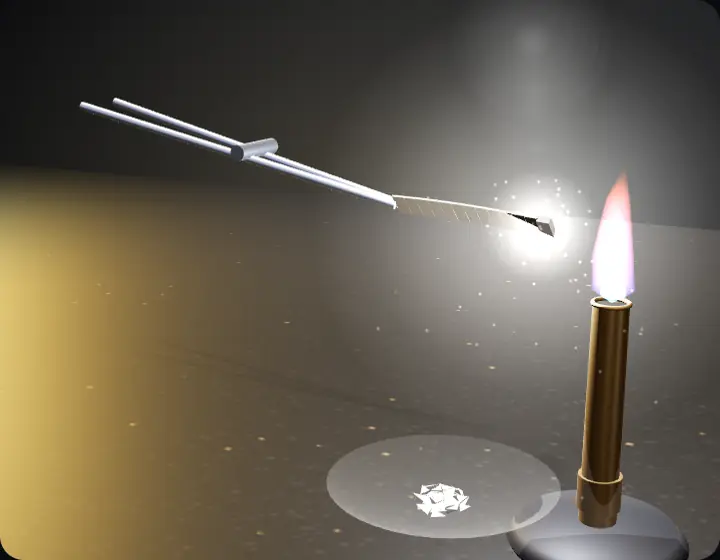
Same experiment, 2D and 3Dवही प्रयोग, 2D और 3D मेंWahi experiment, 2D aur 3D meinA magnesium ribbon held in tongs over a burner. It catches fire with a dazzling white light, and a white powder (magnesium oxide) falls into the watch glass.चिमटे में पकड़ा मैग्नीशियम रिबन बर्नर पर। वह चकाचौंध सफ़ेद रोशनी के साथ जलता है और सफ़ेद पाउडर (मैग्नीशियम ऑक्साइड) वॉच ग्लास में गिरता है।Chimte mein pakda magnesium ribbon burner par. Woh chaka-chaundh white light ke saath jalta hai aur white powder (magnesium oxide) watch glass mein girta hai.
Loading the 3D lab…3D लैब लोड हो रही है…3D lab load ho rahi hai…
The same experiment as a 3D lab. Watch the ribbon burn from the tip, glowing white, while the white ash collects below. Drag to turn it. Tap “Play again” to repeat.वही प्रयोग 3D लैब में। रिबन सिरे से जलता है, सफ़ेद चमक के साथ, और नीचे सफ़ेद राख जमा होती है। उँगली से घुमाइए। दोबारा देखने के लिए “फिर चलाओ” दबाइए।Wahi experiment 3D lab mein. Ribbon sire se jalta hai, white chamak ke saath, aur neeche white raakh jama hoti hai. Ungli se ghumaiye. Dobara dekhne ke liye “Phir chalao” dabaiye.
A chemical reaction (a change in which new substances with new properties are formed) is different from a physical change (only shape, size or state changes, the substance stays the same). Ice melting into water is physical: freeze it and you get ice back. Milk turning into curd is chemical.रासायनिक अभिक्रिया (chemical reaction) वह बदलाव है जिसमें नए गुणों वाले नए पदार्थ बनते हैं। यह भौतिक परिवर्तन (physical change) से अलग है, जिसमें सिर्फ़ आकार, साइज़ या अवस्था बदलती है, पदार्थ वही रहता है। बर्फ़ का पानी बनना भौतिक है: फिर जमा दो तो बर्फ़ वापस। दूध का दही बनना रासायनिक है।Chemical reaction woh badlaav hai jismein naye properties wali nayi cheezein banti hain. Yeh physical change se alag hai, jismein sirf shape, size ya state badalti hai, cheez wahi rehti hai. Barf ka paani banna physical hai: phir jama do to barf wapas. Doodh ka dahi banna chemical hai.
In the lab, clean a magnesium ribbon with sandpaper (to rub off its dull outer layer) and hold it in a flame. It burns with a dazzling white light and leaves a white powder. The shiny metal is gone; a new substance, magnesium oxide, is in its place. Magnesium joined with oxygen from the air.लैब में मैग्नीशियम रिबन को रेगमाल (sandpaper) से साफ़ कीजिए (ऊपर की धुँधली परत हटाने के लिए) और लौ में पकड़िए। वह चकाचौंध सफ़ेद रोशनी के साथ जलता है और सफ़ेद पाउडर छोड़ता है। चमकती धातु गायब; उसकी जगह नया पदार्थ मैग्नीशियम ऑक्साइड (magnesium oxide)। मैग्नीशियम हवा की ऑक्सीजन से जुड़ गया।Lab mein magnesium ribbon ko sandpaper se saaf kijiye (upar ki dhundhli layer hatane ke liye) aur lau mein pakadiye. Woh chaka-chaundh white light ke saath jalta hai aur white powder chhodta hai. Chamakti metal gayab; uski jagah nayi cheez magnesium oxide. Magnesium hawa ki oxygen se jud gaya.
The substances you start with are reactants (magnesium and oxygen). The new substances formed are products (magnesium oxide). Every reaction in this chapter is just this: reactants → products. ⚠️ Never look straight at burning magnesium for long; the light is very bright.जिन पदार्थों से शुरुआत होती है वे अभिकारक (reactants) हैं (मैग्नीशियम और ऑक्सीजन)। जो नए पदार्थ बनते हैं वे उत्पाद (products) हैं (मैग्नीशियम ऑक्साइड)। इस चैप्टर की हर अभिक्रिया बस यही है: अभिकारक → उत्पाद। ⚠️ जलते मैग्नीशियम को देर तक सीधे मत देखिए; रोशनी बहुत तेज़ होती है।Jin cheezon se shuruaat hoti hai woh reactants hain (magnesium aur oxygen). Jo nayi cheezein banti hain woh products hain (magnesium oxide). Is chapter ka har reaction bas yahi hai: reactants → products. ⚠️ Jalte magnesium ko der tak seedha mat dekhiye; light bahut tez hoti hai.
💡 Remember-it trick💡 याद रखने की ट्रिक💡 Yaad rakhne wala trick
Shape changed = physical · Substance changed = chemical.आकार बदला = भौतिक · पदार्थ बदला = रासायनिक।Shape badla = physical · Cheez badli = chemical.
⚡ Quick check (no marks, just you)⚡ झटपट जाँच (कोई नंबर नहीं)⚡ Quick check (koi number nahi)
Is cooking a roti on the tawa a physical or a chemical change?तवे पर रोटी सेंकना भौतिक परिवर्तन है या रासायनिक?Tawe par roti sekna physical change hai ya chemical?
HintसंकेतHint
Can you turn the cooked roti back into raw dough?क्या पकी रोटी को वापस कच्चा आटा बना सकते हैं?Kya paki roti ko wapas kaccha aata bana sakte hain?
Answerउत्तरAnswer
Chemical. New substances form (brown spots, new smell and taste) and you cannot get the raw dough back.रासायनिक। नए पदार्थ बनते हैं (भूरे धब्बे, नई खुशबू और स्वाद) और कच्चा आटा वापस नहीं मिलता।Chemical. Nayi cheezein banti hain (bhoore dhabbe, nayi khushboo aur swaad) aur kaccha aata wapas nahi milta.
In burning magnesium, name the reactants and the product.मैग्नीशियम के जलने में अभिकारक और उत्पाद बताइए।Magnesium ke jalne mein reactants aur product batayiye.
HintसंकेतHint
What did the metal join with, and what powder was left?धातु किससे जुड़ी, और कौन-सा पाउडर बचा?Metal kisse judi, aur kaunsa powder bacha?
Answerउत्तरAnswer
Reactants: magnesium and oxygen (from air). Product: magnesium oxide (the white powder).अभिकारक: मैग्नीशियम और ऑक्सीजन (हवा से)। उत्पाद: मैग्नीशियम ऑक्साइड (सफ़ेद पाउडर)।Reactants: magnesium aur oxygen (hawa se). Product: magnesium oxide (white powder).
2How do you know a reaction happened? 5 cluesअभिक्रिया हुई, पता कैसे चले? 5 सुरागReaction hua, pata kaise chale? 5 clues
🎬 Scene from real life🎬 रोज़ की ज़िंदगी से एक सीन🎬 Real life ka scene
🫧 Drop fruit salt (the fizzy powder for acidity) into a glass of water. Instant fizz, bubbles everywhere. Those bubbles are a gas that was not there a second ago: a clue that a reaction is happening.🫧 पानी के गिलास में फ्रूट सॉल्ट (एसिडिटी वाला झागदार पाउडर) डालिए। तुरंत झाग, हर तरफ़ बुलबुले। ये बुलबुले एक गैस हैं जो एक सेकंड पहले वहाँ नहीं थी: यह सुराग है कि अभिक्रिया हो रही है।🫧 Paani ke glass mein fruit salt (acidity wala fizzy powder) daaliye. Turant jhaag, har taraf bubbles. Ye bubbles ek gas hain jo ek second pehle wahan nahi thi: yeh clue hai ki reaction ho raha hai.
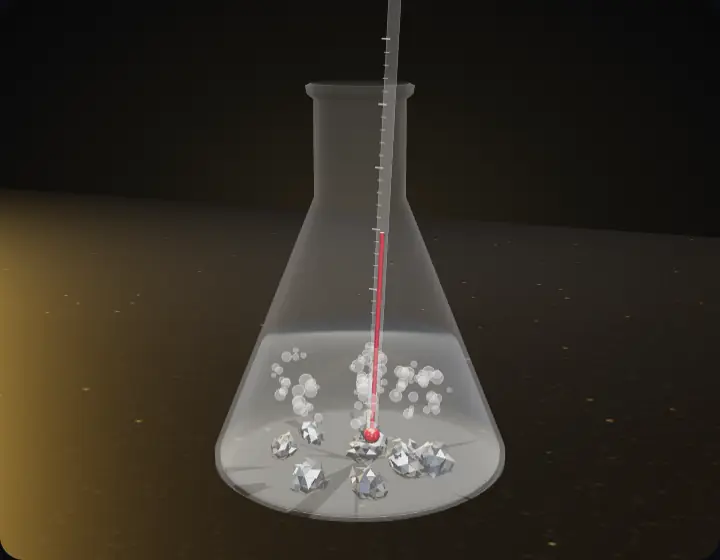
Same flask, 2D and 3Dवही फ्लास्क, 2D और 3D मेंWahi flask, 2D aur 3D meinZinc granules in dilute sulphuric acid. Bubbles of hydrogen gas rise, and the thermometer climbs because the flask gets warm. Two clues at once.तनु सल्फ्यूरिक अम्ल में ज़िंक के दाने। हाइड्रोजन गैस के बुलबुले उठते हैं और थर्मामीटर चढ़ता है क्योंकि फ्लास्क गरम होता है। एक साथ दो सुराग।Dilute sulphuric acid mein zinc ke daane. Hydrogen gas ke bubbles uthte hain aur thermometer chadhta hai kyunki flask garam hota hai. Ek saath do clues.
Loading the 3D lab…3D लैब लोड हो रही है…3D lab load ho rahi hai…
The same flask in 3D: bubbles stream up from the zinc and the red line in the thermometer rises. Drag to look from any side.वही फ्लास्क 3D में: ज़िंक से बुलबुले उठते हैं और थर्मामीटर की लाल लाइन ऊपर जाती है। किसी भी तरफ़ से देखने के लिए घुमाइए।Wahi flask 3D mein: zinc se bubbles uthte hain aur thermometer ki laal line upar jaati hai. Kisi bhi taraf se dekhne ke liye ghumaiye.
You cannot see atoms swapping partners, but a reaction leaves clues you can see, hear, feel or smell: 1. gas (bubbles or fizz), 2. change of colour, 3. change of temperature (gets hot or cold), 4. a precipitate (a solid that suddenly appears inside a liquid), 5. change of state (for example, a solid turning into a gas).परमाणुओं का साथी बदलना आँख से नहीं दिखता, पर अभिक्रिया ऐसे सुराग छोड़ती है जिन्हें आप देख, सुन, छू या सूँघ सकते हैं: 1. गैस (बुलबुले या झाग), 2. रंग बदलना, 3. तापमान बदलना (गरम या ठंडा होना), 4. अवक्षेप (precipitate) (द्रव के अंदर अचानक बनने वाला ठोस), 5. अवस्था बदलना (जैसे ठोस का गैस बनना)।Atoms ka partner badalna aankh se nahi dikhta, par reaction aise clues chhodta hai jinhe aap dekh, sun, chhoo ya soongh sakte hain: 1. gas (bubbles ya jhaag), 2. rang badalna, 3. temperature badalna (garam ya thanda hona), 4. precipitate (liquid ke andar achanak banne wala solid), 5. state badalna (jaise solid ka gas banna).
Try it in the lab: put a few zinc granules (small lumps of zinc metal) in a flask and add dilute sulphuric acid (acid mixed with lots of water). Bubbles of hydrogen gas appear on the zinc, and if you touch the flask it feels warm. Gas + heat = two clues together.लैब में करके देखिए: फ्लास्क में कुछ ज़िंक के दाने (zinc granules) (ज़िंक धातु के छोटे टुकड़े) डालिए और तनु सल्फ्यूरिक अम्ल (dilute sulphuric acid) (बहुत सारे पानी में मिला अम्ल) डालिए। ज़िंक पर हाइड्रोजन गैस के बुलबुले बनते हैं, और फ्लास्क छूने पर गरम लगता है। गैस + गर्मी = एक साथ दो सुराग।Lab mein karke dekhiye: flask mein kuch zinc granules (zinc metal ke chhote tukde) daaliye aur dilute sulphuric acid (bahut saare paani mein mila acid) daaliye. Zinc par hydrogen gas ke bubbles bante hain, aur flask chhoone par garam lagta hai. Gas + garmi = ek saath do clues.
Clues from daily life: a cut apple turning brown (colour), milk going sour (smell and taste), a gas stove flame giving heat (temperature), limewater turning milky (precipitate). One clue is a hint, not proof; check that a new substance really formed.रोज़ की ज़िंदगी के सुराग: कटा सेब भूरा होना (रंग), दूध का खट्टा होना (गंध और स्वाद), गैस चूल्हे की लौ से गर्मी (तापमान), चूने का पानी दूधिया होना (अवक्षेप)। एक सुराग इशारा है, सबूत नहीं; पक्का कीजिए कि सच में नया पदार्थ बना।Roz ki zindagi ke clues: kata seb bhoora hona (rang), doodh ka khatta hona (smell aur swaad), gas chulhe ki lau se garmi (temperature), chune ka paani doodhiya hona (precipitate). Ek clue ishaara hai, saboot nahi; pakka kijiye ki sach mein nayi cheez bani.
💡 Remember-it trick💡 याद रखने की ट्रिक💡 Yaad rakhne wala trick
Gas, colour, heat, solid, state: spot one, suspect a reaction.गैस, रंग, गर्मी, ठोस, अवस्था: एक दिखे, तो अभिक्रिया का शक।Gas, rang, garmi, solid, state: ek dikhe, to reaction ka shak.
⚡ Quick check (no marks, just you)⚡ झटपट जाँच (कोई नंबर नहीं)⚡ Quick check (koi number nahi)
Which two clues did the zinc + acid flask show?ज़िंक + अम्ल वाले फ्लास्क ने कौन-से दो सुराग दिखाए?Zinc + acid wale flask ne kaunse do clues dikhaye?
HintसंकेतHint
Look at the bubbles and the thermometer.बुलबुले और थर्मामीटर देखिए।Bubbles aur thermometer dekhiye.
Answerउत्तरAnswer
Gas given off (hydrogen bubbles) and change in temperature (the flask got warm).गैस निकलना (हाइड्रोजन के बुलबुले) और तापमान बदलना (फ्लास्क गरम हुआ)।Gas nikalna (hydrogen ke bubbles) aur temperature badalna (flask garam hua).
Boiling water also gives bubbles. Is it a chemical reaction?उबलते पानी में भी बुलबुले आते हैं। क्या यह रासायनिक अभिक्रिया है?Ubalte paani mein bhi bubbles aate hain. Kya yeh chemical reaction hai?
HintसंकेतHint
Is the gas a new substance, or just water as steam?क्या गैस नया पदार्थ है, या बस भाप बना पानी?Kya gas nayi cheez hai, ya bas bhaap bana paani?
Answerउत्तरAnswer
No. The bubbles are steam, which is still water. No new substance, so it is a physical change. That is why one clue is not proof.नहीं। बुलबुले भाप हैं, जो पानी ही है। कोई नया पदार्थ नहीं, इसलिए यह भौतिक परिवर्तन है। इसीलिए एक सुराग सबूत नहीं होता।Nahi. Bubbles bhaap hain, jo paani hi hai. Koi nayi cheez nahi, isliye yeh physical change hai. Isiliye ek clue saboot nahi hota.
3Chemical equations and balancingरासायनिक समीकरण और संतुलनChemical equations aur balancing
🎬 Scene from real life🎬 रोज़ की ज़िंदगी से एक सीन🎬 Real life ka scene
🥪 One sandwich needs 2 slices of bread and 1 cheese slice. To make 2 sandwiches you need 4 bread and 2 cheese. You cannot make bread appear from nowhere. Atoms in a reaction follow the same rule.🥪 एक सैंडविच में 2 ब्रेड स्लाइस और 1 चीज़ स्लाइस लगती है। 2 सैंडविच बनाने हैं तो 4 ब्रेड और 2 चीज़ चाहिए। ब्रेड हवा से पैदा नहीं होती। अभिक्रिया में परमाणु भी यही नियम मानते हैं।🥪 Ek sandwich mein 2 bread slice aur 1 cheese slice lagti hai. 2 sandwich banane hain to 4 bread aur 2 cheese chahiye. Bread hawa se paida nahi hoti. Reaction mein atoms bhi yahi rule maante hain.
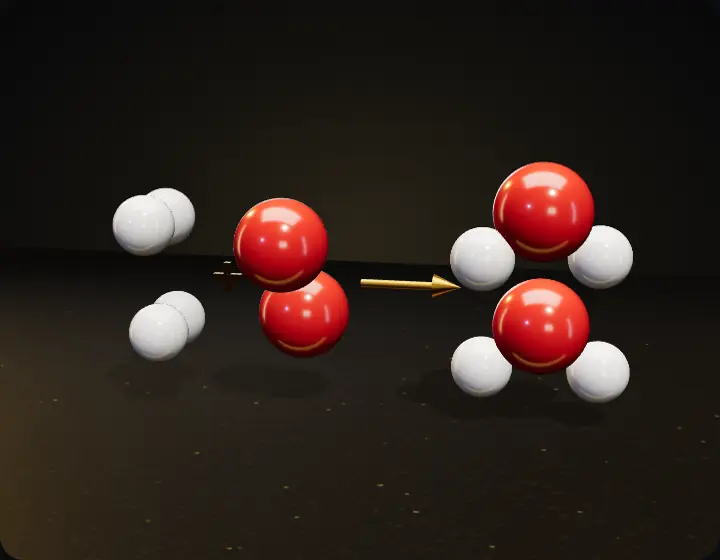
Same atoms, 2D and 3Dवही परमाणु, 2D और 3D मेंWahi atoms, 2D aur 3D mein2 hydrogen molecules + 1 oxygen molecule → 2 water molecules. Count them: 4 H and 2 O on the left, 4 H and 2 O on the right.2 हाइड्रोजन अणु + 1 ऑक्सीजन अणु → 2 पानी के अणु। गिनिए: बाएँ 4 H और 2 O, दाएँ भी 4 H और 2 O।2 hydrogen molecules + 1 oxygen molecule → 2 paani ke molecules. Giniye: left mein 4 H aur 2 O, right mein bhi 4 H aur 2 O.
Loading the 3D lab…3D लैब लोड हो रही है…3D lab load ho rahi hai…
The same molecules in 3D. Watch each atom fly across and join a new partner: no atom is made, none is lost. Drag to turn.वही अणु 3D में। हर परमाणु उड़कर नए साथी से जुड़ता है: न कोई परमाणु बनता है, न कोई खोता है। घुमाकर देखिए।Wahi molecules 3D mein. Har atom udkar naye partner se judta hai: na koi atom banta hai, na koi khota hai. Ghumakar dekhiye.
Writing “magnesium burns in oxygen to give magnesium oxide” every time is long. A word equation shortens it: magnesium + oxygen → magnesium oxide. A chemical equation uses formulas: Mg + O₂ → MgO. Reactants on the left, products on the right, the arrow means “gives”.हर बार “मैग्नीशियम ऑक्सीजन में जलकर मैग्नीशियम ऑक्साइड देता है” लिखना लंबा है। शब्द समीकरण (word equation) इसे छोटा करता है: मैग्नीशियम + ऑक्सीजन → मैग्नीशियम ऑक्साइड। रासायनिक समीकरण (chemical equation) सूत्र इस्तेमाल करता है: Mg + O₂ → MgO। बाएँ अभिकारक, दाएँ उत्पाद, तीर का मतलब “देता है”।Har baar “magnesium oxygen mein jalkar magnesium oxide deta hai” likhna lamba hai. Word equation ise chhota karta hai: magnesium + oxygen → magnesium oxide. Chemical equation formulas use karta hai: Mg + O₂ → MgO. Left mein reactants, right mein products, arrow ka matlab “deta hai”.
But count the oxygen atoms: 2 on the left (O₂), only 1 on the right (MgO). Such an equation is unbalanced (also called a skeletal equation). The law of conservation of mass says mass is neither created nor destroyed in a reaction, so every atom on the left must appear on the right.पर ऑक्सीजन परमाणु गिनिए: बाएँ 2 (O₂), दाएँ सिर्फ़ 1 (MgO)। ऐसा समीकरण असंतुलित (unbalanced) है, इसे कंकाली समीकरण (skeletal equation) भी कहते हैं। द्रव्यमान संरक्षण का नियम (law of conservation of mass) कहता है कि अभिक्रिया में द्रव्यमान न बनता है न नष्ट होता है, इसलिए बाएँ का हर परमाणु दाएँ भी दिखना चाहिए।Par oxygen atoms giniye: left mein 2 (O₂), right mein sirf 1 (MgO). Aisa equation unbalanced hai, ise skeletal equation bhi kehte hain. Law of conservation of mass kehta hai ki reaction mein mass na banta hai na nasht hota hai, isliye left ka har atom right mein bhi dikhna chahiye.
To balance, put numbers in front (called coefficients), never change the small numbers inside a formula. 2Mg + O₂ → 2MgO: now 2 Mg and 2 O on each side ✅. Same for water: 2H₂ + O₂ → 2H₂O. You can also add state symbols: (s) solid, (l) liquid, (g) gas, (aq) dissolved in water.संतुलित (balance) करने के लिए आगे संख्या लगाइए (इन्हें गुणांक (coefficients) कहते हैं), सूत्र के अंदर की छोटी संख्या कभी मत बदलिए। 2Mg + O₂ → 2MgO: अब दोनों तरफ़ 2 Mg और 2 O ✅। पानी के लिए भी: 2H₂ + O₂ → 2H₂O। आप अवस्था चिह्न (state symbols) भी लगा सकते हैं: (s) ठोस, (l) द्रव, (g) गैस, (aq) पानी में घुला।Balance karne ke liye aage number lagaiye (inhe coefficients kehte hain), formula ke andar ka chhota number kabhi mat badaliye. 2Mg + O₂ → 2MgO: ab dono taraf 2 Mg aur 2 O ✅. Paani ke liye bhi: 2H₂ + O₂ → 2H₂O. Aap state symbols bhi laga sakte hain: (s) solid, (l) liquid, (g) gas, (aq) paani mein ghula.
💡 Remember-it trick💡 याद रखने की ट्रिक💡 Yaad rakhne wala trick
Atoms are never made or lost, they only change partners.परमाणु न बनते हैं न खोते हैं, बस साथी बदलते हैं।Atoms na bante hain na khote hain, bas partner badalte hain.
⚡ Quick check (no marks, just you)⚡ झटपट जाँच (कोई नंबर नहीं)⚡ Quick check (koi number nahi)
Balance: H₂ + Cl₂ → HClसंतुलित कीजिए: H₂ + Cl₂ → HClBalance kijiye: H₂ + Cl₂ → HCl
HintसंकेतHint
Count H and Cl on the right. Put a number in front of HCl.दाएँ H और Cl गिनिए। HCl के आगे संख्या लगाइए।Right mein H aur Cl giniye. HCl ke aage number lagaiye.
Answerउत्तरAnswer
H₂ + Cl₂ → 2HCl. Now 2 H and 2 Cl on each side.H₂ + Cl₂ → 2HCl। अब दोनों तरफ़ 2 H और 2 Cl।H₂ + Cl₂ → 2HCl. Ab dono taraf 2 H aur 2 Cl.
A student balances H₂ + O₂ → H₂O by writing H₂ + O₂ → H₂O₂. What is wrong?एक छात्र H₂ + O₂ → H₂O को H₂ + O₂ → H₂O₂ लिखकर संतुलित करता है। गलती क्या है?Ek student H₂ + O₂ → H₂O ko H₂ + O₂ → H₂O₂ likhkar balance karta hai. Galti kya hai?
HintसंकेतHint
Is H₂O₂ still water?क्या H₂O₂ अब भी पानी है?Kya H₂O₂ ab bhi paani hai?
Answerउत्तरAnswer
He changed the formula. H₂O₂ is hydrogen peroxide, a different substance. Only coefficients can change: 2H₂ + O₂ → 2H₂O.उसने सूत्र बदल दिया। H₂O₂ हाइड्रोजन परॉक्साइड है, अलग पदार्थ। सिर्फ़ गुणांक बदल सकते हैं: 2H₂ + O₂ → 2H₂O।Usne formula badal diya. H₂O₂ hydrogen peroxide hai, alag cheez. Sirf coefficients badal sakte hain: 2H₂ + O₂ → 2H₂O.
4Combination and decomposition: join or breakसंयोजन और वियोजन: जोड़ो या तोड़ोCombination aur decomposition: jodo ya todo
🎬 Scene from real life🎬 रोज़ की ज़िंदगी से एक सीन🎬 Real life ka scene
🏠 Before Diwali, painters drop lumps of quicklime (chuna) into a bucket of water. It hisses, bubbles and the bucket gets too hot to touch. Two substances joined into one, and heat came out.🏠 दिवाली से पहले पुताई वाले बिना बुझे चूने के ढेले पानी की बाल्टी में डालते हैं। सनसनाहट, बुलबुले, और बाल्टी इतनी गरम कि छू न सकें। दो पदार्थ जुड़कर एक बने, और गर्मी निकली।🏠 Diwali se pehle putai wale bina bujhe chune (quicklime) ke dhele paani ki baalti mein daalte hain. Sss-sss, bubbles, aur baalti itni garam ki chhoo na sakein. Do cheezein judkar ek bani, aur garmi nikli.
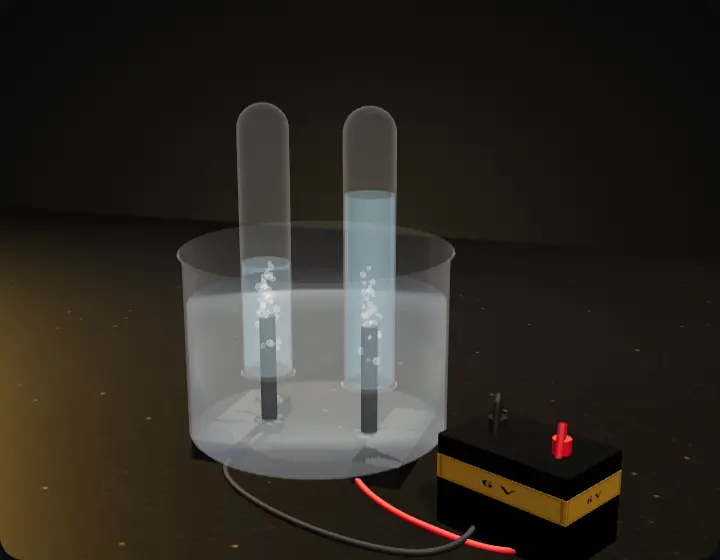
Same set-up, 2D and 3Dवही उपकरण, 2D और 3D मेंWahi setup, 2D aur 3D meinElectrolysis of water: electricity breaks water into hydrogen and oxygen. The hydrogen tube fills twice as fast as the oxygen tube (2 : 1).पानी का विद्युत अपघटन: बिजली पानी को हाइड्रोजन और ऑक्सीजन में तोड़ती है। हाइड्रोजन वाली नली ऑक्सीजन वाली से दोगुनी तेज़ी से भरती है (2 : 1)।Paani ka electrolysis: bijli paani ko hydrogen aur oxygen mein todti hai. Hydrogen wali tube oxygen wali se dugni tezi se bharti hai (2 : 1).
Loading the 3D lab…3D लैब लोड हो रही है…3D lab load ho rahi hai…
The same set-up in 3D. Bubbles rise from both carbon electrodes; watch the water level fall twice as far in the hydrogen tube. Drag to turn.वही उपकरण 3D में। दोनों कार्बन इलेक्ट्रोड से बुलबुले उठते हैं; हाइड्रोजन वाली नली में पानी दोगुना नीचे जाता है। घुमाकर देखिए।Wahi setup 3D mein. Dono carbon electrodes se bubbles uthte hain; hydrogen wali tube mein paani dugna neeche jaata hai. Ghumakar dekhiye.
A combination reaction is when two or more substances join to make a single new substance: A + B → AB. Quicklime + water: CaO + H₂O → Ca(OH)₂ (slaked lime) + heat. Burning coal (C + O₂ → CO₂) and burning magnesium are also combination reactions.संयोजन अभिक्रिया (combination reaction) में दो या ज़्यादा पदार्थ जुड़कर एक नया पदार्थ बनाते हैं: A + B → AB। बिना बुझा चूना + पानी: CaO + H₂O → Ca(OH)₂ (बुझा चूना) + ऊष्मा। कोयले का जलना (C + O₂ → CO₂) और मैग्नीशियम का जलना भी संयोजन अभिक्रियाएँ हैं।Combination reaction mein do ya zyada cheezein judkar ek nayi cheez banati hain: A + B → AB. Quicklime + paani: CaO + H₂O → Ca(OH)₂ (slaked lime, bujha chuna) + heat. Koyle ka jalna (C + O₂ → CO₂) aur magnesium ka jalna bhi combination reactions hain.
Reactions that give out heat are exothermic (exo = out). Quicklime in water, burning fuel and even respiration (food + oxygen in your cells → energy) are exothermic. That is why you feel warm after a meal and a walk.जो अभिक्रियाएँ ऊष्मा बाहर देती हैं वे ऊष्माक्षेपी (exothermic) हैं (exo = बाहर)। पानी में चूना, ईंधन का जलना, और श्वसन (respiration) भी (कोशिकाओं में भोजन + ऑक्सीजन → ऊर्जा) ऊष्माक्षेपी हैं।Jo reactions heat bahar deti hain woh exothermic hain (exo = bahar). Paani mein chuna, fuel ka jalna, aur respiration bhi (cells mein khana + oxygen → energy) exothermic hain.
A decomposition reaction is the opposite: one substance breaks into two or more simpler ones: AB → A + B. It needs energy from heat, electricity or light. With electricity, water splits: 2H₂O → 2H₂ + O₂. Hydrogen comes out double the volume of oxygen, because each water molecule has 2 H for every 1 O. Reactions that take in energy are endothermic.वियोजन अभिक्रिया (decomposition reaction) इसका उल्टा है: एक पदार्थ टूटकर दो या ज़्यादा सरल पदार्थ बनाता है: AB → A + B। इसके लिए ऊष्मा, बिजली या प्रकाश से ऊर्जा चाहिए। बिजली से पानी टूटता है: 2H₂O → 2H₂ + O₂। हाइड्रोजन का आयतन ऑक्सीजन से दोगुना निकलता है, क्योंकि पानी के हर अणु में 1 O के साथ 2 H होते हैं। जो अभिक्रियाएँ ऊर्जा लेती हैं वे ऊष्माशोषी (endothermic) हैं।Decomposition reaction iska ulta hai: ek cheez tootkar do ya zyada simple cheezein banati hai: AB → A + B. Iske liye heat, bijli ya light se energy chahiye. Bijli se paani tootta hai: 2H₂O → 2H₂ + O₂. Hydrogen ka volume oxygen se dugna nikalta hai, kyunki paani ke har molecule mein 1 O ke saath 2 H hote hain. Jo reactions energy leti hain woh endothermic hain.
💡 Remember-it trick💡 याद रखने की ट्रिक💡 Yaad rakhne wala trick
Combination = join (heat comes out) · Decomposition = break (energy goes in).संयोजन = जोड़ो (गर्मी निकले) · वियोजन = तोड़ो (ऊर्जा लगे)।Combination = jodo (garmi nikle) · Decomposition = todo (energy lage).
⚡ Quick check (no marks, just you)⚡ झटपट जाँच (कोई नंबर नहीं)⚡ Quick check (koi number nahi)
CaCO₃ → CaO + CO₂ on heating. Combination or decomposition?गरम करने पर CaCO₃ → CaO + CO₂। संयोजन या वियोजन?Garam karne par CaCO₃ → CaO + CO₂. Combination ya decomposition?
HintसंकेतHint
How many reactants, how many products?कितने अभिकारक, कितने उत्पाद?Kitne reactants, kitne products?
Answerउत्तरAnswer
Decomposition (thermal): one substance (limestone) breaks into two (quicklime and carbon dioxide) using heat.वियोजन (ऊष्मीय): एक पदार्थ (चूना पत्थर) ऊष्मा से टूटकर दो बनाता है (बिना बुझा चूना और कार्बन डाइऑक्साइड)।Decomposition (thermal): ek cheez (limestone) heat se tootkar do banati hai (quicklime aur carbon dioxide).
In electrolysis, one tube collected 10 mL of oxygen. How much hydrogen is in the other?विद्युत अपघटन में एक नली में 10 mL ऑक्सीजन जमा हुई। दूसरी में कितनी हाइड्रोजन?Electrolysis mein ek tube mein 10 mL oxygen jama hui. Doosri mein kitni hydrogen?
HintसंकेतHint
Hydrogen : oxygen = 2 : 1हाइड्रोजन : ऑक्सीजन = 2 : 1Hydrogen : oxygen = 2 : 1
Answerउत्तरAnswer
20 mL. Hydrogen is always double the volume of oxygen when water is split.20 mL। पानी टूटने पर हाइड्रोजन का आयतन हमेशा ऑक्सीजन का दोगुना होता है।20 mL. Paani tootne par hydrogen ka volume hamesha oxygen ka dugna hota hai.
5Displacement: the stronger metal takes the placeविस्थापन: ताकतवर धातु जगह ले लेती हैDisplacement: strong metal jagah le leti hai
🎬 Scene from real life🎬 रोज़ की ज़िंदगी से एक सीन🎬 Real life ka scene
🪑 You are sitting with your friend on the last bench. The class monitor walks in and takes your friend's seat; your friend has to stand. Metals do this too: a more reactive metal pushes a less reactive one out.🪑 आप अपने दोस्त के साथ आख़िरी बेंच पर बैठे हैं। मॉनिटर आता है और दोस्त की सीट ले लेता है; दोस्त को खड़ा होना पड़ता है। धातुएँ भी यही करती हैं: ज़्यादा क्रियाशील धातु कम क्रियाशील को बाहर कर देती है।🪑 Aap apne dost ke saath last bench par baithe hain. Monitor aata hai aur dost ki seat le leta hai; dost ko khada hona padta hai. Metals bhi yahi karti hain: zyada reactive metal kam reactive ko bahar kar deti hai.
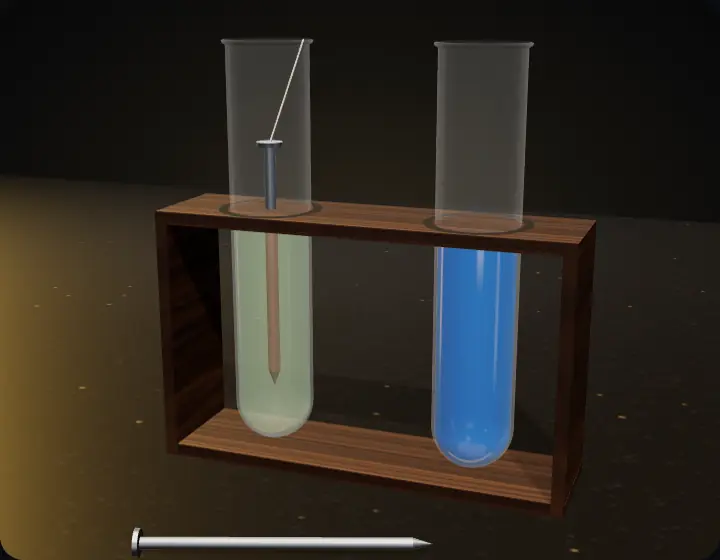
Same tubes, 2D and 3Dवही नलियाँ, 2D और 3D मेंWahi tubes, 2D aur 3D meinAn iron nail hangs in blue copper sulphate solution. Over time the nail gets a brown coat (copper) and the blue fades to pale green (iron sulphate). The second tube, kept aside, stays blue.नीले कॉपर सल्फ़ेट विलयन में लोहे की कील लटकी है। कुछ देर में कील पर भूरी परत (कॉपर) चढ़ती है और नीला रंग हल्का हरा (आयरन सल्फ़ेट) हो जाता है। अलग रखी दूसरी नली नीली ही रहती है।Neele copper sulphate solution mein lohe ki keel latki hai. Kuch der mein keel par bhoori layer (copper) chadhti hai aur neela rang halka hara (iron sulphate) ho jaata hai. Alag rakhi doosri tube neeli hi rehti hai.
Loading the 3D lab…3D लैब लोड हो रही है…3D lab load ho rahi hai…
The same two tubes in 3D. Watch the blue turn pale green and the nail turn brown. The untouched nail on the table stays grey for comparison.वही दो नलियाँ 3D में। नीले को हल्का हरा और कील को भूरा होते देखिए। मेज़ पर रखी दूसरी कील तुलना के लिए स्लेटी ही रहती है।Wahi do tubes 3D mein. Neele ko halka hara aur keel ko bhoora hote dekhiye. Table par rakhi doosri keel comparison ke liye grey hi rehti hai.
In a displacement reaction, a more reactive element pushes a less reactive element out of its compound. Reactive means how eagerly an element reacts. Iron is more reactive than copper, so iron takes copper's place.विस्थापन अभिक्रिया (displacement reaction) में ज़्यादा क्रियाशील तत्व कम क्रियाशील तत्व को उसके यौगिक से बाहर कर देता है। क्रियाशील (reactive) यानी कोई तत्व कितनी आसानी से अभिक्रिया करता है। लोहा कॉपर से ज़्यादा क्रियाशील है, इसलिए लोहा कॉपर की जगह ले लेता है।Displacement reaction mein zyada reactive element kam reactive element ko uske compound se bahar kar deta hai. Reactive yaani koi element kitni aasani se react karta hai. Loha (iron) copper se zyada reactive hai, isliye iron copper ki jagah le leta hai.
Iron nail in copper sulphate solution: Fe + CuSO₄ → FeSO₄ + Cu. The copper pushed out sticks to the nail as a brown layer. The solution turns from blue (copper sulphate) to pale green (iron sulphate, also called ferrous sulphate).कॉपर सल्फ़ेट विलयन में लोहे की कील: Fe + CuSO₄ → FeSO₄ + Cu। बाहर निकला कॉपर कील पर भूरी परत बनकर चिपकता है। विलयन नीले (कॉपर सल्फ़ेट) से हल्का हरा (आयरन सल्फ़ेट, जिसे फ़ेरस सल्फ़ेट भी कहते हैं) हो जाता है।Copper sulphate solution mein lohe ki keel: Fe + CuSO₄ → FeSO₄ + Cu. Bahar nikla copper keel par bhoori layer bankar chipakta hai. Solution neele (copper sulphate) se halka hara (iron sulphate, jise ferrous sulphate bhi kehte hain) ho jaata hai.
More examples: Zn + CuSO₄ → ZnSO₄ + Cu, and Pb + CuCl₂ → PbCl₂ + Cu. Zinc and lead are both more reactive than copper. The reverse never happens: put copper in iron sulphate and nothing changes, because the weaker metal cannot push out the stronger one.और उदाहरण: Zn + CuSO₄ → ZnSO₄ + Cu, और Pb + CuCl₂ → PbCl₂ + Cu। ज़िंक और लेड दोनों कॉपर से ज़्यादा क्रियाशील हैं। उल्टा कभी नहीं होता: आयरन सल्फ़ेट में कॉपर डालिए, कुछ नहीं बदलेगा, क्योंकि कमज़ोर धातु ताकतवर को बाहर नहीं कर सकती।Aur examples: Zn + CuSO₄ → ZnSO₄ + Cu, aur Pb + CuCl₂ → PbCl₂ + Cu. Zinc aur lead dono copper se zyada reactive hain. Ulta kabhi nahi hota: iron sulphate mein copper daaliye, kuch nahi badlega, kyunki kamzor metal taakatwar ko bahar nahi kar sakti.
💡 Remember-it trick💡 याद रखने की ट्रिक💡 Yaad rakhne wala trick
More reactive metal in, less reactive metal out.ज़्यादा क्रियाशील धातु अंदर, कम क्रियाशील बाहर।Zyada reactive metal andar, kam reactive bahar.
⚡ Quick check (no marks, just you)⚡ झटपट जाँच (कोई नंबर नहीं)⚡ Quick check (koi number nahi)
Why does the blue colour of copper sulphate fade when an iron nail is dipped in it?लोहे की कील डालने पर कॉपर सल्फ़ेट का नीला रंग फीका क्यों होता है?Lohe ki keel daalne par copper sulphate ka neela rang feeka kyun hota hai?
HintसंकेतHint
What new solution forms, and what colour is it?कौन-सा नया विलयन बनता है, और उसका रंग क्या है?Kaunsa naya solution banta hai, aur uska rang kya hai?
Answerउत्तरAnswer
Iron displaces copper, so blue copper sulphate changes into pale green iron sulphate.लोहा कॉपर को विस्थापित करता है, इसलिए नीला कॉपर सल्फ़ेट हल्के हरे आयरन सल्फ़ेट में बदल जाता है।Iron copper ko displace karta hai, isliye neela copper sulphate halke hare iron sulphate mein badal jaata hai.
Will copper react with zinc sulphate solution?क्या कॉपर ज़िंक सल्फ़ेट विलयन से अभिक्रिया करेगा?Kya copper zinc sulphate solution se react karega?
HintसंकेतHint
Which is more reactive: zinc or copper?ज़्यादा क्रियाशील कौन है: ज़िंक या कॉपर?Zyada reactive kaun hai: zinc ya copper?
Answerउत्तरAnswer
No. Copper is less reactive than zinc, so it cannot push zinc out.नहीं। कॉपर ज़िंक से कम क्रियाशील है, इसलिए वह ज़िंक को बाहर नहीं कर सकता।Nahi. Copper zinc se kam reactive hai, isliye woh zinc ko bahar nahi kar sakta.
6Double displacement: both swap partnersद्विविस्थापन: दोनों साथी बदलते हैंDouble displacement: dono partner badalte hain
🎬 Scene from real life🎬 रोज़ की ज़िंदगी से एक सीन🎬 Real life ka scene
💃 At a wedding sangeet, two couples are dancing. The DJ shouts “switch!” and the partners swap: A dances with D, C dances with B. Two compounds can do exactly this.💃 शादी के संगीत में दो जोड़े नाच रहे हैं। DJ चिल्लाता है “बदलो!” और साथी बदल जाते हैं: A, D के साथ और C, B के साथ नाचता है। दो यौगिक ठीक यही करते हैं।💃 Shaadi ke sangeet mein do jode naach rahe hain. DJ chillata hai “switch!” aur partners badal jaate hain: A, D ke saath aur C, B ke saath naachta hai. Do compounds bilkul yahi karte hain.
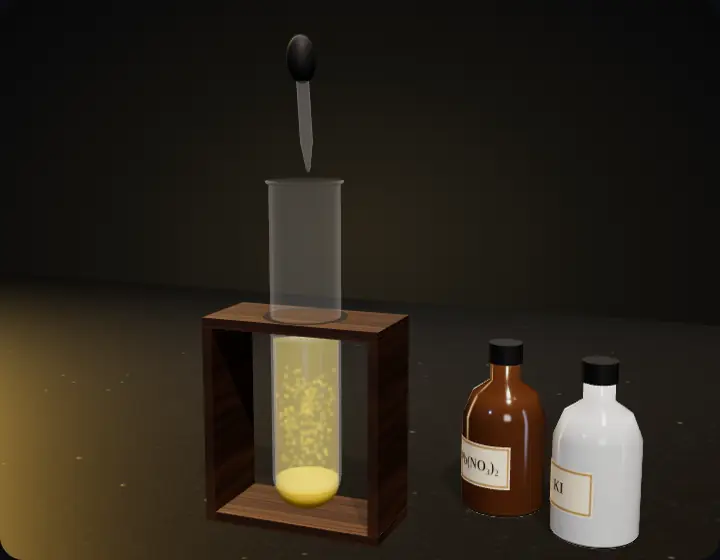
Same tube, 2D and 3Dवही नली, 2D और 3D मेंWahi tube, 2D aur 3D meinDrops of lead nitrate solution fall into potassium iodide solution. A bright yellow solid (lead iodide) appears and settles at the bottom: a precipitate.लेड नाइट्रेट विलयन की बूँदें पोटैशियम आयोडाइड विलयन में गिरती हैं। चमकीला पीला ठोस (लेड आयोडाइड) बनता है और नीचे बैठ जाता है: यही अवक्षेप है।Lead nitrate solution ki boondein potassium iodide solution mein girti hain. Chamkeela peela solid (lead iodide) banta hai aur neeche baith jaata hai: yahi precipitate hai.
Loading the 3D lab…3D लैब लोड हो रही है…3D lab load ho rahi hai…
The same tube in 3D. Each drop makes a yellow cloud that sinks and piles up at the bottom. Drag to turn; tap “Play again” to drop again.वही नली 3D में। हर बूँद से पीला बादल बनता है जो डूबकर नीचे जमा होता है। घुमाइए; फिर से बूँदें डालने के लिए “फिर चलाओ” दबाइए।Wahi tube 3D mein. Har boond se peela baadal banta hai jo doobkar neeche jama hota hai. Ghumaiye; phir se boondein daalne ke liye “Phir chalao” dabaiye.
In a double displacement reaction, two compounds exchange their parts (their ions, the charged pieces a compound is made of): AB + CD → AD + CB. Lead nitrate + potassium iodide: Pb(NO₃)₂ + 2KI → PbI₂ + 2KNO₃.द्विविस्थापन अभिक्रिया (double displacement reaction) में दो यौगिक अपने हिस्से (अपने आयन (ions), यानी आवेशित टुकड़े जिनसे यौगिक बना है) आपस में बदलते हैं: AB + CD → AD + CB। लेड नाइट्रेट + पोटैशियम आयोडाइड: Pb(NO₃)₂ + 2KI → PbI₂ + 2KNO₃।Double displacement reaction mein do compounds apne hisse (apne ions, yaani charged tukde jinse compound bana hai) aapas mein badalte hain: AB + CD → AD + CB. Lead nitrate + potassium iodide: Pb(NO₃)₂ + 2KI → PbI₂ + 2KNO₃.
Both starting solutions are colourless, but lead iodide (PbI₂) does not dissolve in water, so it appears as a bright yellow solid. An insoluble solid that forms inside a solution is called a precipitate, and a reaction that makes one is a precipitation reaction. In equations it is marked with ↓.दोनों शुरुआती विलयन रंगहीन हैं, पर लेड आयोडाइड (PbI₂) पानी में नहीं घुलता, इसलिए चमकीले पीले ठोस के रूप में दिखता है। विलयन के अंदर बनने वाला अघुलनशील ठोस अवक्षेप (precipitate) कहलाता है, और जो अभिक्रिया इसे बनाए वह अवक्षेपण अभिक्रिया (precipitation reaction) है। समीकरण में इसे ↓ से दिखाते हैं।Dono shuruaati solutions rangheen hain, par lead iodide (PbI₂) paani mein nahi ghulta, isliye chamkeele peele solid ke roop mein dikhta hai. Solution ke andar banne wala na ghulne wala solid precipitate kehlata hai, aur jo reaction ise banaye woh precipitation reaction hai. Equation mein ise ↓ se dikhate hain.
Another one: sodium sulphate + barium chloride → barium sulphate (white precipitate) + sodium chloride. Na₂SO₄ + BaCl₂ → BaSO₄↓ + 2NaCl. Tip: in double displacement, metals swap partners; in single displacement, a lone metal kicks one out.एक और: सोडियम सल्फ़ेट + बेरियम क्लोराइड → बेरियम सल्फ़ेट (सफ़ेद अवक्षेप) + सोडियम क्लोराइड। Na₂SO₄ + BaCl₂ → BaSO₄↓ + 2NaCl। टिप: द्विविस्थापन में धातुएँ साथी बदलती हैं; एकल विस्थापन में अकेली धातु किसी को बाहर करती है।Ek aur: sodium sulphate + barium chloride → barium sulphate (white precipitate) + sodium chloride. Na₂SO₄ + BaCl₂ → BaSO₄↓ + 2NaCl. Tip: double displacement mein metals partner badalti hain; single displacement mein akeli metal kisi ko bahar karti hai.
💡 Remember-it trick💡 याद रखने की ट्रिक💡 Yaad rakhne wala trick
Single = one metal kicks out · Double = both couples swap.एकल = एक धातु बाहर करे · द्वि = दोनों जोड़े बदलें।Single = ek metal bahar kare · Double = dono jode badlein.
⚡ Quick check (no marks, just you)⚡ झटपट जाँच (कोई नंबर नहीं)⚡ Quick check (koi number nahi)
What is the yellow solid formed when lead nitrate and potassium iodide are mixed?लेड नाइट्रेट और पोटैशियम आयोडाइड मिलाने पर कौन-सा पीला ठोस बनता है?Lead nitrate aur potassium iodide milane par kaunsa peela solid banta hai?
HintसंकेतHint
Lead swaps partner with potassium. Which new pair does not dissolve?लेड, पोटैशियम से साथी बदलता है। कौन-सा नया जोड़ा नहीं घुलता?Lead, potassium se partner badalta hai. Kaunsa naya joda nahi ghulta?
Answerउत्तरAnswer
Lead iodide (PbI₂), a yellow precipitate. Potassium nitrate stays dissolved.लेड आयोडाइड (PbI₂), पीला अवक्षेप। पोटैशियम नाइट्रेट घुला रहता है।Lead iodide (PbI₂), peela precipitate. Potassium nitrate ghula rehta hai.
Is Zn + CuSO₄ → ZnSO₄ + Cu a double displacement?क्या Zn + CuSO₄ → ZnSO₄ + Cu द्विविस्थापन है?Kya Zn + CuSO₄ → ZnSO₄ + Cu double displacement hai?
HintसंकेतHint
Are there two compounds on the left?क्या बाएँ दो यौगिक हैं?Kya left mein do compounds hain?
Answerउत्तरAnswer
No. Zinc is a lone element pushing copper out, so it is a (single) displacement reaction.नहीं। ज़िंक अकेला तत्व है जो कॉपर को बाहर करता है, इसलिए यह (एकल) विस्थापन अभिक्रिया है।Nahi. Zinc akela element hai jo copper ko bahar karta hai, isliye yeh (single) displacement reaction hai.
7Oxidation, reduction, rust and stale chipsऑक्सीकरण, अपचयन, जंग और बासी चिप्सOxidation, reduction, zang aur baasi chips
🎬 Scene from real life🎬 रोज़ की ज़िंदगी से एक सीन🎬 Real life ka scene
🚲 After one monsoon outside, your cycle chain is covered in a brown, flaky layer. And that packet of chips? It is puffed with gas so the chips do not taste stale. Both stories are about oxygen.🚲 एक बरसात बाहर खड़ी रहने के बाद साइकिल की चेन पर भूरी, परतदार परत चढ़ जाती है। और चिप्स का पैकेट? उसमें गैस भरी होती है ताकि चिप्स बासी न लगें। दोनों कहानियाँ ऑक्सीजन की हैं।🚲 Ek baarish bahar khadi rehne ke baad cycle ki chain par bhoori, partdaar layer chadh jaati hai. Aur chips ka packet? Usmein gas bhari hoti hai taaki chips baasi na lagein. Dono kahaniyan oxygen ki hain.
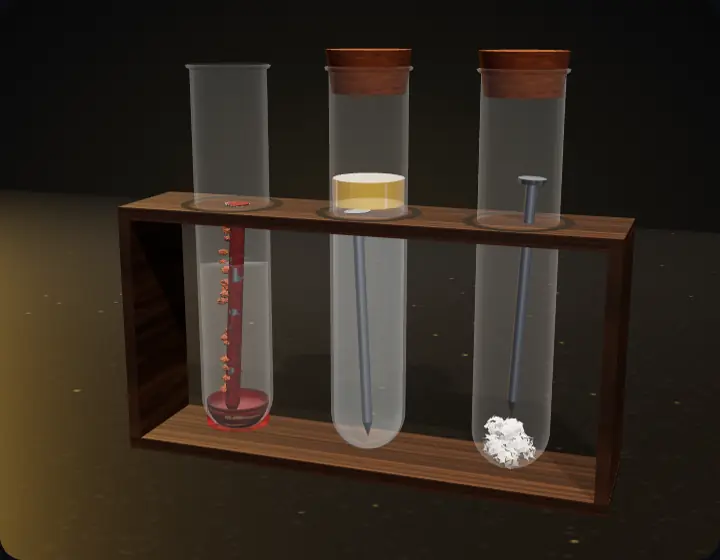
Same 3 tubes, 2D and 3Dवही 3 नलियाँ, 2D और 3D मेंWahi 3 tubes, 2D aur 3D meinThree iron nails. A: air and water, it rusts. B: boiled water with an oil layer on top (no air), no rust. C: dry air with calcium chloride (no water), no rust. Rust needs both air and water.तीन लोहे की कीलें। A: हवा और पानी, जंग लगती है। B: उबला पानी, ऊपर तेल की परत (हवा नहीं), जंग नहीं। C: कैल्शियम क्लोराइड के साथ सूखी हवा (पानी नहीं), जंग नहीं। जंग को हवा और पानी दोनों चाहिए।Teen lohe ki keelein. A: hawa aur paani, zang lagti hai. B: ubla paani, upar tel ki layer (hawa nahi), zang nahi. C: calcium chloride ke saath sookhi hawa (paani nahi), zang nahi. Zang ko hawa aur paani dono chahiye.
Loading the 3D lab…3D लैब लोड हो रही है…3D lab load ho rahi hai…
The same three tubes in 3D, a few days squeezed into seconds. Only nail A turns brown and flaky. Drag to turn.वही तीन नलियाँ 3D में, कुछ दिन सेकंडों में। सिर्फ़ कील A भूरी और परतदार होती है। घुमाकर देखिए।Wahi teen tubes 3D mein, kuch din seconds mein. Sirf keel A bhoori aur partdaar hoti hai. Ghumakar dekhiye.
Oxidation = a substance gains oxygen (or loses hydrogen). Reduction = a substance loses oxygen (or gains hydrogen). They always happen together, so such reactions are called redox reactions. Example: CuO + H₂ → Cu + H₂O. Copper oxide loses oxygen (reduced); hydrogen gains oxygen (oxidised).ऑक्सीकरण (oxidation) = पदार्थ को ऑक्सीजन मिले (या हाइड्रोजन हटे)। अपचयन (reduction) = पदार्थ से ऑक्सीजन हटे (या हाइड्रोजन मिले)। दोनों हमेशा साथ होते हैं, इसलिए इन्हें रेडॉक्स (redox) अभिक्रिया कहते हैं। उदाहरण: CuO + H₂ → Cu + H₂O। कॉपर ऑक्साइड से ऑक्सीजन हटी (अपचयित); हाइड्रोजन को ऑक्सीजन मिली (ऑक्सीकृत)।Oxidation = cheez ko oxygen mile (ya hydrogen hate). Reduction = cheez se oxygen hate (ya hydrogen mile). Dono hamesha saath hote hain, isliye inhe redox reactions kehte hain. Example: CuO + H₂ → Cu + H₂O. Copper oxide se oxygen hati (reduced); hydrogen ko oxygen mili (oxidised).
Corrosion is a metal being slowly eaten away by air, water or chemicals around it. For iron it is called rusting: iron + oxygen + water → rust (a brown, flaky hydrated iron oxide, Fe₂O₃·xH₂O). The tubes show it clearly: no air or no water means no rust. Silver turning black and copper turning green are corrosion too. Painting, oiling, greasing and galvanising (coating iron with zinc) keep air and water away.संक्षारण (corrosion) यानी आसपास की हवा, पानी या रसायनों से धातु का धीरे-धीरे गलना। लोहे में इसे जंग लगना (rusting) कहते हैं: लोहा + ऑक्सीजन + पानी → जंग (भूरा, परतदार जलयुक्त आयरन ऑक्साइड, Fe₂O₃·xH₂O)। नलियाँ साफ़ दिखाती हैं: हवा नहीं या पानी नहीं, तो जंग नहीं। चाँदी का काला और ताँबे का हरा होना भी संक्षारण है। पेंट, तेल, ग्रीस और यशदलेपन (galvanising) (लोहे पर ज़िंक की परत) हवा और पानी को दूर रखते हैं।Corrosion yaani aaspaas ki hawa, paani ya chemicals se metal ka dheere-dheere galna. Lohe mein ise rusting (zang lagna) kehte hain: loha + oxygen + paani → zang (bhoora, partdaar hydrated iron oxide, Fe₂O₃·xH₂O). Tubes saaf dikhati hain: hawa nahi ya paani nahi, to zang nahi. Chandi ka kaala aur taambe ka hara hona bhi corrosion hai. Paint, tel, grease aur galvanising (lohe par zinc ki layer) hawa aur paani ko door rakhte hain.
Rancidity is when oily or fatty food gets oxidised and its smell and taste go bad (stale namkeen, old cooking oil). To slow it: pack chips with nitrogen gas (no oxygen inside), keep food in airtight boxes or the fridge, and add antioxidants (substances that stop oxidation).विकृतगंधिता (rancidity) यानी तेल या वसा वाला खाना ऑक्सीकृत होकर उसकी गंध और स्वाद ख़राब होना (बासी नमकीन, पुराना तेल)। इसे धीमा करने के लिए: चिप्स के पैकेट में नाइट्रोजन गैस (अंदर ऑक्सीजन नहीं), खाना एयरटाइट डिब्बे या फ़्रिज में रखें, और प्रतिऑक्सीकारक (antioxidants) मिलाएँ (जो ऑक्सीकरण रोकते हैं)।Rancidity yaani tel ya fat wala khana oxidise hokar uski smell aur swaad kharab hona (baasi namkeen, purana tel). Ise dheema karne ke liye: chips ke packet mein nitrogen gas (andar oxygen nahi), khana airtight dibbe ya fridge mein rakhein, aur antioxidants milayein (jo oxidation rokte hain).
💡 Remember-it trick💡 याद रखने की ट्रिक💡 Yaad rakhne wala trick
Oxygen in = oxidation · Oxygen out = reduction · Both together = redox.ऑक्सीजन आई = ऑक्सीकरण · ऑक्सीजन गई = अपचयन · दोनों साथ = रेडॉक्स।Oxygen aayi = oxidation · Oxygen gayi = reduction · Dono saath = redox.
⚡ Quick check (no marks, just you)⚡ झटपट जाँच (कोई नंबर नहीं)⚡ Quick check (koi number nahi)
Why is there no rust in tube B, even though the nail is in water?नली B में कील पानी में होने पर भी जंग क्यों नहीं लगी?Tube B mein keel paani mein hone par bhi zang kyun nahi lagi?
HintसंकेतHint
What did boiling and the oil layer remove?उबालने और तेल की परत ने क्या हटाया?Ubalne aur tel ki layer ne kya hataya?
Answerउत्तरAnswer
Boiling removed the dissolved air and the oil layer stops new air from getting in. No oxygen, so no rust.उबालने से घुली हवा निकल गई और तेल की परत नई हवा को अंदर नहीं आने देती। ऑक्सीजन नहीं, तो जंग नहीं।Ubalne se ghuli hawa nikal gayi aur tel ki layer nayi hawa ko andar nahi aane deti. Oxygen nahi, to zang nahi.
Why are chips packets filled with nitrogen?चिप्स के पैकेट में नाइट्रोजन क्यों भरी जाती है?Chips ke packet mein nitrogen kyun bhari jaati hai?
HintसंकेतHint
What makes oily food go stale?तेल वाला खाना बासी किससे होता है?Tel wala khana baasi kisse hota hai?
Answerउत्तरAnswer
To keep oxygen out. Without oxygen the oil in the chips cannot get oxidised, so they do not turn rancid.ऑक्सीजन को बाहर रखने के लिए। ऑक्सीजन नहीं तो चिप्स का तेल ऑक्सीकृत नहीं होता, इसलिए वे बासी नहीं होते।Oxygen ko bahar rakhne ke liye. Oxygen nahi to chips ka tel oxidise nahi hota, isliye woh baasi nahi hote.
🎉 You just did Chapter 1 from zero.🎉 आपने चैप्टर 1 शुरू से पूरा कर लिया।🎉 Aapne Chapter 1 zero se poora kar liya.
The whole chapter in one line: reactants → (bonds break, atoms regroup) → products · balance the atoms · combination, decomposition, displacement, double displacement, redox · watch out for rust and rancidity.पूरा चैप्टर एक लाइन में: अभिकारक → (बंधन टूटे, परमाणु फिर जुड़े) → उत्पाद · परमाणु संतुलित करो · संयोजन, वियोजन, विस्थापन, द्विविस्थापन, रेडॉक्स · जंग और विकृतगंधिता से बचो।Poora chapter ek line mein: reactants → (bonds toote, atoms phir jude) → products · atoms balance karo · combination, decomposition, displacement, double displacement, redox · zang aur rancidity se bacho.
Exam and olympiad level. Try each one before you peek. The mind map first, then why-questions, tricky MCQs, assertion–reason, numericals and the mistakes that cost marks.परीक्षा और ओलंपियाड स्तर। झाँकने से पहले हर सवाल खुद हल करने की कोशिश कीजिए। पहले माइंड मैप, फिर क्यों-सवाल, पेचीदा MCQ, अभिकथन–कारण, संख्यात्मक प्रश्न और वे गलतियाँ जिनसे नंबर कटते हैं।Exam aur olympiad level. Peek karne se pehle har sawaal khud try karo. Pehle mind map, phir why-questions, tricky MCQs, assertion–reason, numericals aur woh galtiyan jinse number katte hain.
🧠 Mind map: the chapter in one glance🧠 माइंड मैप: एक नज़र में पूरा अध्याय🧠 Mind map: ek nazar mein poora chapter
🤔 “Why?” questions🤔 “क्यों?” वाले सवाल🤔 “Kyun?” wale sawaal
Why does the colour of copper sulphate solution fade when a zinc rod is kept in it, but not when a silver wire is kept in it?कॉपर सल्फ़ेट घोल में ज़िंक की छड़ रखने पर रंग फीका पड़ता है, पर चाँदी के तार से नहीं। क्यों?Copper sulphate solution mein zinc ki rod rakhne par colour pheeka padta hai, par silver ke taar se nahi. Kyun?
Model answerआदर्श उत्तरModel answer
Zinc is more reactive than copper, so it displaces copper and forms colourless zinc sulphate. Silver is less reactive than copper, so no displacement happens and the blue stays.ज़िंक ताँबे से अधिक अभिक्रियाशील है, इसलिए ताँबे को विस्थापित करके रंगहीन ज़िंक सल्फ़ेट बनाता है। चाँदी ताँबे से कम अभिक्रियाशील है, इसलिए विस्थापन नहीं होता और नीला रंग बना रहता है।Zinc copper se zyada reactive hai, isliye copper ko displace karke colourless zinc sulphate banata hai. Silver copper se kam reactive hai, isliye displacement nahi hota aur neela rang bana rehta hai.
Why is decomposition called the opposite of combination?वियोजन को संयोजन का उल्टा क्यों कहते हैं?Decomposition ko combination ka ulta kyun kehte hain?
Model answerआदर्श उत्तरModel answer
Combination joins two or more reactants into one product (A + B → AB) and usually releases energy. Decomposition breaks one reactant into two or more products (AB → A + B) and usually needs energy.संयोजन दो या अधिक अभिकारकों को एक उत्पाद में जोड़ता है (A + B → AB) और आमतौर पर ऊर्जा देता है। वियोजन एक अभिकारक को दो या अधिक उत्पादों में तोड़ता है (AB → A + B) और आमतौर पर ऊर्जा लेता है।Combination do ya zyada reactants ko ek product mein jodta hai (A + B → AB) aur aamtaur par energy deta hai. Decomposition ek reactant ko do ya zyada products mein todta hai (AB → A + B) aur aamtaur par energy leta hai.
Why is hydrogen double the volume of oxygen in the electrolysis of water?पानी के विद्युत अपघटन में हाइड्रोजन का आयतन ऑक्सीजन का दोगुना क्यों होता है?Paani ke electrolysis mein hydrogen ka volume oxygen ka double kyun hota hai?
Model answerआदर्श उत्तरModel answer
Each water molecule (H₂O) has two hydrogen atoms for one oxygen atom; the balanced equation 2H₂O → 2H₂ + O₂ gives 2 molecules of H₂ for 1 of O₂, and equal numbers of gas molecules take equal volumes.हर पानी के अणु (H₂O) में एक ऑक्सीजन परमाणु पर दो हाइड्रोजन परमाणु हैं; संतुलित समीकरण 2H₂O → 2H₂ + O₂ में 1 O₂ पर 2 H₂ अणु बनते हैं, और गैस के बराबर अणु बराबर आयतन घेरते हैं।Har paani ke molecule (H₂O) mein ek oxygen atom par do hydrogen atoms hain; balanced equation 2H₂O → 2H₂ + O₂ mein 1 O₂ par 2 H₂ molecules bante hain, aur gas ke barabar molecules barabar volume gherte hain.
Why do we apply oil or grease to the iron parts of a bicycle?साइकिल के लोहे के हिस्सों पर तेल या ग्रीस क्यों लगाते हैं?Cycle ke lohe ke hisson par oil ya grease kyun lagaate hain?
Model answerआदर्श उत्तरModel answer
Oil forms a layer that keeps both air and moisture away from the iron. Rusting needs both, so it is slowed down.तेल एक परत बनाता है जो हवा और नमी दोनों को लोहे से दूर रखती है। जंग के लिए दोनों चाहिए, इसलिए जंग धीमी हो जाती है।Oil ek layer banata hai jo hawa aur nami dono ko lohe se door rakhti hai. Jung ke liye dono chahiye, isliye jung dheemi ho jaati hai.
Why is the reaction between CuO and H₂ called a redox reaction?CuO और H₂ की अभिक्रिया को रेडॉक्स अभिक्रिया क्यों कहते हैं?CuO aur H₂ ke reaction ko redox reaction kyun kehte hain?
Model answerआदर्श उत्तरModel answer
Because oxidation and reduction happen together: CuO loses oxygen (reduced to Cu) while H₂ gains oxygen (oxidised to H₂O).क्योंकि ऑक्सीकरण और अपचयन साथ होते हैं: CuO ऑक्सीजन खोता है (Cu में अपचयित) जबकि H₂ ऑक्सीजन लेता है (H₂O में ऑक्सीकृत)।Kyunki oxidation aur reduction saath hote hain: CuO oxygen khota hai (Cu mein reduce) jabki H₂ oxygen leta hai (H₂O mein oxidise).
🎯 Tricky MCQs🎯 पेचीदा MCQ🎯 Tricky MCQs
Tap an option. Score: विकल्प पर टैप कीजिए। स्कोर: Option pe tap karo. Score: 0 / 10
Which of these is NOT a physical change?इनमें से कौन भौतिक परिवर्तन नहीं है?Inmein se kaunsa physical change nahi hai?
Burning LPG forms new substances (CO₂ and water), so it is chemical. The other three can be reversed.LPG जलने से नए पदार्थ (CO₂ और पानी) बनते हैं, इसलिए यह रासायनिक है। बाकी तीनों उलटे जा सकते हैं।LPG jalne se naye substances (CO₂ aur paani) bante hain, isliye ye chemical hai. Baaki teeno ulte ja sakte hain.
In 2PbO + C → 2Pb + CO₂, which statement is correct?2PbO + C → 2Pb + CO₂ में कौन-सा कथन सही है?2PbO + C → 2Pb + CO₂ mein kaunsa statement sahi hai?
PbO loses oxygen (reduced); carbon gains oxygen to become CO₂ (oxidised).PbO ऑक्सीजन खोता है (अपचयन); कार्बन ऑक्सीजन लेकर CO₂ बनता है (ऑक्सीकरण)।PbO oxygen khota hai (reduction); carbon oxygen lekar CO₂ banta hai (oxidation).
Fe₂O₃ + 2Al → Al₂O₃ + 2Fe is an example of:Fe₂O₃ + 2Al → Al₂O₃ + 2Fe किसका उदाहरण है?Fe₂O₃ + 2Al → Al₂O₃ + 2Fe kiska example hai?
Aluminium, being more reactive, takes iron's place in the oxide: a displacement reaction (it is also redox).अधिक अभिक्रियाशील ऐलुमिनियम ऑक्साइड में लोहे की जगह ले लेता है: विस्थापन अभिक्रिया (यह रेडॉक्स भी है)।Zyada reactive aluminium oxide mein iron ki jagah le leta hai: displacement reaction (ye redox bhi hai).
When dilute HCl is added to iron filings, what happens?लोहे के बुरादे में तनु HCl मिलाने पर क्या होता है?Lohe ke buraade mein dilute HCl milane par kya hota hai?
Iron is above hydrogen in reactivity, so it displaces hydrogen: Fe + 2HCl → FeCl₂ + H₂.लोहा अभिक्रियाशीलता में हाइड्रोजन से ऊपर है, इसलिए हाइड्रोजन को विस्थापित करता है: Fe + 2HCl → FeCl₂ + H₂।Iron reactivity mein hydrogen se upar hai, isliye hydrogen ko displace karta hai: Fe + 2HCl → FeCl₂ + H₂.
2AgCl(s) → 2Ag(s) + Cl₂(g) in sunlight. The grey colour is due to:धूप में 2AgCl(s) → 2Ag(s) + Cl₂(g)। धूसर रंग किसके कारण है?Dhoop mein 2AgCl(s) → 2Ag(s) + Cl₂(g). Grey colour kiski wajah se hai?
Light decomposes silver chloride; the finely divided silver metal formed looks grey.प्रकाश सिल्वर क्लोराइड को तोड़ता है; बनी बारीक चाँदी धूसर दिखती है।Light silver chloride ko todta hai; bani baareek silver grey dikhti hai.
Which equation is correctly balanced?कौन-सा समीकरण सही संतुलित है?Kaunsa equation sahi balanced hai?
Check (b): Na 2 = 2, H 4 = 2 + 2 = 4, O 2 = 2. All others leave H or O unequal.(b) जाँचिए: Na 2 = 2, H 4 = 2 + 2 = 4, O 2 = 2। बाकी में H या O बराबर नहीं।(b) check kijiye: Na 2 = 2, H 4 = 2 + 2 = 4, O 2 = 2. Baaki mein H ya O barabar nahi.
⚖️ Assertion–Reason⚖️ अभिकथन–कारण⚖️ Assertion–Reason
For each pair choose: (a) both true, R explains A · (b) both true, R does not explain A · (c) A true, R false · (d) A false, R true.हर जोड़े के लिए चुनिए: (a) दोनों सही, R, A को समझाता है · (b) दोनों सही, R, A को नहीं समझाता · (c) A सही, R गलत · (d) A गलत, R सही।Har pair ke liye chuno: (a) dono sahi, R, A ko samjhaata hai · (b) dono sahi, R, A ko nahi samjhaata · (c) A sahi, R galat · (d) A galat, R sahi.
A: A chemical equation must be balanced.रासायनिक समीकरण संतुलित होना चाहिए।Chemical equation balanced hona chahiye.
R: Mass can neither be created nor destroyed in a chemical reaction.रासायनिक अभिक्रिया में द्रव्यमान न बनता है, न नष्ट होता है।Chemical reaction mein mass na banta hai, na khatam hota hai.
Both true, and the law of conservation of mass is exactly why we balance.दोनों सही, और द्रव्यमान संरक्षण का नियम ही संतुलन का कारण है।Dono sahi, aur law of conservation of mass hi balancing ki wajah hai.
A: Calcium oxide reacts vigorously with water.कैल्शियम ऑक्साइड पानी से तेज़ अभिक्रिया करता है।Calcium oxide paani se tez react karta hai.
R: All decomposition reactions are exothermic.सभी वियोजन अभिक्रियाएँ ऊष्माक्षेपी होती हैं।Sabhi decomposition reactions exothermic hote hain.
A is true (lots of heat, hissing). R is false: decomposition reactions generally absorb energy (endothermic).A सही है (बहुत ऊष्मा, सनसनाहट)। R गलत है: वियोजन अभिक्रियाएँ सामान्यतः ऊर्जा सोखती हैं (ऊष्माशोषी)।A sahi hai (bahut heat, hissing). R galat hai: decomposition reactions generally energy sokhte hain (endothermic).
A: Copper can displace iron from iron sulphate solution.ताँबा आयरन सल्फ़ेट घोल से लोहे को विस्थापित कर सकता है।Copper iron sulphate solution se iron ko displace kar sakta hai.
R: Iron is more reactive than copper.लोहा ताँबे से अधिक अभिक्रियाशील है।Iron copper se zyada reactive hai.
A is false: a less reactive metal cannot displace a more reactive one. R is true.A गलत है: कम अभिक्रियाशील धातु अधिक अभिक्रियाशील को विस्थापित नहीं कर सकती। R सही है।A galat hai: kam reactive metal zyada reactive ko displace nahi kar sakti. R sahi hai.
A: Chips packets are flushed with nitrogen.चिप्स के पैकेट में नाइट्रोजन भरी जाती है।Chips ke packet mein nitrogen bhari jaati hai.
R: Nitrogen is a light gas that makes the packet look full.नाइट्रोजन हल्की गैस है जो पैकेट को भरा दिखाती है।Nitrogen halki gas hai jo packet ko bhara dikhaati hai.
A is true. R is a true fact too, but it is not the reason: nitrogen is used because it is unreactive and keeps oxygen away, preventing rancidity.A सही है। R भी एक सही तथ्य है, पर कारण नहीं: नाइट्रोजन इसलिए भरी जाती है क्योंकि वह निष्क्रिय है और ऑक्सीजन को दूर रखती है, जिससे विकृतगंधिता रुकती है।A sahi hai. R bhi ek sahi fact hai, par wajah nahi: nitrogen isliye bhari jaati hai kyunki woh unreactive hai aur oxygen ko door rakhti hai, jisse rancidity rukti hai.
🔢 Numericals🔢 संख्यात्मक प्रश्न🔢 Numericals
Balance: Al + O₂ → Al₂O₃संतुलित कीजिए: Al + O₂ → Al₂O₃Balance kijiye: Al + O₂ → Al₂O₃
SolutionहलSolution
- O: 2 on the left, 3 on the right. LCM of 2 and 3 is 6, so 3O₂ and 2Al₂O₃.O: बाईं ओर 2, दाईं ओर 3। 2 और 3 का LCM 6, इसलिए 3O₂ और 2Al₂O₃।O: left mein 2, right mein 3. 2 aur 3 ka LCM 6, isliye 3O₂ aur 2Al₂O₃.
- Now Al: 4 on the right, so 4Al on the left.अब Al: दाईं ओर 4, इसलिए बाईं ओर 4Al।Ab Al: right mein 4, isliye left mein 4Al.
✅ 4Al + 3O₂ → 2Al₂O₃ (Al 4 = 4, O 6 = 6)4Al + 3O₂ → 2Al₂O₃ (Al 4 = 4, O 6 = 6)4Al + 3O₂ → 2Al₂O₃ (Al 4 = 4, O 6 = 6)
2.4 g of magnesium burns completely in oxygen to give 4.0 g of magnesium oxide. What mass of oxygen was used?2.4 g मैग्नीशियम ऑक्सीजन में पूरा जलकर 4.0 g मैग्नीशियम ऑक्साइड देता है। कितनी ऑक्सीजन लगी?2.4 g magnesium oxygen mein poora jalkar 4.0 g magnesium oxide deta hai. Kitni oxygen lagi?
SolutionहलSolution
- Law of conservation of mass: mass of reactants = mass of products.द्रव्यमान संरक्षण का नियम: अभिकारकों का द्रव्यमान = उत्पादों का द्रव्यमान।Law of conservation of mass: reactants ka mass = products ka mass.
- 2.4 g + oxygen = 4.0 g, so oxygen = 4.0 − 2.4.2.4 g + ऑक्सीजन = 4.0 g, तो ऑक्सीजन = 4.0 − 2.4।2.4 g + oxygen = 4.0 g, to oxygen = 4.0 − 2.4.
✅ 1.6 g of oxygen1.6 g ऑक्सीजन1.6 g oxygen
100 g of limestone (CaCO₃) on heating gives 56 g of quicklime. How much carbon dioxide is released?100 g चूना-पत्थर (CaCO₃) गर्म करने पर 56 g बिना बुझा चूना देता है। कितनी कार्बन डाइऑक्साइड निकली?100 g limestone (CaCO₃) garam karne par 56 g quicklime deta hai. Kitni carbon dioxide nikli?
SolutionहलSolution
- CaCO₃ → CaO + CO₂; mass is conserved.CaCO₃ → CaO + CO₂; द्रव्यमान संरक्षित।CaCO₃ → CaO + CO₂; mass conserved.
- CO₂ = 100 − 56.CO₂ = 100 − 56।CO₂ = 100 − 56.
✅ 44 g of CO₂44 g CO₂44 g CO₂
In an electrolysis experiment, 15 mL of oxygen collects in 10 minutes. How much hydrogen collects in the same time, and how much oxygen in 20 minutes at the same rate?विद्युत अपघटन प्रयोग में 10 मिनट में 15 mL ऑक्सीजन जमा होती है। उतने समय में कितनी हाइड्रोजन, और उसी दर से 20 मिनट में कितनी ऑक्सीजन?Electrolysis experiment mein 10 minute mein 15 mL oxygen jama hoti hai. Utne time mein kitni hydrogen, aur usi rate se 20 minute mein kitni oxygen?
SolutionहलSolution
- H₂ : O₂ = 2 : 1, so hydrogen = 2 × 15 mL.H₂ : O₂ = 2 : 1, तो हाइड्रोजन = 2 × 15 mL।H₂ : O₂ = 2 : 1, to hydrogen = 2 × 15 mL.
- Double the time at the same rate doubles the oxygen: 2 × 15 mL.उसी दर पर दोगुने समय में ऑक्सीजन दोगुनी: 2 × 15 mL।Usi rate par double time mein oxygen double: 2 × 15 mL.
✅ Hydrogen 30 mL in 10 min; oxygen 30 mL in 20 min10 मिनट में हाइड्रोजन 30 mL; 20 मिनट में ऑक्सीजन 30 mL10 minute mein hydrogen 30 mL; 20 minute mein oxygen 30 mL
Count the total atoms on each side of 2Pb(NO₃)₂ → 2PbO + 4NO₂ + O₂ and show it is balanced.2Pb(NO₃)₂ → 2PbO + 4NO₂ + O₂ के दोनों ओर कुल परमाणु गिनिए और दिखाइए कि यह संतुलित है।2Pb(NO₃)₂ → 2PbO + 4NO₂ + O₂ ke dono taraf kul atoms giniye aur dikhaiye ki ye balanced hai.
SolutionहलSolution
- Left: Pb 2, N 2 × 2 = 4, O 2 × 6 = 12.बाईं ओर: Pb 2, N 2 × 2 = 4, O 2 × 6 = 12।Left: Pb 2, N 2 × 2 = 4, O 2 × 6 = 12.
- Right: Pb 2, N 4, O 2 (PbO) + 8 (NO₂) + 2 (O₂) = 12.दाईं ओर: Pb 2, N 4, O 2 (PbO) + 8 (NO₂) + 2 (O₂) = 12।Right: Pb 2, N 4, O 2 (PbO) + 8 (NO₂) + 2 (O₂) = 12.
✅ Pb 2 = 2, N 4 = 4, O 12 = 12: balanced (18 atoms each side)Pb 2 = 2, N 4 = 4, O 12 = 12: संतुलित (हर ओर 18 परमाणु)Pb 2 = 2, N 4 = 4, O 12 = 12: balanced (har taraf 18 atoms)
⚠️ Mistakes that cost marks⚠️ गलतियाँ जिनसे नंबर कटते हैं⚠️ Galtiyan jinse number katte hain
✗ Balancing by changing subscripts: Mg + O₂ → MgO₂पादांक बदलकर संतुलन: Mg + O₂ → MgO₂Subscripts badalkar balancing: Mg + O₂ → MgO₂
✓ Change only coefficients: 2Mg + O₂ → 2MgOसिर्फ़ गुणांक बदलिए: 2Mg + O₂ → 2MgOSirf coefficients badaliye: 2Mg + O₂ → 2MgO
✗ Writing that hydrogen collects at the positive electrodeलिखना कि हाइड्रोजन धन इलेक्ट्रोड पर जमा होती हैLikhna ki hydrogen positive electrode par jama hoti hai
✓ Hydrogen at the negative electrode (double volume); oxygen at the positiveहाइड्रोजन ऋण इलेक्ट्रोड पर (दोगुना आयतन); ऑक्सीजन धन परHydrogen negative electrode par (double volume); oxygen positive par
✗ Saying copper displaces iron from FeSO₄कहना कि ताँबा FeSO₄ से लोहे को विस्थापित करता हैKehna ki copper FeSO₄ se iron ko displace karta hai
✓ Iron displaces copper from CuSO₄; never the reverseलोहा CuSO₄ से ताँबे को विस्थापित करता है; उल्टा कभी नहींIron CuSO₄ se copper ko displace karta hai; ulta kabhi nahi
✗ Calling the yellow precipitate potassium nitrateपीले अवक्षेप को पोटैशियम नाइट्रेट कहनाPeele precipitate ko potassium nitrate kehna
✓ The yellow precipitate is lead iodide, PbI₂; KNO₃ stays dissolvedपीला अवक्षेप लेड आयोडाइड, PbI₂ है; KNO₃ घुला रहता हैPeela precipitate lead iodide, PbI₂ hai; KNO₃ ghula rehta hai
✗ Saying rusting needs only waterकहना कि जंग के लिए सिर्फ़ पानी चाहिएKehna ki jung ke liye sirf paani chahiye
✓ Rusting needs both air (oxygen) and waterजंग के लिए हवा (ऑक्सीजन) और पानी दोनों चाहिएJung ke liye hawa (oxygen) aur paani dono chahiye
✗ Forgetting states or writing (aq) for a precipitateअवस्थाएँ भूलना या अवक्षेप के लिए (aq) लिखनाStates bhoolna ya precipitate ke liye (aq) likhna
✓ A precipitate is (s) or ↓; dissolved substances are (aq)अवक्षेप (s) या ↓ होता है; घुले पदार्थ (aq)Precipitate (s) ya ↓ hota hai; ghule substances (aq)
📚 More practice📚 और अभ्यास📚 Aur practice
- 📝 Board Notes: Pass to Topper📝 बोर्ड नोट्स: पास से टॉपर तक📝 Board Notes: Pass se Topper takWhat comes again and again in board papers, at topper level.बोर्ड पेपर में बार-बार क्या आता है, टॉपर स्तर पर।Board paper mein baar-baar kya aata hai, topper level par.
- 📖 NCERT questions with answers📖 NCERT प्रश्न और उत्तर📖 NCERT questions aur answersEvery in-text and exercise question of this chapter.इस अध्याय के पाठ के बीच और अभ्यास के सभी प्रश्न।Is chapter ke in-text aur exercise ke saare questions.
- ⚠️ Common mistakes⚠️ आम गलतियाँ⚠️ Common mistakesWhere students usually lose marks.जहाँ छात्र अक्सर नंबर खोते हैं।Jahan students aksar number khote hain.
- 🧪 Chapter quiz🧪 अध्याय क्विज़🧪 Chapter quizCheck yourself on the whole chapter.पूरे अध्याय पर खुद को जाँचिए।Poore chapter par khud ko check kijiye.
- ✨ Aesthetic notes: Types of Chemical Reactions✨ सुंदर नोट्स: रासायनिक अभिक्रियाओं के प्रकार✨ Aesthetic notes: Chemical Reactions ke TypesOne-page revision.एक पेज में दोहराव।Ek page mein revision.
- 📄 Previous year papers📄 पिछले वर्षों के प्रश्नपत्र📄 Previous year papersChoose your board and practise real papers.अपना बोर्ड चुनिए और असली पेपर हल कीजिए।Apna board chuniye aur asli paper solve kijiye.
The whole chapter, properly: every term explained, real examples, a visual for each idea, a solved example, key points and a quick check. Take one section at a time.पूरा अध्याय, अच्छे से: हर शब्द का अर्थ, असली उदाहरण, हर विचार के लिए चित्र, एक हल किया उदाहरण, मुख्य बातें और झटपट जाँच। एक बार में एक भाग पढ़िए।Poora chapter, achhe se: har term ka matlab, real examples, har idea ke liye visual, ek solved example, key points aur quick check. Ek baar mein ek section padhiye.
Chemical reactions and how to spot oneरासायनिक अभिक्रिया और उसे पहचाननाChemical reaction aur use pehchaanna
🎬 Real life first🎬 पहले असली ज़िंदगी🎬 Pehle real life
🥛 Leave milk out on a hot summer day and by evening it has turned sour. Nobody added anything, yet the taste, the smell and even the thickness have changed. Something new has formed inside the milk. That is a chemical reaction.🥛 गर्मी के दिन दूध बाहर छोड़ दीजिए, शाम तक वह खट्टा हो जाता है। किसी ने कुछ नहीं मिलाया, फिर भी स्वाद, गंध और गाढ़ापन सब बदल गया। दूध के अंदर कुछ नया बन गया है। यही रासायनिक अभिक्रिया है।🥛 Garmi ke din doodh bahar chhod dijiye, shaam tak woh khatta ho jaata hai. Kisi ne kuch nahi milaya, phir bhi taste, smell aur gaadhapan sab badal gaya. Doodh ke andar kuch naya ban gaya hai. Yahi chemical reaction hai.
A chemical reaction is a process in which one or more substances, the reactants (substances we start with), change into new substances, the products (substances that are formed), with different properties. Old bonds between atoms break and new bonds form; the atoms themselves are not created or destroyed.रासायनिक अभिक्रिया वह प्रक्रिया है जिसमें एक या अधिक पदार्थ, यानी अभिकारक (reactants) (जिनसे हम शुरू करते हैं), बदलकर नए पदार्थ, यानी उत्पाद (products) (जो बनते हैं), बन जाते हैं, जिनके गुण अलग होते हैं। परमाणुओं के पुराने बंधन टूटते हैं और नए बनते हैं; परमाणु खुद न बनते हैं, न नष्ट होते हैं।Chemical reaction woh process hai jismein ek ya zyada substances, yaani reactants (jinse hum shuru karte hain), badalkar naye substances, yaani products (jo bante hain), ban jaate hain, jinki properties alag hoti hain. Atoms ke purane bonds toot-te hain aur naye bante hain; atoms khud na bante hain, na khatam hote hain.
Magnesium ribbon in tongs over a burner: dazzling white light, and white magnesium oxide powder collects in the watch glass.चिमटे में मैग्नीशियम रिबन बर्नर पर: चकाचौंध सफ़ेद रोशनी, और सफ़ेद मैग्नीशियम ऑक्साइड पाउडर वॉच ग्लास में जमा होता है।Chimte mein magnesium ribbon burner par: chaka-chaundh white light, aur white magnesium oxide powder watch glass mein jama hota hai.
Loading the 3D lab…3D लैब लोड हो रही है…3D lab load ho rahi hai…
The same experiment as a 3D lab. Drag to turn it and watch the ribbon burn into white ash.वही प्रयोग 3D लैब में। घुमाने के लिए खींचिए और रिबन को सफ़ेद राख बनते देखिए।Wahi experiment 3D lab mein. Ghumaane ke liye drag kijiye aur ribbon ko white raakh bante dekhiye.
A physical change (only shape, size or state changes, no new substance) is different. Ice melting into water is physical: the water can freeze back. Burning paper is chemical: ash and smoke cannot become paper again.भौतिक परिवर्तन (सिर्फ़ आकार, माप या अवस्था बदलती है, कोई नया पदार्थ नहीं बनता) इससे अलग है। बर्फ़ का पिघलकर पानी बनना भौतिक है: पानी फिर जम सकता है। काग़ज़ का जलना रासायनिक है: राख और धुआँ फिर काग़ज़ नहीं बन सकते।Physical change (sirf shape, size ya state badalti hai, koi naya substance nahi banta) isse alag hai. Barf ka pighalkar paani banna physical hai: paani phir jam sakta hai. Kaagaz ka jalna chemical hai: raakh aur dhuaan phir kaagaz nahi ban sakte.
How do we know a reaction has happened? Look for these signs: change of state (a solid or gas appears), change of colour, evolution of a gas (bubbles or fizz), change in temperature (it gets hot or cold) and sometimes light. When a magnesium ribbon is burnt in air, it gives a dazzling white light and leaves a white powder, magnesium oxide (MgO). Light, heat and a new white solid: a clear chemical reaction.कैसे पता चले कि अभिक्रिया हुई? ये संकेत देखिए: अवस्था में बदलाव (ठोस या गैस बनना), रंग में बदलाव, गैस निकलना (बुलबुले या झाग), ताप में बदलाव (गर्म या ठंडा होना) और कभी-कभी प्रकाश। जब मैग्नीशियम रिबन हवा में जलाया जाता है, तो वह चकाचौंध सफ़ेद रोशनी देता है और सफ़ेद पाउडर, मैग्नीशियम ऑक्साइड (MgO), छोड़ता है। प्रकाश, ऊष्मा और नया सफ़ेद ठोस: साफ़ रासायनिक अभिक्रिया।Kaise pata chale ki reaction hua? Ye signs dekhiye: state mein badlaav (solid ya gas banna), colour mein badlaav, gas nikalna (bubbles ya fizz), temperature mein badlaav (garam ya thanda hona) aur kabhi-kabhi light. Jab magnesium ribbon hawa mein jalaya jaata hai, to woh chaka-chaundh white light deta hai aur white powder, magnesium oxide (MgO), chhodta hai. Light, heat aur naya white solid: saaf chemical reaction.
Before burning, the ribbon is rubbed with sandpaper. Why? Magnesium slowly reacts with air and gets a thin dull layer of magnesium oxide on top. Rubbing removes this layer so the fresh metal can burn. Also never look straight at the flame for long: the light is very bright and has ultraviolet in it.जलाने से पहले रिबन को रेगमाल से रगड़ा जाता है। क्यों? मैग्नीशियम हवा से धीरे-धीरे अभिक्रिया करके ऊपर मैग्नीशियम ऑक्साइड की पतली धुँधली परत बना लेता है। रगड़ने से यह परत हटती है ताकि ताज़ा धातु जल सके। लौ को देर तक सीधे मत देखिए: रोशनी बहुत तेज़ है और उसमें पराबैंगनी (ultraviolet) किरणें होती हैं।Jalaane se pehle ribbon ko sandpaper se ragda jaata hai. Kyun? Magnesium hawa se dheere-dheere react karke upar magnesium oxide ki patli dull layer bana leta hai. Ragadne se ye layer hat-ti hai taaki fresh metal jal sake. Flame ko der tak seedhe mat dekhiye: light bahut tez hai aur usmein ultraviolet rays hoti hain.
Worked example: chemical or physical?हल किया उदाहरण: रासायनिक या भौतिक?Solved example: chemical ya physical?
Sort these: (i) cooking rice, (ii) dissolving sugar in tea, (iii) an iron gate rusting, (iv) a glass bottle breaking.इन्हें छाँटिए: (i) चावल पकाना, (ii) चाय में चीनी घुलना, (iii) लोहे के गेट पर जंग लगना, (iv) काँच की बोतल टूटना।Inhe chhaantiye: (i) chawal pakaana, (ii) chai mein cheeni ghulna, (iii) lohe ke gate par jung lagna, (iv) kaanch ki bottle tootna.
- Ask one question for each: has a new substance formed?हर एक के लिए एक सवाल पूछिए: क्या नया पदार्थ बना?Har ek ke liye ek sawaal poochhiye: kya naya substance bana?
- (i) Cooked rice cannot become raw rice again; starch has changed: chemical. (iii) Rust is a new brown substance: chemical.(i) पका चावल फिर कच्चा नहीं बन सकता; स्टार्च बदल गया: रासायनिक। (iii) जंग एक नया भूरा पदार्थ है: रासायनिक।(i) Paka chawal phir kachcha nahi ban sakta; starch badal gaya: chemical. (iii) Jung ek naya brown substance hai: chemical.
- (ii) Boil the tea dry and the sugar is still there: physical. (iv) Broken glass is still glass: physical.(ii) चाय सुखा दीजिए, चीनी वहीं रहती है: भौतिक। (iv) टूटा काँच भी काँच ही है: भौतिक।(ii) Chai sukha dijiye, cheeni wahin rehti hai: physical. (iv) Toota kaanch bhi kaanch hi hai: physical.
📌 Key points📌 मुख्य बातें📌 Key points
- Reactants change into products with new properties.अभिकारक बदलकर नए गुणों वाले उत्पाद बनते हैं।Reactants badalkar naye properties wale products bante hain.
- Signs: change of state, colour, gas evolved, temperature change, light.संकेत: अवस्था, रंग, गैस निकलना, ताप में बदलाव, प्रकाश।Signs: state, colour, gas nikalna, temperature change, light.
- Mg burns with a dazzling white light and forms white MgO.Mg चकाचौंध सफ़ेद रोशनी के साथ जलकर सफ़ेद MgO बनाता है।Mg chaka-chaundh white light ke saath jalkar white MgO banata hai.
- Clean the Mg ribbon first to remove its oxide layer.पहले Mg रिबन साफ़ कीजिए ताकि ऑक्साइड परत हट जाए।Pehle Mg ribbon saaf kijiye taaki oxide layer hat jaaye.
⚡ Quick check (no marks, just you)⚡ झटपट जाँच (कोई नंबर नहीं)⚡ Quick check (koi number nahi)
Name two signs that tell you a chemical reaction has happened when a candle burns.मोमबत्ती जलने पर रासायनिक अभिक्रिया होने के दो संकेत बताइए।Candle jalne par chemical reaction hone ke do signs bataiye.
HintसंकेतHint
What do you see and feel near the flame?लौ के पास क्या दिखता और महसूस होता है?Flame ke paas kya dikhta aur mehsoos hota hai?
Answerउत्तरAnswer
Light and heat are given out, and gases (carbon dioxide and water vapour) are formed.प्रकाश और ऊष्मा निकलती है, और गैसें (कार्बन डाइऑक्साइड और जलवाष्प) बनती हैं।Light aur heat nikalti hai, aur gases (carbon dioxide aur water vapour) banti hain.
Why is magnesium ribbon cleaned with sandpaper before burning?जलाने से पहले मैग्नीशियम रिबन को रेगमाल से क्यों साफ़ करते हैं?Jalaane se pehle magnesium ribbon ko sandpaper se kyun saaf karte hain?
HintसंकेतHint
What forms on its surface in air?हवा में उसकी सतह पर क्या बनता है?Hawa mein uski surface par kya banta hai?
Answerउत्तरAnswer
To remove the layer of magnesium oxide on its surface, so the clean metal can react with oxygen.उसकी सतह पर बनी मैग्नीशियम ऑक्साइड की परत हटाने के लिए, ताकि साफ़ धातु ऑक्सीजन से अभिक्रिया कर सके।Uski surface par bani magnesium oxide ki layer hatane ke liye, taaki saaf metal oxygen se react kar sake.
Melting of wax is physical but burning of wax is chemical. Explain.मोम का पिघलना भौतिक है पर मोम का जलना रासायनिक। समझाइए।Wax ka pighalna physical hai par wax ka jalna chemical. Samjhaiye.
HintसंकेतHint
Can you get the wax back?क्या मोम वापस मिल सकता है?Kya wax wapas mil sakta hai?
Answerउत्तरAnswer
Melted wax becomes solid wax again on cooling: no new substance. Burning wax forms carbon dioxide and water, which cannot turn back into wax: new substances.पिघला मोम ठंडा होकर फिर ठोस मोम बन जाता है: कोई नया पदार्थ नहीं। जलता मोम कार्बन डाइऑक्साइड और पानी बनाता है, जो फिर मोम नहीं बन सकते: नए पदार्थ।Pighla wax thanda hokar phir solid wax ban jaata hai: koi naya substance nahi. Jalta wax carbon dioxide aur paani banata hai, jo phir wax nahi ban sakte: naye substances.
Writing and balancing chemical equationsरासायनिक समीकरण लिखना और संतुलित करनाChemical equation likhna aur balance karna
🎬 Real life first🎬 पहले असली ज़िंदगी🎬 Pehle real life
🧾 A shopkeeper's bill must add up: what goes out of the shop must equal what comes into the cash box. A chemical equation is nature's bill. Every atom that goes in as a reactant must come out in the products. Not one atom extra, not one missing.🧾 दुकानदार का बिल पूरा मिलना चाहिए: जितना सामान गया, उतने पैसे गल्ले में आने चाहिए। रासायनिक समीकरण प्रकृति का बिल है। जो परमाणु अभिकारक में गया, वह उत्पाद में निकलना ही चाहिए। एक भी ज़्यादा नहीं, एक भी कम नहीं।🧾 Dukaandaar ka bill poora milna chahiye: jitna samaan gaya, utne paise galle mein aane chahiye. Chemical equation nature ka bill hai. Jo atom reactant mein gaya, woh product mein nikalna hi chahiye. Ek bhi zyada nahi, ek bhi kam nahi.
A chemical equation is the short way to write a reaction using symbols and formulae, with reactants on the left, products on the right and an arrow (→, read "gives") between them. In words: magnesium + oxygen → magnesium oxide. This is a word equation. With formulae: Mg + O₂ → MgO. This is a skeletal equation (formulae written, atoms not yet counted).रासायनिक समीकरण किसी अभिक्रिया को प्रतीकों और सूत्रों से छोटे में लिखने का तरीका है: बाईं ओर अभिकारक, दाईं ओर उत्पाद और बीच में तीर (→, पढ़ें "देता है")। शब्दों में: मैग्नीशियम + ऑक्सीजन → मैग्नीशियम ऑक्साइड। यह शब्द समीकरण है। सूत्रों में: Mg + O₂ → MgO। यह कंकाली समीकरण (skeletal equation) है (सूत्र लिखे, परमाणु अभी गिने नहीं)।Chemical equation kisi reaction ko symbols aur formulae se chhote mein likhne ka tareeka hai: left mein reactants, right mein products aur beech mein arrow (→, padhein "deta hai"). Words mein: magnesium + oxygen → magnesium oxide. Ye word equation hai. Formulae mein: Mg + O₂ → MgO. Ye skeletal equation hai (formulae likhe, atoms abhi gine nahi).
Two hydrogen molecules and one oxygen molecule rearrange into two water molecules. Count: 4 H and 2 O before, 4 H and 2 O after.दो हाइड्रोजन अणु और एक ऑक्सीजन अणु पुनर्व्यवस्थित होकर दो पानी के अणु बनाते हैं। गिनिए: पहले 4 H और 2 O, बाद में भी 4 H और 2 O।Do hydrogen molecules aur ek oxygen molecule rearrange hokar do paani ke molecules banate hain. Giniye: pehle 4 H aur 2 O, baad mein bhi 4 H aur 2 O.
Loading the 3D lab…3D लैब लोड हो रही है…3D lab load ho rahi hai…
The same rearrangement in 3D. Bonds break, atoms regroup, and no atom is lost.वही पुनर्व्यवस्था 3D में। बंधन टूटते हैं, परमाणु नए समूह बनाते हैं, और कोई परमाणु खोता नहीं।Wahi rearrangement 3D mein. Bonds toot-te hain, atoms naye group banate hain, aur koi atom khota nahi.
Count the oxygen atoms in Mg + O₂ → MgO: two on the left, one on the right. That breaks the law of conservation of mass (mass can neither be created nor destroyed in a chemical reaction). So we balance the equation: we put numbers called coefficients in front of formulae until every element has the same number of atoms on both sides. 2Mg + O₂ → 2MgO is balanced: Mg 2 = 2, O 2 = 2.Mg + O₂ → MgO में ऑक्सीजन परमाणु गिनिए: बाईं ओर दो, दाईं ओर एक। यह द्रव्यमान संरक्षण के नियम (रासायनिक अभिक्रिया में द्रव्यमान न बनाया जा सकता है, न नष्ट किया जा सकता है) को तोड़ता है। इसलिए हम समीकरण संतुलित करते हैं: सूत्रों के आगे संख्याएँ, जिन्हें गुणांक (coefficients) कहते हैं, लगाते हैं जब तक हर तत्व के परमाणु दोनों ओर बराबर न हो जाएँ। 2Mg + O₂ → 2MgO संतुलित है: Mg 2 = 2, O 2 = 2।Mg + O₂ → MgO mein oxygen atoms giniye: left mein do, right mein ek. Ye law of conservation of mass (chemical reaction mein mass na banaya ja sakta hai, na khatam kiya ja sakta hai) ko todta hai. Isliye hum equation balance karte hain: formulae ke aage numbers, jinhe coefficients kehte hain, lagate hain jab tak har element ke atoms dono taraf barabar na ho jaayein. 2Mg + O₂ → 2MgO balanced hai: Mg 2 = 2, O 2 = 2.
Golden rule: change only the coefficients, never the subscripts (the small numbers inside a formula). Writing MgO₂ to "fix" the oxygen would describe a different substance. The method that works every time is hit and trial: start with the formula that has the most atoms, balance one element at a time, and leave H and O for the end if they appear in many places.सुनहरा नियम: सिर्फ़ गुणांक बदलिए, पादांक (subscripts) कभी नहीं (सूत्र के अंदर की छोटी संख्याएँ)। ऑक्सीजन "ठीक" करने के लिए MgO₂ लिखना किसी दूसरे पदार्थ को दिखाएगा। हर बार काम करने वाली विधि हिट एंड ट्रायल (hit and trial) है: सबसे ज़्यादा परमाणुओं वाले सूत्र से शुरू कीजिए, एक बार में एक तत्व संतुलित कीजिए, और H व O कई जगह हों तो उन्हें आख़िर में लीजिए।Golden rule: sirf coefficients badaliye, subscripts kabhi nahi (formula ke andar ke chhote numbers). Oxygen "theek" karne ke liye MgO₂ likhna kisi doosre substance ko dikhayega. Har baar kaam karne wala method hit and trial hai: sabse zyada atoms wale formula se shuru kijiye, ek baar mein ek element balance kijiye, aur H va O kai jagah hon to unhe aakhir mein lijiye.
A complete equation also tells the physical states: (s) solid, (l) liquid, (g) gas, (aq) aqueous, meaning dissolved in water. Conditions such as heat (Δ), light, a catalyst or pressure are written above or below the arrow. Example: 2H₂(g) + O₂(g) → 2H₂O(l).पूरा समीकरण भौतिक अवस्थाएँ भी बताता है: (s) ठोस, (l) द्रव, (g) गैस, (aq) जलीय, यानी पानी में घुला हुआ। परिस्थितियाँ जैसे ऊष्मा (Δ), प्रकाश, उत्प्रेरक (catalyst) या दाब तीर के ऊपर या नीचे लिखी जाती हैं। उदाहरण: 2H₂(g) + O₂(g) → 2H₂O(l)।Poora equation physical states bhi batata hai: (s) solid, (l) liquid, (g) gas, (aq) aqueous, yaani paani mein ghula hua. Conditions jaise heat (Δ), light, catalyst ya pressure arrow ke upar ya neeche likhi jaati hain. Example: 2H₂(g) + O₂(g) → 2H₂O(l).
Worked example: balance Fe + H₂O → Fe₃O₄ + H₂हल किया उदाहरण: Fe + H₂O → Fe₃O₄ + H₂ संतुलित कीजिएSolved example: Fe + H₂O → Fe₃O₄ + H₂ balance kijiye
Iron heated in steam gives iron oxide and hydrogen. Balance the equation and add states.लोहे को भाप में गर्म करने पर आयरन ऑक्साइड और हाइड्रोजन बनते हैं। समीकरण संतुलित कीजिए और अवस्थाएँ जोड़िए।Lohe ko bhaap mein garam karne par iron oxide aur hydrogen bante hain. Equation balance kijiye aur states jodiye.
- Biggest formula is Fe₃O₄. It has 4 O, so write 4H₂O on the left: Fe + 4H₂O → Fe₃O₄ + H₂.सबसे बड़ा सूत्र Fe₃O₄ है। इसमें 4 O हैं, तो बाईं ओर 4H₂O लिखिए: Fe + 4H₂O → Fe₃O₄ + H₂।Sabse bada formula Fe₃O₄ hai. Ismein 4 O hain, to left mein 4H₂O likhiye: Fe + 4H₂O → Fe₃O₄ + H₂.
- Now H: 8 on the left, so 4H₂ on the right. Then Fe: 3 on the right, so 3Fe on the left.अब H: बाईं ओर 8, तो दाईं ओर 4H₂। फिर Fe: दाईं ओर 3, तो बाईं ओर 3Fe।Ab H: left mein 8, to right mein 4H₂. Phir Fe: right mein 3, to left mein 3Fe.
- 3Fe(s) + 4H₂O(g) → Fe₃O₄(s) + 4H₂(g). Check: Fe 3 = 3, H 8 = 8, O 4 = 4. Balanced.3Fe(s) + 4H₂O(g) → Fe₃O₄(s) + 4H₂(g)। जाँच: Fe 3 = 3, H 8 = 8, O 4 = 4। संतुलित।3Fe(s) + 4H₂O(g) → Fe₃O₄(s) + 4H₂(g). Check: Fe 3 = 3, H 8 = 8, O 4 = 4. Balanced.
📌 Key points📌 मुख्य बातें📌 Key points
- Word equation → skeletal equation → balanced equation.शब्द समीकरण → कंकाली समीकरण → संतुलित समीकरण।Word equation → skeletal equation → balanced equation.
- Balancing follows the law of conservation of mass.संतुलन द्रव्यमान संरक्षण के नियम पर आधारित है।Balancing law of conservation of mass par based hai.
- Change coefficients only, never subscripts.सिर्फ़ गुणांक बदलिए, पादांक कभी नहीं।Sirf coefficients badaliye, subscripts kabhi nahi.
- States: (s), (l), (g), (aq); conditions go on the arrow.अवस्थाएँ: (s), (l), (g), (aq); परिस्थितियाँ तीर पर।States: (s), (l), (g), (aq); conditions arrow par.
⚡ Quick check (no marks, just you)⚡ झटपट जाँच (कोई नंबर नहीं)⚡ Quick check (koi number nahi)
Balance: H₂ + Cl₂ → HClसंतुलित कीजिए: H₂ + Cl₂ → HClBalance kijiye: H₂ + Cl₂ → HCl
HintसंकेतHint
Count H and Cl on the right.दाईं ओर H और Cl गिनिए।Right mein H aur Cl giniye.
Answerउत्तरAnswer
H₂ + Cl₂ → 2HCl (H 2 = 2, Cl 2 = 2).H₂ + Cl₂ → 2HCl (H 2 = 2, Cl 2 = 2)।H₂ + Cl₂ → 2HCl (H 2 = 2, Cl 2 = 2).
Why must a chemical equation be balanced?रासायनिक समीकरण संतुलित क्यों होना चाहिए?Chemical equation balanced kyun hona chahiye?
HintसंकेतHint
Which law?कौन-सा नियम?Kaunsa law?
Answerउत्तरAnswer
Because of the law of conservation of mass: atoms are neither created nor destroyed, so each element must have equal atoms on both sides.द्रव्यमान संरक्षण के नियम के कारण: परमाणु न बनते हैं, न नष्ट होते हैं, इसलिए हर तत्व के परमाणु दोनों ओर बराबर होने चाहिए।Law of conservation of mass ki wajah se: atoms na bante hain, na khatam hote hain, isliye har element ke atoms dono taraf barabar hone chahiye.
What does (aq) mean in NaCl(aq)?NaCl(aq) में (aq) का क्या अर्थ है?NaCl(aq) mein (aq) ka kya matlab hai?
HintसंकेतHint
Think of water.पानी के बारे में सोचिए।Paani ke baare mein sochiye.
Answerउत्तरAnswer
Aqueous: the sodium chloride is dissolved in water (a salt solution).जलीय: सोडियम क्लोराइड पानी में घुला है (नमक का घोल)।Aqueous: sodium chloride paani mein ghula hai (namak ka ghol).
Combination reactionsसंयोजन अभिक्रियाCombination reaction
🎬 Real life first🎬 पहले असली ज़िंदगी🎬 Pehle real life
🏠 Before Diwali, many families whitewash their walls. The painter drops lumps of chuna (quicklime) into a bucket of water and it hisses, bubbles and the bucket gets too hot to touch. Two substances are joining to make one: a combination reaction.🏠 दिवाली से पहले कई परिवार दीवारों पर सफ़ेदी करवाते हैं। पेंटर चूने (बिना बुझा चूना) के टुकड़े पानी की बाल्टी में डालता है, वह सनसनाता है, बुलबुले उठते हैं और बाल्टी छूने लायक नहीं रहती। दो पदार्थ मिलकर एक बन रहे हैं: संयोजन अभिक्रिया।🏠 Diwali se pehle kai families deewaron par safedi karwaati hain. Painter chune (quicklime) ke tukde paani ki baalti mein daalta hai, woh hiss karta hai, bubbles uthte hain aur baalti chhoone laayak nahi rehti. Do substances milkar ek ban rahe hain: combination reaction.
A combination reaction is one in which two or more reactants combine to form a single product. General form: A + B → AB. Quicklime with water: CaO(s) + H₂O(l) → Ca(OH)₂(aq) + heat. Calcium oxide (quicklime) and water give calcium hydroxide (slaked lime).संयोजन अभिक्रिया वह है जिसमें दो या अधिक अभिकारक मिलकर एक ही उत्पाद बनाते हैं। सामान्य रूप: A + B → AB। बिना बुझा चूना और पानी: CaO(s) + H₂O(l) → Ca(OH)₂(aq) + ऊष्मा। कैल्शियम ऑक्साइड (बिना बुझा चूना) और पानी से कैल्शियम हाइड्रॉक्साइड (बुझा चूना) बनता है।Combination reaction woh hai jismein do ya zyada reactants milkar ek hi product banate hain. General form: A + B → AB. Quicklime aur paani: CaO(s) + H₂O(l) → Ca(OH)₂(aq) + heat. Calcium oxide (quicklime) aur paani se calcium hydroxide (slaked lime) banta hai.
Lumps of quicklime (CaO) in water: the water hisses, steam rises, the beaker gets very hot and a milky solution of slaked lime, Ca(OH)₂, forms.पानी में बिना बुझे चूने (CaO) के टुकड़े: पानी सनसनाता है, भाप उठती है, बीकर बहुत गर्म होता है और बुझे चूने, Ca(OH)₂, का दूधिया घोल बनता है।Paani mein quicklime (CaO) ke tukde: paani hiss karta hai, bhaap uthti hai, beaker bahut garam hota hai aur slaked lime, Ca(OH)₂, ka doodhiya ghol banta hai.
The slaked lime solution is painted on the wall. Over the next two to three days it reacts slowly with carbon dioxide in the air: Ca(OH)₂(aq) + CO₂(g) → CaCO₃(s) + H₂O(l). A thin, shiny layer of calcium carbonate forms, which is why whitewashed walls look brighter after a few days. (Calcium carbonate is the same chemical as marble.)बुझे चूने का घोल दीवार पर पोता जाता है। अगले दो-तीन दिनों में यह हवा की कार्बन डाइऑक्साइड से धीरे-धीरे अभिक्रिया करता है: Ca(OH)₂(aq) + CO₂(g) → CaCO₃(s) + H₂O(l)। कैल्शियम कार्बोनेट की पतली चमकदार परत बनती है, इसीलिए सफ़ेदी कुछ दिन बाद ज़्यादा चमकती है। (कैल्शियम कार्बोनेट वही रसायन है जिससे संगमरमर बना है।)Slaked lime ka ghol deewar par pota jaata hai. Agle do-teen dinon mein ye hawa ki carbon dioxide se dheere-dheere react karta hai: Ca(OH)₂(aq) + CO₂(g) → CaCO₃(s) + H₂O(l). Calcium carbonate ki patli shiny layer banti hai, isiliye safedi kuch din baad zyada chamakti hai. (Calcium carbonate wahi chemical hai jisse marble bana hai.)
Other combination reactions: burning of coal, C(s) + O₂(g) → CO₂(g); formation of water, 2H₂(g) + O₂(g) → 2H₂O(l); and Mg burning to MgO from section A. Notice that quicklime and water released a lot of heat. A reaction that gives out heat is an exothermic reaction. Most combination reactions are exothermic.अन्य संयोजन अभिक्रियाएँ: कोयले का जलना, C(s) + O₂(g) → CO₂(g); पानी का बनना, 2H₂(g) + O₂(g) → 2H₂O(l); और भाग A में Mg से MgO बनना। ध्यान दीजिए, चूने और पानी ने बहुत ऊष्मा दी। ऊष्मा देने वाली अभिक्रिया को ऊष्माक्षेपी (exothermic) अभिक्रिया कहते हैं। ज़्यादातर संयोजन अभिक्रियाएँ ऊष्माक्षेपी होती हैं।Doosre combination reactions: koyle ka jalna, C(s) + O₂(g) → CO₂(g); paani ka banna, 2H₂(g) + O₂(g) → 2H₂O(l); aur section A mein Mg se MgO banna. Dhyaan dijiye, chune aur paani ne bahut heat di. Heat dene wala reaction exothermic reaction kehlata hai. Zyadatar combination reactions exothermic hote hain.
Your own body runs an exothermic reaction all day. In respiration, glucose from food combines with oxygen in your cells: C₆H₁₂O₆(aq) + 6O₂(aq) → 6CO₂(aq) + 6H₂O(l) + energy. That energy keeps you warm and lets you move. Decay of vegetable waste into compost is also exothermic, which is why a compost pit feels warm inside.आपका शरीर पूरे दिन एक ऊष्माक्षेपी अभिक्रिया चलाता है। श्वसन में भोजन का ग्लूकोज़ कोशिकाओं में ऑक्सीजन से मिलता है: C₆H₁₂O₆(aq) + 6O₂(aq) → 6CO₂(aq) + 6H₂O(l) + ऊर्जा। यही ऊर्जा आपको गर्म रखती है और चलने-फिरने देती है। सब्ज़ियों के कचरे का खाद बनना भी ऊष्माक्षेपी है, इसलिए खाद का गड्ढा अंदर से गर्म लगता है।Aapka body poore din ek exothermic reaction chalata hai. Respiration mein khaane ka glucose cells mein oxygen se milta hai: C₆H₁₂O₆(aq) + 6O₂(aq) → 6CO₂(aq) + 6H₂O(l) + energy. Yahi energy aapko garam rakhti hai aur chalne-phirne deti hai. Sabziyon ke kachre ka compost banna bhi exothermic hai, isliye compost pit andar se garam lagta hai.
Worked example: is it a combination reaction?हल किया उदाहरण: क्या यह संयोजन अभिक्रिया है?Solved example: kya ye combination reaction hai?
Classify: (i) 2Na + Cl₂ → 2NaCl, (ii) CaCO₃ → CaO + CO₂, (iii) 2CO + O₂ → 2CO₂.वर्गीकरण कीजिए: (i) 2Na + Cl₂ → 2NaCl, (ii) CaCO₃ → CaO + CO₂, (iii) 2CO + O₂ → 2CO₂।Classify kijiye: (i) 2Na + Cl₂ → 2NaCl, (ii) CaCO₃ → CaO + CO₂, (iii) 2CO + O₂ → 2CO₂.
- Rule: count the products. Many reactants → one product means combination.नियम: उत्पाद गिनिए। कई अभिकारक → एक उत्पाद यानी संयोजन।Rule: products giniye. Kai reactants → ek product yaani combination.
- (i) Na and Cl₂ → only NaCl: combination. (iii) CO and O₂ → only CO₂: combination (a compound can combine too).(i) Na और Cl₂ → सिर्फ़ NaCl: संयोजन। (iii) CO और O₂ → सिर्फ़ CO₂: संयोजन (यौगिक भी संयोजन कर सकता है)।(i) Na aur Cl₂ → sirf NaCl: combination. (iii) CO aur O₂ → sirf CO₂: combination (compound bhi combine kar sakta hai).
- (ii) One reactant breaks into two products: the opposite, a decomposition (section D).(ii) एक अभिकारक दो उत्पादों में टूटता है: उल्टा, यानी वियोजन (भाग D)।(ii) Ek reactant do products mein toot-ta hai: ulta, yaani decomposition (section D).
📌 Key points📌 मुख्य बातें📌 Key points
- Combination: A + B → AB, a single product.संयोजन: A + B → AB, एक ही उत्पाद।Combination: A + B → AB, ek hi product.
- CaO + H₂O → Ca(OH)₂ + heat (slaking of lime).CaO + H₂O → Ca(OH)₂ + ऊष्मा (चूना बुझाना)।CaO + H₂O → Ca(OH)₂ + heat (chuna bujhaana).
- Whitewash shines because Ca(OH)₂ + CO₂ → CaCO₃ over 2–3 days.सफ़ेदी चमकती है क्योंकि 2–3 दिन में Ca(OH)₂ + CO₂ → CaCO₃।Safedi chamakti hai kyunki 2–3 din mein Ca(OH)₂ + CO₂ → CaCO₃.
- Exothermic = heat given out (respiration, burning, composting).ऊष्माक्षेपी = ऊष्मा निकलती है (श्वसन, जलना, खाद बनना)।Exothermic = heat nikalti hai (respiration, jalna, compost banna).
⚡ Quick check (no marks, just you)⚡ झटपट जाँच (कोई नंबर नहीं)⚡ Quick check (koi number nahi)
Why is respiration called an exothermic reaction?श्वसन को ऊष्माक्षेपी अभिक्रिया क्यों कहते हैं?Respiration ko exothermic reaction kyun kehte hain?
HintसंकेतHint
What does it release?यह क्या छोड़ता है?Ye kya chhodta hai?
Answerउत्तरAnswer
Because glucose combining with oxygen releases energy (heat) in our cells.क्योंकि ग्लूकोज़ के ऑक्सीजन से मिलने पर कोशिकाओं में ऊर्जा (ऊष्मा) निकलती है।Kyunki glucose ke oxygen se milne par cells mein energy (heat) nikalti hai.
Write the reaction of quicklime with water, with states.अवस्थाओं के साथ बिना बुझे चूने और पानी की अभिक्रिया लिखिए।States ke saath quicklime aur paani ka reaction likhiye.
HintसंकेतHint
CaO is quicklime.CaO बिना बुझा चूना है।CaO quicklime hai.
Answerउत्तरAnswer
CaO(s) + H₂O(l) → Ca(OH)₂(aq) + heatCaO(s) + H₂O(l) → Ca(OH)₂(aq) + ऊष्माCaO(s) + H₂O(l) → Ca(OH)₂(aq) + heat
A whitewashed wall looks shinier on day 3 than on day 1. Why?सफ़ेदी वाली दीवार पहले दिन से तीसरे दिन ज़्यादा चमकती है। क्यों?Safedi wali deewar pehle din se teesre din zyada chamakti hai. Kyun?
HintसंकेतHint
Which gas in air?हवा की कौन-सी गैस?Hawa ki kaunsi gas?
Answerउत्तरAnswer
Calcium hydroxide slowly reacts with CO₂ in air to form a shiny layer of calcium carbonate.कैल्शियम हाइड्रॉक्साइड हवा की CO₂ से धीरे-धीरे अभिक्रिया करके कैल्शियम कार्बोनेट की चमकदार परत बनाता है।Calcium hydroxide hawa ki CO₂ se dheere-dheere react karke calcium carbonate ki shiny layer banata hai.
Decomposition reactionsवियोजन अभिक्रियाDecomposition reaction
🎬 Real life first🎬 पहले असली ज़िंदगी🎬 Pehle real life
🏗️ Every bag of cement at a building site starts as limestone. In huge kilns, limestone is heated above about 800 °C and it breaks into quicklime and carbon dioxide. One substance splitting into two or more: a decomposition reaction.🏗️ निर्माण-स्थल पर सीमेंट का हर बोरा चूना-पत्थर से शुरू होता है। बड़ी भट्टियों में चूना-पत्थर को लगभग 800 °C से ऊपर गर्म किया जाता है और वह बिना बुझे चूने और कार्बन डाइऑक्साइड में टूट जाता है। एक पदार्थ का दो या अधिक में टूटना: वियोजन अभिक्रिया।🏗️ Construction site par cement ka har bora limestone se shuru hota hai. Badi bhattiyon mein limestone ko lagbhag 800 °C se upar garam kiya jaata hai aur woh quicklime aur carbon dioxide mein toot jaata hai. Ek substance ka do ya zyada mein tootna: decomposition reaction.
A decomposition reaction is one in which a single reactant breaks down into two or more simpler products. General form: AB → A + B. It is the opposite of combination. Breaking bonds needs energy, so decomposition needs heat, electricity or light. Reactions that absorb energy are called endothermic reactions.वियोजन अभिक्रिया वह है जिसमें एक अभिकारक टूटकर दो या अधिक सरल उत्पाद बनाता है। सामान्य रूप: AB → A + B। यह संयोजन का उल्टा है। बंधन तोड़ने में ऊर्जा लगती है, इसलिए वियोजन के लिए ऊष्मा, विद्युत या प्रकाश चाहिए। ऊर्जा सोखने वाली अभिक्रियाओं को ऊष्माशोषी (endothermic) अभिक्रिया कहते हैं।Decomposition reaction woh hai jismein ek reactant tootkar do ya zyada simple products banata hai. General form: AB → A + B. Ye combination ka ulta hai. Bonds todne mein energy lagti hai, isliye decomposition ke liye heat, electricity ya light chahiye. Energy sokhne wale reactions ko endothermic reactions kehte hain.
Electrolysis of water: bubbles at both electrodes, and the tube over the negative electrode collects twice as much gas (hydrogen) as the one over the positive electrode (oxygen).पानी का विद्युत अपघटन: दोनों इलेक्ट्रोड पर बुलबुले, और ऋण इलेक्ट्रोड वाली नली में धन वाली (ऑक्सीजन) से दोगुनी गैस (हाइड्रोजन) जमा होती है।Paani ka electrolysis: dono electrodes par bubbles, aur negative electrode wali tube mein positive wali (oxygen) se double gas (hydrogen) jama hoti hai.
Loading the 3D lab…3D लैब लोड हो रही है…3D lab load ho rahi hai…
The same electrolysis in 3D. Watch the hydrogen tube fill twice as fast.वही विद्युत अपघटन 3D में। हाइड्रोजन वाली नली को दोगुनी तेज़ी से भरते देखिए।Wahi electrolysis 3D mein. Hydrogen wali tube ko double speed se bharte dekhiye.
Thermal decomposition (by heat). Green crystals of ferrous sulphate lose water, then break down on strong heating into a reddish-brown solid with the smell of burning sulphur: 2FeSO₄(s) → Fe₂O₃(s) + SO₂(g) + SO₃(g). Limestone: CaCO₃(s) → CaO(s) + CO₂(g). Lead nitrate gives brown fumes of nitrogen dioxide: 2Pb(NO₃)₂(s) → 2PbO(s) + 4NO₂(g) + O₂(g).ऊष्मीय वियोजन (ऊष्मा से)। फ़ेरस सल्फ़ेट के हरे क्रिस्टल पहले पानी खोते हैं, फिर तेज़ गर्म करने पर लाल-भूरे ठोस में टूटते हैं और जलते गंधक जैसी गंध आती है: 2FeSO₄(s) → Fe₂O₃(s) + SO₂(g) + SO₃(g)। चूना-पत्थर: CaCO₃(s) → CaO(s) + CO₂(g)। लेड नाइट्रेट से नाइट्रोजन डाइऑक्साइड का भूरा धुआँ निकलता है: 2Pb(NO₃)₂(s) → 2PbO(s) + 4NO₂(g) + O₂(g)।Thermal decomposition (heat se). Ferrous sulphate ke green crystals pehle paani khote hain, phir tez garam karne par reddish-brown solid mein toot-te hain aur jalte sulphur jaisi smell aati hai: 2FeSO₄(s) → Fe₂O₃(s) + SO₂(g) + SO₃(g). Limestone: CaCO₃(s) → CaO(s) + CO₂(g). Lead nitrate se nitrogen dioxide ka brown dhuaan nikalta hai: 2Pb(NO₃)₂(s) → 2PbO(s) + 4NO₂(g) + O₂(g).
Electrolytic decomposition (by electricity). Pass current through water with a few drops of dilute sulphuric acid (pure water barely conducts). Bubbles rise at both electrodes (the metal rods that carry current into the liquid): 2H₂O(l) → 2H₂(g) + O₂(g). Hydrogen collects at the negative electrode and oxygen at the positive, and the volume of hydrogen is double that of oxygen, matching the formula H₂O.विद्युत अपघटन (electrolytic decomposition) (विद्युत से)। तनु सल्फ़्यूरिक अम्ल की कुछ बूँदें मिले पानी में धारा बहाइए (शुद्ध पानी मुश्किल से चालन करता है)। दोनों इलेक्ट्रोड (धातु की छड़ें जो द्रव में धारा ले जाती हैं) पर बुलबुले उठते हैं: 2H₂O(l) → 2H₂(g) + O₂(g)। हाइड्रोजन ऋण इलेक्ट्रोड पर और ऑक्सीजन धन पर जमा होती है, और हाइड्रोजन का आयतन ऑक्सीजन का दोगुना होता है, जो H₂O सूत्र से मेल खाता है।Electrolytic decomposition (electricity se). Dilute sulphuric acid ki kuch boondein mile paani mein current bahaaiye (pure paani mushkil se conduct karta hai). Dono electrodes (metal ki rods jo liquid mein current le jaati hain) par bubbles uthte hain: 2H₂O(l) → 2H₂(g) + O₂(g). Hydrogen negative electrode par aur oxygen positive par jama hoti hai, aur hydrogen ka volume oxygen ka double hota hai, jo H₂O formula se match karta hai.
Photolytic decomposition (by light). White silver chloride kept in sunlight turns grey as silver forms: 2AgCl(s) → 2Ag(s) + Cl₂(g). Silver bromide behaves the same way: 2AgBr(s) → 2Ag(s) + Br₂(g). This is how old black-and-white photographic film worked, and why these chemicals are stored in dark bottles.प्रकाश-अपघटन (photolytic decomposition) (प्रकाश से)। सफ़ेद सिल्वर क्लोराइड धूप में रखने पर चाँदी बनने से धूसर हो जाता है: 2AgCl(s) → 2Ag(s) + Cl₂(g)। सिल्वर ब्रोमाइड भी ऐसा ही करता है: 2AgBr(s) → 2Ag(s) + Br₂(g)। पुरानी श्वेत-श्याम फ़ोटो फ़िल्म इसी से काम करती थी, और इसीलिए ये रसायन गहरे रंग की बोतलों में रखे जाते हैं।Photolytic decomposition (light se). White silver chloride dhoop mein rakhne par silver banne se grey ho jaata hai: 2AgCl(s) → 2Ag(s) + Cl₂(g). Silver bromide bhi aisa hi karta hai: 2AgBr(s) → 2Ag(s) + Br₂(g). Purani black-and-white photo film isi se kaam karti thi, aur isiliye ye chemicals dark bottles mein rakhe jaate hain.
Worked example: which energy breaks it?हल किया उदाहरण: कौन-सी ऊर्जा तोड़ती है?Solved example: kaunsi energy todti hai?
Name the type of decomposition: (i) CaCO₃ → CaO + CO₂, (ii) 2H₂O → 2H₂ + O₂, (iii) 2AgBr → 2Ag + Br₂.वियोजन का प्रकार बताइए: (i) CaCO₃ → CaO + CO₂, (ii) 2H₂O → 2H₂ + O₂, (iii) 2AgBr → 2Ag + Br₂।Decomposition ka type bataiye: (i) CaCO₃ → CaO + CO₂, (ii) 2H₂O → 2H₂ + O₂, (iii) 2AgBr → 2Ag + Br₂.
- Ask what is supplied to break the bonds.पूछिए कि बंधन तोड़ने के लिए क्या दिया गया।Poochhiye ki bonds todne ke liye kya diya gaya.
- (i) Heat in a kiln: thermal. (ii) Current through water: electrolytic.(i) भट्टी में ऊष्मा: ऊष्मीय। (ii) पानी में धारा: विद्युत अपघटन।(i) Bhatti mein heat: thermal. (ii) Paani mein current: electrolytic.
- (iii) Sunlight: photolytic. All three absorb energy, so all are endothermic.(iii) धूप: प्रकाश-अपघटन। तीनों ऊर्जा सोखते हैं, इसलिए तीनों ऊष्माशोषी हैं।(iii) Dhoop: photolytic. Teeno energy sokhte hain, isliye teeno endothermic hain.
📌 Key points📌 मुख्य बातें📌 Key points
- Decomposition: AB → A + B (opposite of combination).वियोजन: AB → A + B (संयोजन का उल्टा)।Decomposition: AB → A + B (combination ka ulta).
- Three types: thermal (heat), electrolytic (current), photolytic (light).तीन प्रकार: ऊष्मीय (ऊष्मा), विद्युत (धारा), प्रकाश।Teen types: thermal (heat), electrolytic (current), photolytic (light).
- Electrolysis of water: H₂ : O₂ = 2 : 1 by volume.पानी का विद्युत अपघटन: आयतन में H₂ : O₂ = 2 : 1।Paani ka electrolysis: volume mein H₂ : O₂ = 2 : 1.
- Most decomposition reactions are endothermic.ज़्यादातर वियोजन अभिक्रियाएँ ऊष्माशोषी होती हैं।Zyadatar decomposition reactions endothermic hote hain.
⚡ Quick check (no marks, just you)⚡ झटपट जाँच (कोई नंबर नहीं)⚡ Quick check (koi number nahi)
Why is silver chloride kept in dark-coloured bottles?सिल्वर क्लोराइड गहरे रंग की बोतलों में क्यों रखा जाता है?Silver chloride dark colour ki bottles mein kyun rakha jaata hai?
HintसंकेतHint
What does sunlight do to it?धूप उसका क्या करती है?Dhoop uska kya karti hai?
Answerउत्तरAnswer
Light decomposes it into silver and chlorine (2AgCl → 2Ag + Cl₂). Dark bottles block the light.प्रकाश उसे चाँदी और क्लोरीन में तोड़ देता है (2AgCl → 2Ag + Cl₂)। गहरी बोतलें प्रकाश रोकती हैं।Light use silver aur chlorine mein tod deta hai (2AgCl → 2Ag + Cl₂). Dark bottles light rokti hain.
In electrolysis of water, 24 mL of hydrogen is collected. How much oxygen is collected?पानी के विद्युत अपघटन में 24 mL हाइड्रोजन जमा हुई। कितनी ऑक्सीजन जमा होगी?Paani ke electrolysis mein 24 mL hydrogen jama hui. Kitni oxygen jama hogi?
HintसंकेतHint
Ratio 2 : 1.अनुपात 2 : 1।Ratio 2 : 1.
Answerउत्तरAnswer
12 mL (half of the hydrogen).12 mL (हाइड्रोजन का आधा)।12 mL (hydrogen ka aadha).
What colour change do you see when ferrous sulphate crystals are heated strongly?फ़ेरस सल्फ़ेट क्रिस्टल को तेज़ गर्म करने पर रंग में क्या बदलाव दिखता है?Ferrous sulphate crystals ko tez garam karne par colour mein kya badlaav dikhta hai?
HintसंकेतHint
Start green…शुरुआत हरे से…Shuruaat green se…
Answerउत्तरAnswer
Green crystals turn white (water lost), then a reddish-brown solid (ferric oxide) forms, with a smell of burning sulphur.हरे क्रिस्टल सफ़ेद होते हैं (पानी निकलता है), फिर लाल-भूरा ठोस (फ़ेरिक ऑक्साइड) बनता है और जलते गंधक जैसी गंध आती है।Green crystals white hote hain (paani nikalta hai), phir reddish-brown solid (ferric oxide) banta hai aur jalte sulphur jaisi smell aati hai.
Displacement reactionsविस्थापन अभिक्रियाDisplacement reaction
🎬 Real life first🎬 पहले असली ज़िंदगी🎬 Pehle real life
🔧 Village farmers know this trick: copper sulphate (neela thotha) sprayed on crops must never be mixed in an iron bucket. Leave an iron tool in the blue solution and soon it is coated with brown copper, while the blue fades. Iron has pushed copper out.🔧 गाँव के किसान यह बात जानते हैं: फ़सलों पर छिड़का जाने वाला कॉपर सल्फ़ेट (नीला थोथा) लोहे की बाल्टी में कभी नहीं घोलते। नीले घोल में लोहे का औज़ार छोड़ दीजिए, जल्द ही उस पर भूरा ताँबा चढ़ जाता है और नीला रंग फीका पड़ जाता है। लोहे ने ताँबे को बाहर धकेल दिया।🔧 Gaon ke kisaan ye baat jaante hain: faslon par chhidka jaane wala copper sulphate (neela thotha) lohe ki baalti mein kabhi nahi gholte. Neele ghol mein lohe ka auzaar chhod dijiye, jaldi hi us par brown copper chadh jaata hai aur neela rang pheeka pad jaata hai. Lohe ne copper ko bahar dhakel diya.
In a displacement reaction, a more reactive element (one that reacts more readily) pushes a less reactive element out of its compound. General form: A + BC → AC + B, when A is more reactive than B. Iron nail in copper sulphate solution: Fe(s) + CuSO₄(aq) → FeSO₄(aq) + Cu(s).विस्थापन अभिक्रिया में अधिक अभिक्रियाशील तत्व (जो जल्दी अभिक्रिया करता है) कम अभिक्रियाशील तत्व को उसके यौगिक से बाहर कर देता है। सामान्य रूप: A + BC → AC + B, जब A, B से अधिक अभिक्रियाशील हो। कॉपर सल्फ़ेट घोल में लोहे की कील: Fe(s) + CuSO₄(aq) → FeSO₄(aq) + Cu(s)।Displacement reaction mein zyada reactive element (jo jaldi react karta hai) kam reactive element ko uske compound se bahar kar deta hai. General form: A + BC → AC + B, jab A, B se zyada reactive ho. Copper sulphate solution mein lohe ki keel: Fe(s) + CuSO₄(aq) → FeSO₄(aq) + Cu(s).
An iron nail hanging in blue copper sulphate solution. After about 20 minutes the nail is coated brown with copper and the solution turns pale green.नीले कॉपर सल्फ़ेट घोल में लटकी लोहे की कील। लगभग 20 मिनट बाद कील पर भूरा ताँबा चढ़ जाता है और घोल हल्का हरा हो जाता है।Neele copper sulphate solution mein latki lohe ki keel. Lagbhag 20 minute baad keel par brown copper chadh jaata hai aur solution halka hara ho jaata hai.
Loading the 3D lab…3D लैब लोड हो रही है…3D lab load ho rahi hai…
The same experiment in 3D. Watch the copper coat grow on the nail and the blue fade to green.वही प्रयोग 3D में। कील पर ताँबे की परत बढ़ते और नीले को हरा होते देखिए।Wahi experiment 3D mein. Keel par copper ki layer badhte aur neele ko hara hote dekhiye.
Two changes prove it. The grey nail gets a brownish coat of copper metal, and the blue solution slowly turns pale green, because blue copper sulphate is being replaced by green iron sulphate. Iron is more reactive than copper, so it takes copper's place.दो बदलाव इसे साबित करते हैं। धूसर कील पर ताँबे की भूरी परत चढ़ती है, और नीला घोल धीरे-धीरे हल्का हरा हो जाता है, क्योंकि नीले कॉपर सल्फ़ेट की जगह हरा आयरन सल्फ़ेट बन रहा है। लोहा ताँबे से अधिक अभिक्रियाशील है, इसलिए वह ताँबे की जगह ले लेता है।Do badlaav ise saabit karte hain. Grey keel par copper ki brown layer chadhti hai, aur neela ghol dheere-dheere halka hara ho jaata hai, kyunki neele copper sulphate ki jagah hara iron sulphate ban raha hai. Iron copper se zyada reactive hai, isliye woh copper ki jagah le leta hai.
More examples: Zn(s) + CuSO₄(aq) → ZnSO₄(aq) + Cu(s) and Pb(s) + CuCl₂(aq) → PbCl₂(aq) + Cu(s). Zinc granules in dilute sulphuric acid also show displacement: Zn(s) + H₂SO₄(aq) → ZnSO₄(aq) + H₂(g). Zinc pushes hydrogen out of the acid, and the hydrogen bubbles burn with a pop sound near a flame.और उदाहरण: Zn(s) + CuSO₄(aq) → ZnSO₄(aq) + Cu(s) और Pb(s) + CuCl₂(aq) → PbCl₂(aq) + Cu(s)। तनु सल्फ़्यूरिक अम्ल में ज़िंक के दाने भी विस्थापन दिखाते हैं: Zn(s) + H₂SO₄(aq) → ZnSO₄(aq) + H₂(g)। ज़िंक अम्ल से हाइड्रोजन को बाहर करता है, और हाइड्रोजन के बुलबुले लौ के पास पॉप की आवाज़ के साथ जलते हैं।Aur examples: Zn(s) + CuSO₄(aq) → ZnSO₄(aq) + Cu(s) aur Pb(s) + CuCl₂(aq) → PbCl₂(aq) + Cu(s). Dilute sulphuric acid mein zinc ke daane bhi displacement dikhate hain: Zn(s) + H₂SO₄(aq) → ZnSO₄(aq) + H₂(g). Zinc acid se hydrogen ko bahar karta hai, aur hydrogen ke bubbles flame ke paas pop sound ke saath jalte hain.
The reverse does not happen: a copper wire in iron sulphate solution stays unchanged, because copper is less reactive than iron. A rough order worth remembering for this chapter: K > Na > Ca > Mg > Al > Zn > Fe > Pb > H > Cu > Hg > Ag > Au. A metal can displace any metal to its right.उल्टा नहीं होता: आयरन सल्फ़ेट घोल में ताँबे का तार जैसा था वैसा रहता है, क्योंकि ताँबा लोहे से कम अभिक्रियाशील है। इस अध्याय के लिए याद रखने लायक मोटा क्रम: K > Na > Ca > Mg > Al > Zn > Fe > Pb > H > Cu > Hg > Ag > Au। कोई धातु अपने दाईं ओर की किसी भी धातु को विस्थापित कर सकती है।Ulta nahi hota: iron sulphate solution mein copper ka taar jaisa tha waisa rehta hai, kyunki copper iron se kam reactive hai. Is chapter ke liye yaad rakhne laayak rough order: K > Na > Ca > Mg > Al > Zn > Fe > Pb > H > Cu > Hg > Ag > Au. Koi metal apne right side ki kisi bhi metal ko displace kar sakti hai.
Worked example: will it react?हल किया उदाहरण: क्या अभिक्रिया होगी?Solved example: kya reaction hoga?
Predict: (i) Zn + FeSO₄, (ii) Cu + ZnSO₄, (iii) Mg + CuSO₄.अनुमान लगाइए: (i) Zn + FeSO₄, (ii) Cu + ZnSO₄, (iii) Mg + CuSO₄।Predict kijiye: (i) Zn + FeSO₄, (ii) Cu + ZnSO₄, (iii) Mg + CuSO₄.
- Use the order: the free metal must be more reactive than the metal in the salt.क्रम का उपयोग कीजिए: खुली धातु, लवण वाली धातु से अधिक अभिक्रियाशील होनी चाहिए।Order use kijiye: free metal, salt wali metal se zyada reactive honi chahiye.
- (i) Zn > Fe: Zn + FeSO₄ → ZnSO₄ + Fe, reacts. (iii) Mg > Cu: Mg + CuSO₄ → MgSO₄ + Cu, reacts.(i) Zn > Fe: Zn + FeSO₄ → ZnSO₄ + Fe, होती है। (iii) Mg > Cu: Mg + CuSO₄ → MgSO₄ + Cu, होती है।(i) Zn > Fe: Zn + FeSO₄ → ZnSO₄ + Fe, hota hai. (iii) Mg > Cu: Mg + CuSO₄ → MgSO₄ + Cu, hota hai.
- (ii) Cu is less reactive than Zn: no reaction.(ii) Cu, Zn से कम अभिक्रियाशील: कोई अभिक्रिया नहीं।(ii) Cu, Zn se kam reactive: koi reaction nahi.
📌 Key points📌 मुख्य बातें📌 Key points
- Displacement: A + BC → AC + B (A more reactive than B).विस्थापन: A + BC → AC + B (A, B से अधिक अभिक्रियाशील)।Displacement: A + BC → AC + B (A, B se zyada reactive).
- Fe + CuSO₄: brown coat on nail, blue → pale green.Fe + CuSO₄: कील पर भूरी परत, नीला → हल्का हरा।Fe + CuSO₄: keel par brown layer, neela → halka hara.
- Zn + dilute H₂SO₄ gives H₂, which burns with a pop.Zn + तनु H₂SO₄ से H₂, जो पॉप की आवाज़ से जलती है।Zn + dilute H₂SO₄ se H₂, jo pop ki awaaz se jalti hai.
- A less reactive metal cannot displace a more reactive one.कम अभिक्रियाशील धातु अधिक अभिक्रियाशील को विस्थापित नहीं कर सकती।Kam reactive metal zyada reactive ko displace nahi kar sakti.
⚡ Quick check (no marks, just you)⚡ झटपट जाँच (कोई नंबर नहीं)⚡ Quick check (koi number nahi)
Why does the colour of copper sulphate solution change when an iron nail is dipped in it?लोहे की कील डुबोने पर कॉपर सल्फ़ेट घोल का रंग क्यों बदलता है?Lohe ki keel dubone par copper sulphate solution ka colour kyun badalta hai?
HintसंकेतHint
What new salt forms?कौन-सा नया लवण बनता है?Kaunsa naya salt banta hai?
Answerउत्तरAnswer
Iron displaces copper and forms iron sulphate, which is pale green, so the blue fades to green.लोहा ताँबे को विस्थापित करके आयरन सल्फ़ेट बनाता है, जो हल्का हरा है, इसलिए नीला हरा हो जाता है।Iron copper ko displace karke iron sulphate banata hai, jo halka hara hai, isliye neela hara ho jaata hai.
Can copper sulphate solution be stored in an iron container? Why?क्या कॉपर सल्फ़ेट घोल लोहे के बर्तन में रख सकते हैं? क्यों?Kya copper sulphate solution lohe ke bartan mein rakh sakte hain? Kyun?
HintसंकेतHint
Think about the nail.कील के बारे में सोचिए।Keel ke baare mein sochiye.
Answerउत्तरAnswer
No. Iron would displace copper, so the container would be eaten away and the solution spoiled.नहीं। लोहा ताँबे को विस्थापित करेगा, इसलिए बर्तन गलेगा और घोल ख़राब होगा।Nahi. Iron copper ko displace karega, isliye bartan galega aur solution kharaab hoga.
Which gas forms when zinc reacts with dilute sulphuric acid, and how do you test it?ज़िंक और तनु सल्फ़्यूरिक अम्ल से कौन-सी गैस बनती है, और उसकी जाँच कैसे करें?Zinc aur dilute sulphuric acid se kaunsi gas banti hai, aur uski jaanch kaise karein?
HintसंकेतHint
A burning splint…जलती तीली…Jalti teeli…
Answerउत्तरAnswer
Hydrogen. Bring a burning splint near it: it burns with a pop sound.हाइड्रोजन। पास जलती तीली लाइए: वह पॉप की आवाज़ के साथ जलती है।Hydrogen. Paas jalti teeli laaiye: woh pop ki awaaz ke saath jalti hai.
Double displacement and precipitationद्विविस्थापन और अवक्षेपणDouble displacement aur precipitation
🎬 Real life first🎬 पहले असली ज़िंदगी🎬 Pehle real life
💃 At a wedding dance, two couples swap partners: A was with B, C was with D, and after the song A is with D and C is with B. Ions in two salt solutions do exactly this partner swap, and sometimes the new pair is so attached that it falls out as a solid.💃 शादी में नाचते समय दो जोड़े साथी बदल लेते हैं: A, B के साथ था, C, D के साथ, और गाने के बाद A, D के साथ और C, B के साथ। दो लवणों के घोलों में आयन ठीक यही अदला-बदली करते हैं, और कभी-कभी नई जोड़ी इतनी पक्की होती है कि ठोस बनकर नीचे बैठ जाती है।💃 Shaadi mein naachte waqt do couples partner badal lete hain: A, B ke saath tha, C, D ke saath, aur gaane ke baad A, D ke saath aur C, B ke saath. Do salts ke gholon mein ions theek yahi adla-badli karte hain, aur kabhi-kabhi nayi jodi itni pakki hoti hai ki solid bankar neeche baith jaati hai.
A double displacement reaction is one in which two compounds exchange their ions (charged particles that make up a salt). General form: AB + CD → AD + CB. Sodium sulphate and barium chloride solutions: Na₂SO₄(aq) + BaCl₂(aq) → BaSO₄(s) + 2NaCl(aq). Sodium swaps partners with barium.द्विविस्थापन अभिक्रिया वह है जिसमें दो यौगिक अपने आयन (आवेशित कण जिनसे लवण बनता है) आपस में बदल लेते हैं। सामान्य रूप: AB + CD → AD + CB। सोडियम सल्फ़ेट और बेरियम क्लोराइड के घोल: Na₂SO₄(aq) + BaCl₂(aq) → BaSO₄(s) + 2NaCl(aq)। सोडियम और बेरियम ने साथी बदल लिए।Double displacement reaction woh hai jismein do compounds apne ions (charged particles jinse salt banta hai) aapas mein badal lete hain. General form: AB + CD → AD + CB. Sodium sulphate aur barium chloride ke ghol: Na₂SO₄(aq) + BaCl₂(aq) → BaSO₄(s) + 2NaCl(aq). Sodium aur barium ne partners badal liye.
Colourless lead nitrate poured into colourless potassium iodide: a bright yellow precipitate of lead iodide forms at once and settles.रंगहीन लेड नाइट्रेट को रंगहीन पोटैशियम आयोडाइड में डालने पर: लेड आयोडाइड का चमकीला पीला अवक्षेप तुरंत बनकर नीचे बैठता है।Colourless lead nitrate ko colourless potassium iodide mein daalne par: lead iodide ka bright yellow precipitate turant bankar neeche baithta hai.
Loading the 3D lab…3D लैब लोड हो रही है…3D lab load ho rahi hai…
The same experiment in 3D. Watch the yellow cloud form and sink.वही प्रयोग 3D में। पीले बादल को बनते और नीचे बैठते देखिए।Wahi experiment 3D mein. Peele baadal ko bante aur neeche baithte dekhiye.
The barium sulphate formed does not dissolve in water, so it appears as a white solid that settles down. An insoluble solid formed in a solution is called a precipitate, and a reaction that gives one is a precipitation reaction. In equations a precipitate is shown with (s) or a downward arrow ↓.बना हुआ बेरियम सल्फ़ेट पानी में नहीं घुलता, इसलिए सफ़ेद ठोस के रूप में दिखकर नीचे बैठ जाता है। घोल में बनने वाले अघुलनशील ठोस को अवक्षेप (precipitate) कहते हैं, और जो अभिक्रिया उसे देती है वह अवक्षेपण अभिक्रिया है। समीकरण में अवक्षेप को (s) या नीचे वाले तीर ↓ से दिखाते हैं।Bana hua barium sulphate paani mein nahi ghulta, isliye white solid ke roop mein dikhkar neeche baith jaata hai. Solution mein banne wale insoluble solid ko precipitate kehte hain, aur jo reaction use deta hai woh precipitation reaction hai. Equation mein precipitate ko (s) ya neeche wale arrow ↓ se dikhate hain.
The brightest example: colourless lead nitrate solution poured into colourless potassium iodide solution instantly gives a bright yellow precipitate of lead iodide: Pb(NO₃)₂(aq) + 2KI(aq) → PbI₂(s) + 2KNO₃(aq). Two clear liquids, one yellow solid. Lead compounds are poisonous, so this is done only in the lab, with gloves.सबसे चमकीला उदाहरण: रंगहीन लेड नाइट्रेट घोल को रंगहीन पोटैशियम आयोडाइड घोल में डालते ही लेड आयोडाइड का चमकीला पीला अवक्षेप बनता है: Pb(NO₃)₂(aq) + 2KI(aq) → PbI₂(s) + 2KNO₃(aq)। दो साफ़ द्रव, एक पीला ठोस। लेड के यौगिक ज़हरीले होते हैं, इसलिए यह सिर्फ़ प्रयोगशाला में, दस्ताने पहनकर किया जाता है।Sabse chamkeela example: colourless lead nitrate solution ko colourless potassium iodide solution mein daalte hi lead iodide ka bright yellow precipitate banta hai: Pb(NO₃)₂(aq) + 2KI(aq) → PbI₂(s) + 2KNO₃(aq). Do saaf liquids, ek peela solid. Lead ke compounds zehreele hote hain, isliye ye sirf lab mein, gloves pehenkar kiya jaata hai.
Not every double displacement gives a precipitate. When an acid and a base react, the swap gives a salt and water: NaOH(aq) + HCl(aq) → NaCl(aq) + H₂O(l). This is called neutralisation, and you will study it in the next chapter.हर द्विविस्थापन अवक्षेप नहीं देता। जब अम्ल और क्षारक अभिक्रिया करते हैं, तो अदला-बदली से लवण और पानी बनते हैं: NaOH(aq) + HCl(aq) → NaCl(aq) + H₂O(l)। इसे उदासीनीकरण (neutralisation) कहते हैं, जो आप अगले अध्याय में पढ़ेंगे।Har double displacement precipitate nahi deta. Jab acid aur base react karte hain, to adla-badli se salt aur paani bante hain: NaOH(aq) + HCl(aq) → NaCl(aq) + H₂O(l). Ise neutralisation kehte hain, jo aap agle chapter mein padhenge.
Worked example: find the precipitateहल किया उदाहरण: अवक्षेप पहचानिएSolved example: precipitate pehchaaniye
Complete and balance: AgNO₃(aq) + NaCl(aq) → ? Silver chloride is insoluble in water.पूरा और संतुलित कीजिए: AgNO₃(aq) + NaCl(aq) → ? सिल्वर क्लोराइड पानी में अघुलनशील है।Poora aur balance kijiye: AgNO₃(aq) + NaCl(aq) → ? Silver chloride paani mein insoluble hai.
- Swap partners: Ag goes with Cl, Na goes with NO₃.साथी बदलिए: Ag, Cl के साथ; Na, NO₃ के साथ।Partners badaliye: Ag, Cl ke saath; Na, NO₃ ke saath.
- AgNO₃(aq) + NaCl(aq) → AgCl(s) + NaNO₃(aq). Atoms: Ag 1, N 1, O 3, Na 1, Cl 1 on both sides: already balanced.AgNO₃(aq) + NaCl(aq) → AgCl(s) + NaNO₃(aq)। परमाणु: दोनों ओर Ag 1, N 1, O 3, Na 1, Cl 1: पहले से संतुलित।AgNO₃(aq) + NaCl(aq) → AgCl(s) + NaNO₃(aq). Atoms: dono taraf Ag 1, N 1, O 3, Na 1, Cl 1: pehle se balanced.
- AgCl is the white precipitate; this is a double displacement + precipitation reaction.AgCl सफ़ेद अवक्षेप है; यह द्विविस्थापन + अवक्षेपण अभिक्रिया है।AgCl white precipitate hai; ye double displacement + precipitation reaction hai.
📌 Key points📌 मुख्य बातें📌 Key points
- Double displacement: AB + CD → AD + CB (ions swap).द्विविस्थापन: AB + CD → AD + CB (आयन बदलते हैं)।Double displacement: AB + CD → AD + CB (ions badalte hain).
- Precipitate = insoluble solid formed in a solution, shown (s) or ↓.अवक्षेप = घोल में बना अघुलनशील ठोस, (s) या ↓।Precipitate = solution mein bana insoluble solid, (s) ya ↓.
- Na₂SO₄ + BaCl₂ → BaSO₄ (white ppt) + 2NaCl.Na₂SO₄ + BaCl₂ → BaSO₄ (सफ़ेद अवक्षेप) + 2NaCl।Na₂SO₄ + BaCl₂ → BaSO₄ (white ppt) + 2NaCl.
- Pb(NO₃)₂ + 2KI → PbI₂ (yellow ppt) + 2KNO₃.Pb(NO₃)₂ + 2KI → PbI₂ (पीला अवक्षेप) + 2KNO₃।Pb(NO₃)₂ + 2KI → PbI₂ (yellow ppt) + 2KNO₃.
⚡ Quick check (no marks, just you)⚡ झटपट जाँच (कोई नंबर नहीं)⚡ Quick check (koi number nahi)
What is a precipitate?अवक्षेप क्या है?Precipitate kya hai?
HintसंकेतHint
Does it dissolve?क्या यह घुलता है?Kya ye ghulta hai?
Answerउत्तरAnswer
An insoluble solid that forms when two solutions react.दो घोलों की अभिक्रिया से बनने वाला अघुलनशील ठोस।Do gholon ke reaction se banne wala insoluble solid.
Colour of the precipitate when barium chloride is added to sodium sulphate solution?सोडियम सल्फ़ेट घोल में बेरियम क्लोराइड मिलाने पर अवक्षेप का रंग?Sodium sulphate solution mein barium chloride milane par precipitate ka colour?
HintसंकेतHint
BaSO₄BaSO₄BaSO₄
Answerउत्तरAnswer
White (barium sulphate).सफ़ेद (बेरियम सल्फ़ेट)।White (barium sulphate).
Why is Pb(NO₃)₂ + 2KI called a double displacement reaction?Pb(NO₃)₂ + 2KI को द्विविस्थापन अभिक्रिया क्यों कहते हैं?Pb(NO₃)₂ + 2KI ko double displacement reaction kyun kehte hain?
HintसंकेतHint
Who swaps with whom?किसने किससे अदला-बदली की?Kisne kisse adla-badli ki?
Answerउत्तरAnswer
Lead and potassium exchange partners: lead joins iodide (PbI₂) and potassium joins nitrate (KNO₃).लेड और पोटैशियम साथी बदलते हैं: लेड आयोडाइड से जुड़ता है (PbI₂) और पोटैशियम नाइट्रेट से (KNO₃)।Lead aur potassium partners badalte hain: lead iodide se judta hai (PbI₂) aur potassium nitrate se (KNO₃).
Oxidation and reduction (redox)ऑक्सीकरण और अपचयन (रेडॉक्स)Oxidation aur reduction (redox)
🎬 Real life first🎬 पहले असली ज़िंदगी🎬 Pehle real life
🍳 Heat a shiny copper-bottom kadhai on a high flame and the bottom turns dull black. Scrub it with lemon or tamarind and the copper shines again. The black layer is copper that has gained oxygen.🍳 ताँबे के तले वाली चमकदार कड़ाही को तेज़ आँच पर गर्म कीजिए, तला धुँधला काला हो जाता है। नींबू या इमली से रगड़िए, ताँबा फिर चमक उठता है। यह काली परत वह ताँबा है जिसने ऑक्सीजन ले ली है।🍳 Copper-bottom wali chamakdaar kadhai ko tez aanch par garam kijiye, bottom dull kaala ho jaata hai. Nimbu ya imli se ragdiye, copper phir chamak uthta hai. Ye kaali layer woh copper hai jisne oxygen le li hai.
Oxidation is the gain of oxygen or the loss of hydrogen by a substance. Reduction is the loss of oxygen or the gain of hydrogen. Brown copper powder heated in a china dish turns black as copper(II) oxide forms: 2Cu(s) + O₂(g) → 2CuO(s). Copper is oxidised.ऑक्सीकरण किसी पदार्थ द्वारा ऑक्सीजन लेना या हाइड्रोजन खोना है। अपचयन ऑक्सीजन खोना या हाइड्रोजन लेना है। चीनी मिट्टी की प्याली में गर्म किया भूरा ताँबा पाउडर कॉपर(II) ऑक्साइड बनने से काला हो जाता है: 2Cu(s) + O₂(g) → 2CuO(s)। ताँबे का ऑक्सीकरण हुआ।Oxidation kisi substance ka oxygen lena ya hydrogen khona hai. Reduction oxygen khona ya hydrogen lena hai. China dish mein garam kiya brown copper powder copper(II) oxide banne se kaala ho jaata hai: 2Cu(s) + O₂(g) → 2CuO(s). Copper ka oxidation hua.
Brown copper powder in a china dish over a burner. Where air touches the hot copper, a black layer of copper(II) oxide forms.बर्नर पर चीनी मिट्टी की प्याली में भूरा ताँबा पाउडर। जहाँ हवा गर्म ताँबे को छूती है, वहाँ कॉपर(II) ऑक्साइड की काली परत बनती है।Burner par china dish mein brown copper powder. Jahan hawa garam copper ko chhooti hai, wahan copper(II) oxide ki kaali layer banti hai.
Now pass hydrogen gas over the hot black copper oxide. The black coating turns brown again: CuO(s) + H₂(g) → Cu(s) + H₂O(l). Here two things happen at once. CuO loses oxygen, so it is reduced. H₂ gains oxygen, so it is oxidised. Oxidation and reduction always happen together, so such reactions are called redox reactions (red-uction + ox-idation).अब गर्म काले कॉपर ऑक्साइड पर हाइड्रोजन गैस गुज़ारिए। काली परत फिर भूरी हो जाती है: CuO(s) + H₂(g) → Cu(s) + H₂O(l)। यहाँ दो काम एक साथ होते हैं। CuO ऑक्सीजन खोता है, तो उसका अपचयन हुआ। H₂ ऑक्सीजन लेता है, तो उसका ऑक्सीकरण हुआ। ऑक्सीकरण और अपचयन हमेशा साथ होते हैं, इसलिए ऐसी अभिक्रियाओं को रेडॉक्स अभिक्रिया (रिडक्शन + ऑक्सीडेशन) कहते हैं।Ab garam kaale copper oxide par hydrogen gas guzaariye. Kaali layer phir brown ho jaati hai: CuO(s) + H₂(g) → Cu(s) + H₂O(l). Yahan do kaam ek saath hote hain. CuO oxygen khota hai, to uska reduction hua. H₂ oxygen leta hai, to uska oxidation hua. Oxidation aur reduction hamesha saath hote hain, isliye aise reactions ko redox reactions (red-uction + ox-idation) kehte hain.
The substance that gives oxygen (and gets reduced) is the oxidising agent; the substance that takes oxygen (and gets oxidised) is the reducing agent. In CuO + H₂ → Cu + H₂O, CuO is the oxidising agent and H₂ is the reducing agent. More redox examples: ZnO + C → Zn + CO (zinc oxide reduced, carbon oxidised) and MnO₂ + 4HCl → MnCl₂ + 2H₂O + Cl₂ (HCl loses hydrogen, so it is oxidised).जो पदार्थ ऑक्सीजन देता है (और स्वयं अपचयित होता है) वह ऑक्सीकारक है; जो ऑक्सीजन लेता है (और स्वयं ऑक्सीकृत होता है) वह अपचायक है। CuO + H₂ → Cu + H₂O में CuO ऑक्सीकारक और H₂ अपचायक है। और रेडॉक्स उदाहरण: ZnO + C → Zn + CO (ज़िंक ऑक्साइड का अपचयन, कार्बन का ऑक्सीकरण) और MnO₂ + 4HCl → MnCl₂ + 2H₂O + Cl₂ (HCl हाइड्रोजन खोता है, इसलिए उसका ऑक्सीकरण हुआ)।Jo substance oxygen deta hai (aur khud reduce hota hai) woh oxidising agent hai; jo oxygen leta hai (aur khud oxidise hota hai) woh reducing agent hai. CuO + H₂ → Cu + H₂O mein CuO oxidising agent aur H₂ reducing agent hai. Aur redox examples: ZnO + C → Zn + CO (zinc oxide ka reduction, carbon ka oxidation) aur MnO₂ + 4HCl → MnCl₂ + 2H₂O + Cl₂ (HCl hydrogen khota hai, isliye uska oxidation hua).
Worked example: who is oxidised, who is reduced?हल किया उदाहरण: किसका ऑक्सीकरण, किसका अपचयन?Solved example: kiska oxidation, kiska reduction?
In ZnO + C → Zn + CO, identify the substance oxidised, the substance reduced, and the reducing agent.ZnO + C → Zn + CO में ऑक्सीकृत पदार्थ, अपचयित पदार्थ और अपचायक बताइए।ZnO + C → Zn + CO mein oxidised substance, reduced substance aur reducing agent bataiye.
- Follow the oxygen: it moves from ZnO to C.ऑक्सीजन का पीछा कीजिए: यह ZnO से C पर जाती है।Oxygen ka peechha kijiye: ye ZnO se C par jaati hai.
- ZnO loses oxygen → reduced. C gains oxygen (becomes CO) → oxidised.ZnO ऑक्सीजन खोता है → अपचयित। C ऑक्सीजन लेता है (CO बनता है) → ऑक्सीकृत।ZnO oxygen khota hai → reduced. C oxygen leta hai (CO banta hai) → oxidised.
- Carbon takes the oxygen away, so carbon is the reducing agent (and ZnO the oxidising agent).कार्बन ऑक्सीजन ले जाता है, इसलिए कार्बन अपचायक है (और ZnO ऑक्सीकारक)।Carbon oxygen le jaata hai, isliye carbon reducing agent hai (aur ZnO oxidising agent).
📌 Key points📌 मुख्य बातें📌 Key points
- Oxidation: gain of O or loss of H. Reduction: loss of O or gain of H.ऑक्सीकरण: O लेना या H खोना। अपचयन: O खोना या H लेना।Oxidation: O lena ya H khona. Reduction: O khona ya H lena.
- 2Cu + O₂ → 2CuO: brown copper turns black.2Cu + O₂ → 2CuO: भूरा ताँबा काला होता है।2Cu + O₂ → 2CuO: brown copper kaala hota hai.
- CuO + H₂ → Cu + H₂O: CuO reduced, H₂ oxidised (redox).CuO + H₂ → Cu + H₂O: CuO अपचयित, H₂ ऑक्सीकृत (रेडॉक्स)।CuO + H₂ → Cu + H₂O: CuO reduced, H₂ oxidised (redox).
- Oxidising agent gives O; reducing agent takes O.ऑक्सीकारक O देता है; अपचायक O लेता है।Oxidising agent O deta hai; reducing agent O leta hai.
⚡ Quick check (no marks, just you)⚡ झटपट जाँच (कोई नंबर नहीं)⚡ Quick check (koi number nahi)
Define oxidation in terms of hydrogen.हाइड्रोजन के आधार पर ऑक्सीकरण की परिभाषा दीजिए।Hydrogen ke aadhaar par oxidation ki definition dijiye.
HintसंकेतHint
Gain or loss?लेना या खोना?Lena ya khona?
Answerउत्तरAnswer
Oxidation is the loss of hydrogen by a substance.किसी पदार्थ द्वारा हाइड्रोजन खोना ऑक्सीकरण है।Kisi substance ka hydrogen khona oxidation hai.
Why does copper powder turn black on heating in air?हवा में गर्म करने पर ताँबा पाउडर काला क्यों हो जाता है?Hawa mein garam karne par copper powder kaala kyun ho jaata hai?
HintसंकेतHint
It reacts with…यह किससे अभिक्रिया करता है…Ye kisse react karta hai…
Answerउत्तरAnswer
Copper combines with oxygen to form black copper(II) oxide: 2Cu + O₂ → 2CuO.ताँबा ऑक्सीजन से मिलकर काला कॉपर(II) ऑक्साइड बनाता है: 2Cu + O₂ → 2CuO।Copper oxygen se milkar kaala copper(II) oxide banata hai: 2Cu + O₂ → 2CuO.
In CuO + H₂ → Cu + H₂O, which is the oxidising agent?CuO + H₂ → Cu + H₂O में ऑक्सीकारक कौन है?CuO + H₂ → Cu + H₂O mein oxidising agent kaun hai?
HintसंकेतHint
Who gives oxygen?ऑक्सीजन कौन देता है?Oxygen kaun deta hai?
Answerउत्तरAnswer
CuO, because it gives its oxygen to hydrogen.CuO, क्योंकि यह अपनी ऑक्सीजन हाइड्रोजन को देता है।CuO, kyunki ye apni oxygen hydrogen ko deta hai.
Oxidation in daily life: corrosion and rancidityदैनिक जीवन में ऑक्सीकरण: संक्षारण और विकृतगंधिताDaily life mein oxidation: corrosion aur rancidity
🎬 Real life first🎬 पहले असली ज़िंदगी🎬 Pehle real life
🚲 A bicycle left outside through the monsoon gets orange-brown flakes on its chain and mudguards. And a packet of namkeen left open for a week tastes and smells strange. Both are oxidation, working slowly on things you own.🚲 बरसात भर बाहर छोड़ी गई साइकिल की चेन और मडगार्ड पर नारंगी-भूरी पपड़ी जम जाती है। और हफ़्ते भर खुला छोड़ा नमकीन का पैकेट अजीब स्वाद और गंध देने लगता है। दोनों ऑक्सीकरण हैं, जो आपकी चीज़ों पर धीरे-धीरे काम करता है।🚲 Barsaat bhar bahar chhodi gayi cycle ki chain aur mudguard par orange-brown papdi jam jaati hai. Aur hafte bhar khula chhoda namkeen ka packet ajeeb taste aur smell dene lagta hai. Dono oxidation hain, jo aapki cheezon par dheere-dheere kaam karta hai.
Corrosion is the slow eating away of a metal when it is attacked by substances around it such as moisture, air and acids. Iron gets a reddish-brown coat called rust (mainly hydrated iron(III) oxide, Fe₂O₃·xH₂O), silver turns black and copper gets a green coat. Corrosion damages car bodies, bridges, iron railings, ships and pipes, and replacing them costs a lot of money every year.संक्षारण किसी धातु का धीरे-धीरे गलना है जब आसपास की नमी, हवा और अम्ल जैसे पदार्थ उस पर हमला करते हैं। लोहे पर लाल-भूरी परत चढ़ती है जिसे जंग कहते हैं (मुख्यतः जलयोजित आयरन(III) ऑक्साइड, Fe₂O₃·xH₂O), चाँदी काली पड़ती है और ताँबे पर हरी परत चढ़ती है। संक्षारण से गाड़ियों की बॉडी, पुल, लोहे की रेलिंग, जहाज़ और पाइप ख़राब होते हैं, और उन्हें बदलने में हर साल बहुत पैसा लगता है।Corrosion kisi metal ka dheere-dheere galna hai jab aaspaas ki nami, hawa aur acids jaise substances us par hamla karte hain. Lohe par reddish-brown layer chadhti hai jise rust (jung) kehte hain (mainly hydrated iron(III) oxide, Fe₂O₃·xH₂O), silver kaali padti hai aur copper par green layer chadhti hai. Corrosion se gaadiyon ki body, pul, lohe ki railing, jahaaz aur pipes kharaab hote hain, aur unhe badalne mein har saal bahut paisa lagta hai.
Three iron nails: A in water open to air (rusts), B in boiled water under an oil layer (no air, no rust), C in dry air with calcium chloride (no water, no rust).लोहे की तीन कीलें: A हवा के संपर्क वाले पानी में (जंग), B तेल की परत के नीचे उबले पानी में (हवा नहीं, जंग नहीं), C कैल्शियम क्लोराइड के साथ सूखी हवा में (पानी नहीं, जंग नहीं)।Lohe ki teen keelein: A hawa ke contact wale paani mein (jung), B tel ki layer ke neeche uble paani mein (hawa nahi, jung nahi), C calcium chloride ke saath sookhi hawa mein (paani nahi, jung nahi).
Loading the 3D lab…3D लैब लोड हो रही है…3D lab load ho rahi hai…
The same three tubes in 3D. Only nail A grows rust.वही तीन नलियाँ 3D में। सिर्फ़ कील A पर जंग बढ़ती है।Wahi teen tubes 3D mein. Sirf keel A par jung badhti hai.
Rusting needs both air (oxygen) and water. The classic test uses three iron nails. Tube A: nail in ordinary water open to air, it rusts. Tube B: nail in boiled water (air removed) with a layer of oil on top to keep air out, no rust. Tube C: nail in dry air with anhydrous calcium chloride, which soaks up moisture, no rust. Take away either air or water and rusting stops.जंग लगने के लिए हवा (ऑक्सीजन) और पानी दोनों चाहिए। प्रसिद्ध जाँच में लोहे की तीन कीलें लेते हैं। नली A: हवा के संपर्क में साधारण पानी में कील, जंग लगती है। नली B: उबले पानी (हवा निकाली हुई) में कील, ऊपर तेल की परत ताकि हवा न घुसे, जंग नहीं। नली C: निर्जल कैल्शियम क्लोराइड के साथ सूखी हवा में कील, जो नमी सोख लेता है, जंग नहीं। हवा या पानी में से कोई एक हटाइए और जंग रुक जाती है।Jung lagne ke liye hawa (oxygen) aur paani dono chahiye. Famous test mein lohe ki teen keelein lete hain. Tube A: hawa ke contact mein normal paani mein keel, jung lagti hai. Tube B: uble paani (hawa nikaali hui) mein keel, upar tel ki layer taaki hawa na ghuse, jung nahi. Tube C: anhydrous calcium chloride ke saath sookhi hawa mein keel, jo nami sokh leta hai, jung nahi. Hawa ya paani mein se koi ek hataaiye aur jung ruk jaati hai.
To prevent rusting we keep air and water away from iron: painting, oiling or greasing (bicycle chains), galvanising (coating iron with zinc, as on roofing sheets and buckets), electroplating with chromium or tin, and making alloys such as stainless steel.जंग रोकने के लिए हम लोहे से हवा और पानी को दूर रखते हैं: पेंट करना, तेल या ग्रीस लगाना (साइकिल की चेन), यशदलेपन (galvanising) (लोहे पर ज़िंक की परत, जैसे छत की चादरें और बाल्टियाँ), क्रोमियम या टिन की विद्युत-लेपन (electroplating), और स्टेनलेस स्टील जैसी मिश्रधातु बनाना।Jung rokne ke liye hum lohe se hawa aur paani ko door rakhte hain: paint karna, oil ya grease lagaana (cycle ki chain), galvanising (lohe par zinc ki layer, jaise chhat ki chaadarein aur baaltiyaan), chromium ya tin ki electroplating, aur stainless steel jaisi alloys banaana.
Rancidity is the oxidation of fats and oils in food, which makes it smell and taste bad. To slow it down: add antioxidants (substances that stop oxidation), store food in airtight containers and keep it cool, and fill chip packets with nitrogen, an unreactive gas, instead of air. That is why a chips packet feels puffed up.विकृतगंधिता (rancidity) भोजन के वसा और तेलों का ऑक्सीकरण है, जिससे उसकी गंध और स्वाद ख़राब हो जाते हैं। इसे धीमा करने के लिए: प्रतिऑक्सीकारक (antioxidants) (ऑक्सीकरण रोकने वाले पदार्थ) मिलाइए, भोजन को वायुरुद्ध डिब्बों में और ठंडी जगह रखिए, और चिप्स के पैकेट में हवा की जगह नाइट्रोजन, एक निष्क्रिय गैस, भरी जाती है। इसीलिए चिप्स का पैकेट फूला हुआ लगता है।Rancidity khaane ke fats aur oils ka oxidation hai, jisse uski smell aur taste kharaab ho jaate hain. Ise dheema karne ke liye: antioxidants (oxidation rokne wale substances) milaiye, khaane ko airtight dabbon mein aur thandi jagah rakhiye, aur chips ke packet mein hawa ki jagah nitrogen, ek unreactive gas, bhari jaati hai. Isiliye chips ka packet phoola hua lagta hai.
Worked example: why galvanise?हल किया उदाहरण: यशदलेपन क्यों?Solved example: galvanising kyun?
An iron bucket is galvanised. Even after the zinc layer gets scratched, the iron does not rust quickly. Why?लोहे की बाल्टी पर यशदलेपन किया गया है। ज़िंक की परत खुरच जाने के बाद भी लोहे पर जल्दी जंग नहीं लगती। क्यों?Lohe ki baalti par galvanising kiya gaya hai. Zinc ki layer khurach jaane ke baad bhi lohe par jaldi jung nahi lagti. Kyun?
- Zinc is more reactive than iron (reactivity order, section E).ज़िंक लोहे से अधिक अभिक्रियाशील है (अभिक्रियाशीलता क्रम, भाग E)।Zinc iron se zyada reactive hai (reactivity order, section E).
- So air and water attack the zinc first; the zinc corrodes instead of the iron.इसलिए हवा और पानी पहले ज़िंक पर हमला करते हैं; लोहे की जगह ज़िंक गलता है।Isliye hawa aur paani pehle zinc par hamla karte hain; iron ki jagah zinc galta hai.
- Result: the iron stays protected as long as zinc remains nearby.नतीजा: जब तक पास में ज़िंक है, लोहा सुरक्षित रहता है।Nateeja: jab tak paas mein zinc hai, iron surakshit rehta hai.
📌 Key points📌 मुख्य बातें📌 Key points
- Corrosion: metal eaten away by air, moisture, acids.संक्षारण: हवा, नमी, अम्ल से धातु का गलना।Corrosion: hawa, nami, acids se metal ka galna.
- Rust (Fe₂O₃·xH₂O) needs both air and water.जंग (Fe₂O₃·xH₂O) के लिए हवा और पानी दोनों चाहिए।Rust (Fe₂O₃·xH₂O) ke liye hawa aur paani dono chahiye.
- Prevent: paint, oil/grease, galvanise, electroplate, alloy.रोकथाम: पेंट, तेल/ग्रीस, यशदलेपन, विद्युत-लेपन, मिश्रधातु।Prevent: paint, oil/grease, galvanise, electroplate, alloy.
- Rancidity: oxidised fats; stop with antioxidants, airtight packs, nitrogen.विकृतगंधिता: वसा का ऑक्सीकरण; रोकें प्रतिऑक्सीकारक, वायुरुद्ध पैकेट, नाइट्रोजन से।Rancidity: fats ka oxidation; rokein antioxidants, airtight packs, nitrogen se.
⚡ Quick check (no marks, just you)⚡ झटपट जाँच (कोई नंबर नहीं)⚡ Quick check (koi number nahi)
Why are chips packets filled with nitrogen?चिप्स के पैकेट में नाइट्रोजन क्यों भरी जाती है?Chips ke packet mein nitrogen kyun bhari jaati hai?
HintसंकेतHint
What makes oil go bad?तेल किससे ख़राब होता है?Tel kisse kharaab hota hai?
Answerउत्तरAnswer
Nitrogen is unreactive and pushes out oxygen, so the oil in the chips does not get oxidised (prevents rancidity).नाइट्रोजन निष्क्रिय है और ऑक्सीजन को बाहर रखती है, इसलिए चिप्स के तेल का ऑक्सीकरण नहीं होता (विकृतगंधिता रुकती है)।Nitrogen unreactive hai aur oxygen ko bahar rakhti hai, isliye chips ke tel ka oxidation nahi hota (rancidity rukti hai).
In the three-tube test, why is boiled water used in tube B?तीन नलियों वाली जाँच में नली B में उबला पानी क्यों लिया जाता है?Teen tubes wale test mein tube B mein ubla paani kyun liya jaata hai?
HintसंकेतHint
What does boiling remove?उबालने से क्या निकलता है?Ubaalne se kya nikalta hai?
Answerउत्तरAnswer
Boiling removes the dissolved air, and the oil layer stops fresh air from dissolving, so the nail has water but no air.उबालने से घुली हवा निकल जाती है, और तेल की परत नई हवा घुलने नहीं देती, इसलिए कील के पास पानी है पर हवा नहीं।Ubaalne se ghuli hawa nikal jaati hai, aur tel ki layer nayi hawa ghulne nahi deti, isliye keel ke paas paani hai par hawa nahi.
Name two ways to prevent rusting of an iron gate.लोहे के गेट को जंग से बचाने के दो तरीके बताइए।Lohe ke gate ko jung se bachaane ke do tareeke bataiye.
HintसंकेतHint
Keep air and water away.हवा और पानी को दूर रखिए।Hawa aur paani ko door rakhiye.
Answerउत्तरAnswer
Painting it, and galvanising (coating with zinc). Oiling or greasing the hinges also helps.पेंट करना, और यशदलेपन (ज़िंक की परत)। कब्ज़ों पर तेल या ग्रीस लगाना भी मदद करता है।Paint karna, aur galvanising (zinc ki layer). Kabzon par oil ya grease lagaana bhi madad karta hai.
📄 Short revision notes (old version)📄 छोटे रिवीज़न नोट्स (पुराना संस्करण)📄 Short revision notes (purana version)
Diagrams in this chapterइस अध्याय के डायग्रामIs chapter ke diagrams
 ▶ Animate: electrolysis of water▶ एनिमेट: जल का विद्युत अपघटन▶ Animate: paani ka electrolysisAnimated · 3D
 ▶ Animate: balancing an equation step by step▶ एनिमेट: समीकरण को चरण-दर-चरण संतुलित करना▶ Animate: equation ko step-by-step balance karnaAnimated
 ▶ Animate: iron nail in copper sulphate▶ एनिमेट: कॉपर सल्फेट में लोहे की कील▶ Animate: copper sulphate mein iron nailAnimated
 ▶ Animate: ions swap, a precipitate forms▶ एनिमेट: आयनों की अदला-बदली, अवक्षेप बनना▶ Animate: ions ki adla-badli, precipitate bannaAnimated
 Types of chemical reactions (atoms as coloured balls)रासायनिक अभिक्रियाओं के प्रकारTypes of chemical reactions (atoms as coloured balls)Section 1.2
 Burning of magnesium ribbon in airवायु में मैग्नीशियम रिबन का जलनाBurning of magnesium ribbon in airFig 1.1
 Electrolysis of waterजल का विद्युत अपघटनElectrolysis of waterFig 1.6
 Iron nail dipped in copper sulphate solutionकॉपर सल्फ़ेट विलयन में डूबी लोहे की कीलIron nail dipped in copper sulphate solutionFig 1.8
In this chapter (NCERT sections)इस अध्याय में (NCERT खंड)Is chapter mein (NCERT sections)
- 1.0What is a chemical reaction?रासायनिक अभिक्रिया क्या है?Chemical reaction kya hai?
- 1.1Chemical equationsरासायनिक समीकरणChemical equations
- 1.2Types of chemical reactionsरासायनिक अभिक्रियाओं के प्रकारChemical reactions ke types
- 1.3Effects of oxidation in everyday lifeदैनिक जीवन में ऑक्सीकरण के प्रभावDaily life mein oxidation ke effects
- ★Yaad rakho — quick revisionयाद रखो — झटपट दोहरावYaad rakho — quick revision
- ⚠Common mistakesआम गलतियाँCommon mistakes
- ✎NCERT questions — short answersNCERT प्रश्न — संक्षिप्त उत्तरNCERT questions — short answers
- 🎯Quizक्विज़Quiz
1.0What is a chemical reaction?रासायनिक अभिक्रिया क्या है?Chemical reaction kya hai?
Milk turning sour in summer, an iron tawa rusting, grapes fermenting, food being cooked or digested, and the way we respire — in all these, the identity of the starting substance changes and a new substance is formed. This is a chemical change, and the process is a chemical reaction.गर्मियों में दूध का खट्टा होना, लोहे के तवे पर जंग लगना, अंगूर का किण्वन, भोजन का पकना या पचना और श्वसन — इन सबमें प्रारंभिक पदार्थ की पहचान बदल जाती है और नया पदार्थ बनता है। यह रासायनिक परिवर्तन है और यह प्रक्रिया रासायनिक अभिक्रिया कहलाती है।Garmi mein doodh ka khatta hona, lohe ke tawe par jang lagna, angoor ka fermentation, khana pakna ya pachna aur saans lena — in sab mein shuru wale padarth ki pehchaan badal jaati hai aur naya padarth banta hai. Ye chemical change hai aur ye process chemical reaction kehlata hai.Milk turns sour in summer. An iron tawa gets rust. Grapes ferment. Food gets cooked or digested, and we breathe (respire). In all these, the identity of the starting substance changes (it becomes something else) and a new substance is formed. This is called a chemical change. The process is called a chemical reaction.
Burning of magnesium ribbon in airवायु में मैग्नीशियम रिबन का जलनाBurning of magnesium ribbon in airNCERT Fig 1.1 · 5 tappable partsOpen- Activity 1.1 — A cleaned magnesium ribbon burns with a dazzling white flame and changes into a white powder, magnesium oxide.क्रियाकलाप 1.1 — साफ़ किया हुआ मैग्नीशियम रिबन चकाचौंध करने वाली श्वेत लौ के साथ जलकर सफ़ेद पाउडर, मैग्नीशियम ऑक्साइड बन जाता है।Activity 1.1 — Saaf kiya hua magnesium ribbon chamakdaar safed lau ke saath jalkar safed powder, magnesium oxide ban jaata hai.
- Activity 1.2 — Lead nitrate solution + potassium iodide solution → a yellow precipitate of lead iodide.क्रियाकलाप 1.2 — लेड नाइट्रेट विलयन + पोटैशियम आयोडाइड विलयन → लेड आयोडाइड का पीला अवक्षेप।Activity 1.2 — Lead nitrate solution + potassium iodide solution → lead iodide ka peela precipitate.
- Activity 1.3 — Zinc granules + dilute hydrochloric or sulphuric acid → bubbles of hydrogen gas, and the flask becomes warm.क्रियाकलाप 1.3 — जिंक के दाने + तनु हाइड्रोक्लोरिक या सल्फ़्यूरिक अम्ल → हाइड्रोजन गैस के बुलबुले, और फ्लास्क गर्म हो जाता है।Activity 1.3 — Zinc granules + dilute HCl ya H₂SO₄ → hydrogen gas ke bulbule, aur flask garam ho jaata hai.
Didn’t get this part?समझ नहीं आया?Samajh nahi aaya?
1.1Chemical equationsरासायनिक समीकरणChemical equations
We write a reaction in short as a word equation. Substances that react are reactants (left side, LHS); new substances formed are products (right side, RHS). The arrow (→) points from reactants to products. Using formulas instead of words gives a chemical equation.अभिक्रिया को छोटे रूप में शब्द-समीकरण से लिखते हैं। अभिक्रिया करने वाले पदार्थ अभिकारक (बाएँ, LHS) और बनने वाले नए पदार्थ उत्पाद (दाएँ, RHS) हैं। तीर (→) अभिकारक से उत्पाद की ओर होता है। शब्दों की जगह सूत्र लिखने पर रासायनिक समीकरण बनता है।Reaction ko chhote roop mein word equation se likhte hain. React karne wale padarth reactants (left side, LHS) aur naye bane padarth products (right side, RHS) hain. Arrow (→) reactants se products ki taraf hota hai. Words ki jagah formulas likhne par chemical equation banta hai.We can write a reaction in short form using words. This is a word equation. The substances that react are called reactants. They go on the left side (LHS). The new substances made are called products. They go on the right side (RHS). The arrow (→) points from reactants to products. If we use chemical formulas instead of words, it is called a chemical equation.
1.1.1Balanced chemical equationsसंतुलित रासायनिक समीकरणBalanced chemical equations
Law of conservation of mass: mass can neither be created nor destroyed in a chemical reaction. So the number of atoms of each element must be equal on both sides. Such an equation is a balanced equation. Zn + H₂SO₄ → ZnSO₄ + H₂ is already balanced (Zn 1 = 1, H 2 = 2, S 1 = 1, O 4 = 4).द्रव्यमान संरक्षण का नियम: रासायनिक अभिक्रिया में द्रव्यमान न तो उत्पन्न होता है, न नष्ट। इसलिए हर तत्व के परमाणुओं की संख्या दोनों ओर बराबर होनी चाहिए। ऐसा समीकरण संतुलित समीकरण है। Zn + H₂SO₄ → ZnSO₄ + H₂ पहले से संतुलित है (Zn 1 = 1, H 2 = 2, S 1 = 1, O 4 = 4)।Law of conservation of mass: chemical reaction mein mass na banta hai, na khatam hota hai. Isliye har element ke atoms dono taraf barabar hone chahiye. Aisa equation balanced equation hai. Zn + H₂SO₄ → ZnSO₄ + H₂ pehle se balanced hai (Zn 1 = 1, H 2 = 2, S 1 = 1, O 4 = 4).Law of conservation of mass: in a chemical reaction, mass is never made and never destroyed. So the number of atoms of each element must be the same on both sides of the equation. Such an equation is called a balanced equation. Example: Zn + H₂SO₄ → ZnSO₄ + H₂ is already balanced. Count the atoms: Zn 1 = 1, H 2 = 2, S 1 = 1, O 4 = 4.
2. Count atoms (LHS | RHS): Fe 1 | 3, H 2 | 2, O 1 | 4.
3. Start with the compound with most atoms (Fe₃O₄). Oxygen: 4 before H₂O → Fe + 4H₂O → Fe₃O₄ + H₂.
4. Hydrogen: LHS now has 8 → 4 before H₂ → Fe + 4H₂O → Fe₃O₄ + 4H₂.
5. Iron: 3 before Fe → 3Fe + 4H₂O → Fe₃O₄ + 4H₂.
6. Check: Fe 3 = 3, H 8 = 8, O 4 = 4 ✔ (this trial method is called the hit-and-trial method).चरणबद्ध संतुलन: Fe + H₂O → Fe₃O₄ + H₂1. हर सूत्र के चारों ओर बॉक्स — सूत्र के अंदर कुछ न बदलें; केवल आगे संख्या लगाएँ।
2. परमाणु गिनें (LHS | RHS): Fe 1 | 3, H 2 | 2, O 1 | 4।
3. सबसे अधिक परमाणु वाले यौगिक (Fe₃O₄) से शुरू करें। ऑक्सीजन: H₂O के आगे 4 → Fe + 4H₂O → Fe₃O₄ + H₂।
4. हाइड्रोजन: LHS में अब 8 → H₂ के आगे 4 → Fe + 4H₂O → Fe₃O₄ + 4H₂।
5. आयरन: Fe के आगे 3 → 3Fe + 4H₂O → Fe₃O₄ + 4H₂।
6. जाँच: Fe 3 = 3, H 8 = 8, O 4 = 4 ✔ (इसे हिट-एंड-ट्रायल विधि कहते हैं)।Step by step balance: Fe + H₂O → Fe₃O₄ + H₂1. Har formula ke around box — formula ke andar kuch mat badliye; sirf aage number lagaiye.
2. Atoms giniye (LHS | RHS): Fe 1 | 3, H 2 | 2, O 1 | 4.
3. Sabse zyada atoms wale compound (Fe₃O₄) se shuru kijiye. Oxygen: H₂O ke aage 4 → Fe + 4H₂O → Fe₃O₄ + H₂.
4. Hydrogen: LHS mein ab 8 → H₂ ke aage 4 → Fe + 4H₂O → Fe₃O₄ + 4H₂.
5. Iron: Fe ke aage 3 → 3Fe + 4H₂O → Fe₃O₄ + 4H₂.
6. Check: Fe 3 = 3, H 8 = 8, O 4 = 4 ✔ (ise hit-and-trial method kehte hain).How to balance Fe + H₂O → Fe₃O₄ + H₂, step by step
1. Think of each formula as a closed box. Never change anything inside a formula. You can only put numbers in front of it.
2. Count the atoms on each side (LHS | RHS): Fe 1 | 3, H 2 | 2, O 1 | 4.
3. Start with the formula that has the most atoms (Fe₃O₄). To match oxygen, put 4 before H₂O → Fe + 4H₂O → Fe₃O₄ + H₂.
4. Now hydrogen: the LHS has 8 hydrogen atoms, so put 4 before H₂ → Fe + 4H₂O → Fe₃O₄ + 4H₂.
5. Now iron: put 3 before Fe → 3Fe + 4H₂O → Fe₃O₄ + 4H₂.
6. Check again: Fe 3 = 3, H 8 = 8, O 4 = 4 ✔. This way of trying numbers until it works is called the hit-and-trial method.
1.1.2Writing symbols of physical statesभौतिक अवस्थाओं के संकेतPhysical states ke symbols
To make an equation more informative, write each state: (s) solid, (l) liquid, (g) gas, (aq) aqueous — present as a solution in water. Conditions such as temperature, pressure or a catalyst are written above or below the arrow.समीकरण को अधिक जानकारीपूर्ण बनाने के लिए अवस्था लिखिए: (s) ठोस, (l) द्रव, (g) गैस, (aq) जलीय — पानी में विलयन। ताप, दाब या उत्प्रेरक जैसी शर्तें तीर के ऊपर या नीचे लिखी जाती हैं।Equation ko zyada informative banane ke liye state likhiye: (s) solid, (l) liquid, (g) gas, (aq) aqueous — paani mein solution. Temperature, pressure ya catalyst jaisi conditions arrow ke upar ya neeche likhte hain.To give more information, we write the state of each substance: (s) = solid, (l) = liquid, (g) = gas, (aq) = aqueous, which means it is dissolved in water. Conditions like temperature, pressure or a catalyst (a substance that speeds up a reaction) are written above or below the arrow.
Didn’t get this part?समझ नहीं आया?Samajh nahi aaya?
1.2Types of chemical reactionsरासायनिक अभिक्रियाओं के प्रकारChemical reactions ke types
In a reaction, atoms of one element do not change into those of another element. Only old bonds break and new bonds form between atoms. The picture shows the main types with coloured balls — tap a row.अभिक्रिया में एक तत्व के परमाणु दूसरे तत्व के परमाणुओं में नहीं बदलते। केवल पुराने बंध टूटते हैं और नए बंध बनते हैं। चित्र में रंगीन गोलों से मुख्य प्रकार दिखाए गए हैं — किसी पंक्ति पर टैप करें।Reaction mein ek element ke atoms doosre element mein nahi badalte. Sirf purane bonds tootte hain aur naye bonds bante hain. Picture mein coloured balls se main types dikhaye gaye hain — kisi row par tap kijiye.In a reaction, the atoms of one element do not turn into atoms of another element. Only old bonds break and new bonds form between the atoms. The picture shows the main types of reactions with coloured balls. Tap a row to see each one.
Types of chemical reactions (atoms as coloured balls)रासायनिक अभिक्रियाओं के प्रकारTypes of chemical reactions (atoms as coloured balls)NCERT Section 1.2 · 4 tappable partsOpen1.2.1Combination reactionसंयोजन अभिक्रियाCombination reaction
When two or more substances (elements or compounds) combine to form a single product, it is a combination reaction. Calcium oxide (quick lime) reacts vigorously with water to form slaked lime and releases a large amount of heat.जब दो या अधिक पदार्थ (तत्व या यौगिक) मिलकर एक ही उत्पाद बनाते हैं, तो यह संयोजन अभिक्रिया है। कैल्शियम ऑक्साइड (बिना बुझा चूना) जल से तीव्रता से अभिक्रिया करके बुझा चूना बनाता है और बहुत ऊष्मा निकलती है।Jab do ya zyada padarth (elements ya compounds) milkar ek hi product banate hain, to ye combination reaction hai. Calcium oxide (quick lime) paani se tezi se react karke slaked lime banata hai aur bahut heat nikalti hai.When two or more substances (elements or compounds) join to make a single product, it is called a combination reaction. Example: calcium oxide (quick lime) reacts strongly with water. It makes slaked lime and gives out a lot of heat.
In these reactions, heat is released along with the products. Examples: quick lime + water; burning of natural gas, CH₄ + 2O₂ → CO₂ + 2H₂O; respiration in our body, C₆H₁₂O₆ + 6O₂ → 6CO₂ + 6H₂O + energy; and vegetable waste breaking down into compost.
1.2.2Decomposition reactionवियोजन अभिक्रियाDecomposition reaction
When a single reactant breaks down into simpler products, it is a decomposition reaction — the opposite of combination. It needs energy as heat (thermal decomposition), light or electricity.जब एक ही अभिकारक टूटकर सरल उत्पाद बनाता है, तो यह वियोजन अभिक्रिया है — संयोजन का उल्टा। इसके लिए ऊष्मा (ऊष्मीय वियोजन), प्रकाश या विद्युत के रूप में ऊर्जा चाहिए।Jab ek hi reactant tootkar simple products banata hai, to ye decomposition reaction hai — combination ka ulta. Iske liye heat (thermal decomposition), light ya electricity ke roop mein energy chahiye.When one single reactant breaks down into simpler products, it is called a decomposition reaction. It is the opposite of a combination reaction. It needs energy to happen. The energy can be heat (this is called thermal decomposition), light or electricity.
Electrolysis of waterजल का विद्युत अपघटनElectrolysis of waterNCERT Fig 1.6 · 9 tappable partsOpenIn the electrolysis of water, bubbles form at both electrodes. The gas at the cathode is hydrogen, and its volume is double that of oxygen at the anode, because water (H₂O) has 2 hydrogen atoms for every oxygen atom. Hydrogen burns with a pop sound. Try it in the 3D lab: electrolysis of water3D.जल के विद्युत अपघटन में दोनों इलेक्ट्रोड पर बुलबुले बनते हैं। कैथोड पर हाइड्रोजन इकट्ठा होती है और उसका आयतन ऐनोड पर बनी ऑक्सीजन का दोगुना होता है, क्योंकि जल (H₂O) में हर ऑक्सीजन परमाणु पर 2 हाइड्रोजन परमाणु हैं। हाइड्रोजन पॉप की ध्वनि के साथ जलती है। 3D लैब में करके देखिए: जल का विद्युत अपघटन3D।Paani ke electrolysis mein dono electrodes par bulbule bante hain. Cathode par hydrogen jama hoti hai aur uska volume anode wali oxygen ka double hota hai, kyunki H₂O mein har oxygen atom par 2 hydrogen atoms hain. Hydrogen pop ki awaaz ke saath jalti hai. 3D lab mein khud kijiye: paani ka electrolysis3D.In the electrolysis of water (breaking water using electricity), bubbles form at both electrodes. The gas at the cathode (negative electrode) is hydrogen. Its volume is double the volume of oxygen at the anode (positive electrode). This is because water (H₂O) has 2 hydrogen atoms for every 1 oxygen atom. Hydrogen burns with a pop sound. You can try this in the 3D lab: electrolysis of water3D.
In these reactions, energy is absorbed (taken in). Decomposition reactions need energy (heat, light or electricity) to break the reactants. So they are endothermic. In the NCERT activity, barium hydroxide is mixed with ammonium chloride, and the test tube feels cold.
1.2.3Displacement reactionविस्थापन अभिक्रियाDisplacement reaction
Iron nail dipped in copper sulphate solutionकॉपर सल्फ़ेट विलयन में डूबी लोहे की कीलIron nail dipped in copper sulphate solutionNCERT Fig 1.8 · 5 tappable partsOpenDip a cleaned iron nail in blue copper sulphate solution for about 20 minutes: the nail becomes brownish (copper deposits on it) and the blue colour fades (iron sulphate forms). Iron has displaced copper. A more reactive element displaces a less reactive element from its compound — a displacement reaction.साफ़ की हुई लोहे की कील को नीले कॉपर सल्फ़ेट विलयन में लगभग 20 मिनट डुबोइए: कील भूरी हो जाती है (उस पर कॉपर जमता है) और नीला रंग फीका पड़ जाता है (आयरन सल्फ़ेट बनता है)। लोहे ने कॉपर को विस्थापित किया। अधिक अभिक्रियाशील तत्व कम अभिक्रियाशील तत्व को उसके यौगिक से हटा देता है — यह विस्थापन अभिक्रिया है।Saaf ki hui lohe ki keel ko neele copper sulphate solution mein lagbhag 20 minute dubaiye: keel bhoori ho jaati hai (us par copper jamta hai) aur neela rang feeka pad jaata hai (iron sulphate banta hai). Lohe ne copper ko displace kiya. Zyada reactive element kam reactive element ko uske compound se hata deta hai — ye displacement reaction hai.Put a clean iron nail in blue copper sulphate solution for about 20 minutes. The nail becomes brownish, because copper sticks on it. The blue colour fades, because iron sulphate is formed. Iron has displaced (pushed out) copper. Rule: a more reactive element pushes out a less reactive element from its compound. This is a displacement reaction.
1.2.4Double displacement reactionद्विविस्थापन अभिक्रियाDouble displacement reaction
Mix sodium sulphate and barium chloride solutions: a white insoluble substance, barium sulphate, forms. The two compounds exchange their ions — a double displacement reaction. The insoluble solid is a precipitate; any reaction that produces a precipitate is a precipitation reaction.सोडियम सल्फ़ेट और बेरियम क्लोराइड के विलयन मिलाइए: सफ़ेद अघुलनशील पदार्थ, बेरियम सल्फ़ेट बनता है। दोनों यौगिक आयनों का आदान-प्रदान करते हैं — यह द्विविस्थापन अभिक्रिया है। अघुलनशील ठोस अवक्षेप है; अवक्षेप बनाने वाली हर अभिक्रिया अवक्षेपण अभिक्रिया है।Sodium sulphate aur barium chloride ke solutions milaiye: safed insoluble padarth, barium sulphate banta hai. Dono compounds ions exchange karte hain — ye double displacement reaction hai. Insoluble solid precipitate hai; precipitate banane wala har reaction precipitation reaction hai.Mix sodium sulphate solution with barium chloride solution. A white solid that does not dissolve, barium sulphate, is formed. The two compounds swap their ions (charged parts) with each other. This is a double displacement reaction. The solid that does not dissolve is called a precipitate. Any reaction that makes a precipitate is a precipitation reaction.
1.2.5Oxidation and reductionऑक्सीकरण और अपचयनOxidation aur reduction
Heat copper powder in a china dish: its surface gets coated with black copper(II) oxide — oxygen is added to copper. Pass hydrogen over the hot black CuO: it turns brown again as copper is obtained.चाइना डिश में कॉपर चूर्ण गर्म कीजिए: उसकी सतह पर काला कॉपर(II) ऑक्साइड जम जाता है — कॉपर से ऑक्सीजन जुड़ती है। गर्म काले CuO पर हाइड्रोजन प्रवाहित करें: कॉपर बनने से यह फिर भूरा हो जाता है।China dish mein copper powder garam kijiye: surface par kaala copper(II) oxide jam jaata hai — copper se oxygen judti hai. Garam kaale CuO par hydrogen bhejiye: copper banne se ye phir bhoora ho jaata hai.Heat copper powder in a china dish. Its surface gets covered with black copper(II) oxide. This means oxygen has been added to copper. Now pass hydrogen gas over the hot black CuO. It turns brown again, because we get copper back.
Reduction = loss of oxygen or gain of hydrogen.
One reactant oxidised and the other reduced in the same reaction = redox (oxidation–reduction) reaction.ऑक्सीकरण बनाम अपचयन — NCERT परिभाषाएँऑक्सीकरण = ऑक्सीजन का जुड़ना या हाइड्रोजन का हटना।
अपचयन = ऑक्सीजन का हटना या हाइड्रोजन का जुड़ना।
एक ही अभिक्रिया में एक अभिकारक का ऑक्सीकरण और दूसरे का अपचयन = रेडॉक्स (ऑक्सीकरण–अपचयन) अभिक्रिया।Oxidation vs reduction — NCERT definitionsOxidation = oxygen judna ya hydrogen hatna.
Reduction = oxygen hatna ya hydrogen judna.
Ek hi reaction mein ek reactant oxidise aur doosra reduce = redox (oxidation–reduction) reaction.Oxidation and reduction — NCERT definitions
Oxidation = gaining oxygen or losing hydrogen.
Reduction = losing oxygen or gaining hydrogen.
When one reactant is oxidised and the other is reduced in the same reaction, it is called a redox (oxidation–reduction) reaction.
Didn’t get this part?समझ नहीं आया?Samajh nahi aaya?
1.3Effects of oxidation in everyday lifeदैनिक जीवन में ऑक्सीकरण के प्रभावDaily life mein oxidation ke effects
1.3.1Corrosionसंक्षारणCorrosion
When a metal is attacked by substances around it such as moisture and acids, it corrodes. Examples: reddish-brown rust on iron, black coating on silver, green coating on copper. Corrosion damages car bodies, bridges, iron railings and ships. Paint keeps moisture and air away from iron and so prevents rusting.जब कोई धातु अपने आसपास के पदार्थों जैसे नमी और अम्ल से प्रभावित होती है, तो उसका संक्षारण होता है। उदाहरण: लोहे पर लाल-भूरी जंग, चाँदी पर काली परत, ताँबे पर हरी परत। संक्षारण से कार, पुल, लोहे की रेलिंग और जहाज़ खराब होते हैं। पेंट लोहे से नमी और हवा को दूर रखता है, इसलिए जंग नहीं लगती।Jab koi metal aas-paas ke padarth jaise nami aur acids se kharab hoti hai, to use corrosion kehte hain. Examples: lohe par laal-bhoori jang, chaandi par kaali layer, taambe par hari layer. Corrosion se car, pul, lohe ki railing aur jahaaz kharab hote hain. Paint lohe se nami aur hawa door rakhta hai, isliye jang nahi lagti.When a metal is slowly eaten away by things around it, like moisture (water in the air) and acids, we say it corrodes. Examples: reddish-brown rust on iron, a black layer on silver, and a green layer on copper. Corrosion damages car bodies, bridges, iron railings and ships. Paint keeps moisture and air away from iron, so it stops rusting.
1.3.2RancidityविकृतगंधिताRancidity
When fats and oils are oxidised, they become rancid — their smell and taste change. To slow this down: antioxidants (substances that prevent oxidation) are added, food is kept in air-tight containers, and chips packets are flushed with nitrogen gas.जब वसा और तेल का ऑक्सीकरण होता है, तो वे विकृतगंधी हो जाते हैं — उनकी गंध और स्वाद बदल जाते हैं। इसे धीमा करने के लिए प्रति-ऑक्सीकारक मिलाए जाते हैं, भोजन वायुरोधी डिब्बों में रखा जाता है, और चिप्स के पैकेट में नाइट्रोजन गैस भरी जाती है।Jab fats aur oils oxidise hote hain, to wo rancid ho jaate hain — smell aur taste badal jaata hai. Ise dheema karne ke liye antioxidants milaye jaate hain, khana air-tight dabbon mein rakha jaata hai, aur chips ke packet mein nitrogen gas bhari jaati hai.When fats and oils get oxidised, they become rancid. This means their smell and taste go bad. To slow this down: antioxidants (substances that stop oxidation) are added to food, food is kept in air-tight containers, and chips packets are filled with nitrogen gas.
Didn’t get this part?समझ नहीं आया?Samajh nahi aaya?
★ Yaad rakho — quick revision★ याद रखो — झटपट दोहराव★ Yaad rakho — quick revision
- A complete chemical equation shows reactants, products and their physical states (s, l, g, aq).पूर्ण रासायनिक समीकरण में अभिकारक, उत्पाद और उनकी भौतिक अवस्थाएँ (s, l, g, aq) होती हैं।Complete chemical equation mein reactants, products aur unki physical states (s, l, g, aq) hoti hain.
- Equations must always be balanced — atoms of each element equal on both sides (law of conservation of mass).समीकरण हमेशा संतुलित हो — हर तत्व के परमाणु दोनों ओर बराबर (द्रव्यमान संरक्षण का नियम)।Equation hamesha balanced ho — har element ke atoms dono taraf barabar (law of conservation of mass).
- Combination: two or more substances → one product. Decomposition: one substance → two or more simpler products.संयोजन: दो या अधिक पदार्थ → एक उत्पाद। वियोजन: एक पदार्थ → दो या अधिक सरल उत्पाद।Combination: do ya zyada padarth → ek product. Decomposition: ek padarth → do ya zyada simple products.
- Exothermic = heat released; endothermic = energy absorbed.ऊष्माक्षेपी = ऊष्मा निकलती है; ऊष्माशोषी = ऊर्जा अवशोषित।Exothermic = heat nikalti hai; endothermic = energy absorb hoti hai.
- Displacement: a more reactive element displaces a less reactive one. Double displacement: two compounds exchange ions.विस्थापन: अधिक अभिक्रियाशील तत्व कम अभिक्रियाशील को हटाता है। द्विविस्थापन: दो यौगिक आयनों का आदान-प्रदान करते हैं।Displacement: zyada reactive element kam reactive ko hatata hai. Double displacement: do compounds ions exchange karte hain.
- Precipitation reaction = gives an insoluble solid (precipitate).अवक्षेपण अभिक्रिया = अघुलनशील ठोस (अवक्षेप) बनता है।Precipitation reaction = insoluble solid (precipitate) banta hai.
- Oxidation = gain of O or loss of H; reduction = loss of O or gain of H.ऑक्सीकरण = O जुड़ना या H हटना; अपचयन = O हटना या H जुड़ना।Oxidation = O judna ya H hatna; reduction = O hatna ya H judna.
- Electrolysis of water: hydrogen at the cathode is double the volume of oxygen at the anode.जल का विद्युत अपघटन: कैथोड पर हाइड्रोजन का आयतन ऐनोड की ऑक्सीजन का दोगुना।Paani ka electrolysis: cathode ki hydrogen ka volume anode ki oxygen ka double.
⚠ Common mistakes⚠ आम गलतियाँ⚠ Common mistakes
- Changing a formula to balance (writing H₂O₂ instead of 2H₂O). Only put numbers in front of formulas.संतुलन के लिए सूत्र बदल देना (2H₂O की जगह H₂O₂)। केवल सूत्र के आगे संख्या लगाएँ।Balance karne ke liye formula badal dena (2H₂O ki jagah H₂O₂). Sirf formula ke aage number lagaiye.
- In 2PbO + C → 2Pb + CO₂, saying "CO₂ is oxidised". Carbon (C) is oxidised; lead oxide (PbO) is reduced.2PbO + C → 2Pb + CO₂ में "CO₂ का ऑक्सीकरण" कहना। ऑक्सीकरण कार्बन (C) का; अपचयन लेड ऑक्साइड (PbO) का।2PbO + C → 2Pb + CO₂ mein "CO₂ oxidise hua" kehna. Oxidise carbon (C) hota hai; reduce lead oxide (PbO).
- Swapping the gases: hydrogen at the cathode (−), oxygen at the anode (+).गैसें उलट देना: हाइड्रोजन कैथोड (−) पर, ऑक्सीजन ऐनोड (+) पर।Gases ulat dena: hydrogen cathode (−) par, oxygen anode (+) par.
- Calling every colour change a "displacement". Check: did a free element push out another element from its compound?हर रंग-परिवर्तन को "विस्थापन" कहना। जाँचें: क्या एक मुक्त तत्व ने दूसरे को उसके यौगिक से हटाया?Har rang badalne ko "displacement" kehna. Check kijiye: kya ek free element ne doosre ko uske compound se hataya?
- Forgetting state symbols: BaSO₄ is the precipitate (s); NaCl stays in solution (aq).अवस्था संकेत भूलना: BaSO₄ अवक्षेप (s) है; NaCl विलयन में (aq) रहता है।State symbols bhoolna: BaSO₄ precipitate (s) hai; NaCl solution mein (aq) rehta hai.
✎ NCERT questions — short answers✎ NCERT प्रश्न — संक्षिप्त उत्तर✎ NCERT questions — short answers
In-text questions (tap a question to see the answer)पाठ के बीच के प्रश्न (उत्तर देखने के लिए प्रश्न पर टैप करें)In-text questions (answer dekhne ke liye question par tap kijiye)
Why should a magnesium ribbon be cleaned before burning in air?वायु में जलाने से पहले मैग्नीशियम रिबन को साफ़ क्यों करना चाहिए?Hawa mein jalane se pehle magnesium ribbon saaf kyon karna chahiye?
Write balanced equations: (i) Hydrogen + Chlorine → Hydrogen chloride (ii) Barium chloride + Aluminium sulphate → Barium sulphate + Aluminium chloride (iii) Sodium + Water → Sodium hydroxide + Hydrogenसंतुलित समीकरण लिखिए: (i) हाइड्रोजन + क्लोरीन → हाइड्रोजन क्लोराइड (ii) बेरियम क्लोराइड + ऐलुमिनियम सल्फ़ेट → बेरियम सल्फ़ेट + ऐलुमिनियम क्लोराइड (iii) सोडियम + जल → सोडियम हाइड्रॉक्साइड + हाइड्रोजनBalanced equations likhiye: (i) Hydrogen + Chlorine → Hydrogen chloride (ii) Barium chloride + Aluminium sulphate → Barium sulphate + Aluminium chloride (iii) Sodium + Water → Sodium hydroxide + Hydrogen
(ii) 3BaCl₂ + Al₂(SO₄)₃ → 3BaSO₄ + 2AlCl₃
(iii) 2Na + 2H₂O → 2NaOH + H₂(i) H₂ + Cl₂ → 2HCl
(ii) 3BaCl₂ + Al₂(SO₄)₃ → 3BaSO₄ + 2AlCl₃
(iii) 2Na + 2H₂O → 2NaOH + H₂(i) H₂ + Cl₂ → 2HCl
(ii) 3BaCl₂ + Al₂(SO₄)₃ → 3BaSO₄ + 2AlCl₃
(iii) 2Na + 2H₂O → 2NaOH + H₂
Write balanced equations with state symbols: (i) barium chloride and sodium sulphate solutions give insoluble barium sulphate and sodium chloride solution (ii) sodium hydroxide solution + hydrochloric acid solution give sodium chloride solution and waterअवस्था संकेतों सहित संतुलित समीकरण: (i) बेरियम क्लोराइड और सोडियम सल्फ़ेट के विलयन → अघुलनशील बेरियम सल्फ़ेट + सोडियम क्लोराइड विलयन (ii) सोडियम हाइड्रॉक्साइड विलयन + हाइड्रोक्लोरिक अम्ल विलयन → सोडियम क्लोराइड विलयन + जलState symbols ke saath balanced equations: (i) barium chloride aur sodium sulphate solutions → insoluble barium sulphate + sodium chloride solution (ii) sodium hydroxide solution + hydrochloric acid solution → sodium chloride solution + paani
(ii) NaOH(aq) + HCl(aq) → NaCl(aq) + H₂O(l)(i) BaCl₂(aq) + Na₂SO₄(aq) → BaSO₄(s) + 2NaCl(aq)
(ii) NaOH(aq) + HCl(aq) → NaCl(aq) + H₂O(l)(i) BaCl₂(aq) + Na₂SO₄(aq) → BaSO₄(s) + 2NaCl(aq)
(ii) NaOH(aq) + HCl(aq) → NaCl(aq) + H₂O(l)
A solution of a substance X is used for whitewashing. (i) Name X and write its formula. (ii) Write its reaction with water.पदार्थ X का विलयन सफ़ेदी में प्रयोग होता है। (i) X का नाम व सूत्र लिखिए। (ii) जल के साथ इसकी अभिक्रिया लिखिए।Padarth X ka solution safedi mein use hota hai. (i) X ka naam aur formula likhiye. (ii) Paani ke saath iska reaction likhiye.
(ii) CaO(s) + H₂O(l) → Ca(OH)₂(aq) + Heat. The slaked lime solution formed is used for whitewashing.(i) X = कैल्शियम ऑक्साइड (बिना बुझा चूना), CaO।
(ii) CaO(s) + H₂O(l) → Ca(OH)₂(aq) + ऊष्मा। बना हुआ बुझे चूने का विलयन सफ़ेदी में लगता है।(i) X = calcium oxide (quick lime), CaO.
(ii) CaO(s) + H₂O(l) → Ca(OH)₂(aq) + Heat. Bana hua slaked lime solution safedi mein lagta hai.
Why is the gas collected in one test tube in Activity 1.7 double of the other? Name this gas.क्रियाकलाप 1.7 में एक परखनली की गैस दूसरी से दोगुनी क्यों है? गैस का नाम बताइए।Activity 1.7 mein ek test tube ki gas doosri se double kyon hai? Gas ka naam bataiye.
Why does the colour of copper sulphate solution change when an iron nail is dipped in it?लोहे की कील डुबोने पर कॉपर सल्फ़ेट विलयन का रंग क्यों बदलता है?Lohe ki keel dubane par copper sulphate solution ka rang kyon badalta hai?
Give an example of a double displacement reaction other than the one in Activity 1.10.क्रियाकलाप 1.10 के अतिरिक्त द्विविस्थापन अभिक्रिया का एक उदाहरण दीजिए।Activity 1.10 ke alawa double displacement ka ek example dijiye.
Identify the substances oxidised and reduced: (i) 4Na(s) + O₂(g) → 2Na₂O(s) (ii) CuO(s) + H₂(g) → Cu(s) + H₂O(l)ऑक्सीकृत और अपचयित पदार्थ पहचानिए: (i) 4Na + O₂ → 2Na₂O (ii) CuO + H₂ → Cu + H₂OOxidise aur reduce hone wale padarth pehchaaniye: (i) 4Na + O₂ → 2Na₂O (ii) CuO + H₂ → Cu + H₂O
(ii) CuO is reduced to Cu (loses oxygen); H₂ is oxidised to H₂O.(i) Na का ऑक्सीकरण (ऑक्सीजन जुड़ी); O₂ का अपचयन।
(ii) CuO का Cu में अपचयन (ऑक्सीजन हटी); H₂ का H₂O में ऑक्सीकरण।(i) Na oxidise hua (oxygen judi); O₂ reduce hua.
(ii) CuO reduce hokar Cu (oxygen hati); H₂ oxidise hokar H₂O.
Exercisesअभ्यासExercises
1. Which statements about 2PbO(s) + C(s) → 2Pb(s) + CO₂(g) are incorrect? (a) Lead is getting reduced (b) CO₂ is getting oxidised (c) Carbon is getting oxidised (d) Lead oxide is getting reduced1. 2PbO + C → 2Pb + CO₂ के बारे में कौन-से कथन गलत हैं? (a) लेड का अपचयन (b) CO₂ का ऑक्सीकरण (c) कार्बन का ऑक्सीकरण (d) लेड ऑक्साइड का अपचयन1. 2PbO + C → 2Pb + CO₂ ke baare mein kaunse statements galat hain? (a) Lead reduce (b) CO₂ oxidise (c) Carbon oxidise (d) Lead oxide reduce
2. Fe₂O₃ + 2Al → Al₂O₃ + 2Fe is an example of a …2. Fe₂O₃ + 2Al → Al₂O₃ + 2Fe किसका उदाहरण है?2. Fe₂O₃ + 2Al → Al₂O₃ + 2Fe kiska example hai?
3. What happens when dilute hydrochloric acid is added to iron filings?3. लोहे के बुरादे में तनु हाइड्रोक्लोरिक अम्ल डालने पर क्या होता है?3. Lohe ke burade mein dilute HCl daalne par kya hota hai?
4. What is a balanced chemical equation? Why should chemical equations be balanced?4. संतुलित रासायनिक समीकरण क्या है? समीकरण संतुलित क्यों होने चाहिए?4. Balanced chemical equation kya hai? Equations balanced kyon hone chahiye?
5. Translate and balance: (a) hydrogen + nitrogen → ammonia (b) hydrogen sulphide burns in air → water + sulphur dioxide (c) barium chloride + aluminium sulphate → aluminium chloride + barium sulphate precipitate (d) potassium + water → potassium hydroxide + hydrogen5. समीकरण में बदलकर संतुलित कीजिए: (a) हाइड्रोजन + नाइट्रोजन → अमोनिया (b) हाइड्रोजन सल्फ़ाइड वायु में जलकर → जल + सल्फ़र डाइऑक्साइड (c) बेरियम क्लोराइड + ऐलुमिनियम सल्फ़ेट → ऐलुमिनियम क्लोराइड + बेरियम सल्फ़ेट अवक्षेप (d) पोटैशियम + जल → पोटैशियम हाइड्रॉक्साइड + हाइड्रोजन5. Equation banakar balance kijiye: (a) hydrogen + nitrogen → ammonia (b) H₂S hawa mein jalkar → paani + SO₂ (c) BaCl₂ + Al₂(SO₄)₃ → AlCl₃ + BaSO₄ precipitate (d) potassium + paani → KOH + hydrogen
(b) 2H₂S(g) + 3O₂(g) → 2H₂O(l) + 2SO₂(g)
(c) 3BaCl₂(aq) + Al₂(SO₄)₃(aq) → 2AlCl₃(aq) + 3BaSO₄(s)
(d) 2K(s) + 2H₂O(l) → 2KOH(aq) + H₂(g)(a) 3H₂(g) + N₂(g) → 2NH₃(g)
(b) 2H₂S(g) + 3O₂(g) → 2H₂O(l) + 2SO₂(g)
(c) 3BaCl₂(aq) + Al₂(SO₄)₃(aq) → 2AlCl₃(aq) + 3BaSO₄(s)
(d) 2K(s) + 2H₂O(l) → 2KOH(aq) + H₂(g)(a) 3H₂(g) + N₂(g) → 2NH₃(g)
(b) 2H₂S(g) + 3O₂(g) → 2H₂O(l) + 2SO₂(g)
(c) 3BaCl₂(aq) + Al₂(SO₄)₃(aq) → 2AlCl₃(aq) + 3BaSO₄(s)
(d) 2K(s) + 2H₂O(l) → 2KOH(aq) + H₂(g)
6. Balance: (a) HNO₃ + Ca(OH)₂ → Ca(NO₃)₂ + H₂O (b) NaOH + H₂SO₄ → Na₂SO₄ + H₂O (c) NaCl + AgNO₃ → AgCl + NaNO₃ (d) BaCl₂ + H₂SO₄ → BaSO₄ + HCl6. संतुलित कीजिए: (a)–(d)6. Balance kijiye: (a)–(d)
(b) 2NaOH + H₂SO₄ → Na₂SO₄ + 2H₂O
(c) NaCl + AgNO₃ → AgCl + NaNO₃ (already balanced)
(d) BaCl₂ + H₂SO₄ → BaSO₄ + 2HCl(a) 2HNO₃ + Ca(OH)₂ → Ca(NO₃)₂ + 2H₂O
(b) 2NaOH + H₂SO₄ → Na₂SO₄ + 2H₂O
(c) NaCl + AgNO₃ → AgCl + NaNO₃ (पहले से संतुलित)
(d) BaCl₂ + H₂SO₄ → BaSO₄ + 2HCl(a) 2HNO₃ + Ca(OH)₂ → Ca(NO₃)₂ + 2H₂O
(b) 2NaOH + H₂SO₄ → Na₂SO₄ + 2H₂O
(c) NaCl + AgNO₃ → AgCl + NaNO₃ (pehle se balanced)
(d) BaCl₂ + H₂SO₄ → BaSO₄ + 2HCl
7. Balanced equations: (a) calcium hydroxide + carbon dioxide → calcium carbonate + water (b) zinc + silver nitrate → zinc nitrate + silver (c) aluminium + copper chloride → aluminium chloride + copper (d) barium chloride + potassium sulphate → barium sulphate + potassium chloride7. संतुलित समीकरण लिखिए: (a)–(d)7. Balanced equations likhiye: (a)–(d)
(b) Zn + 2AgNO₃ → Zn(NO₃)₂ + 2Ag
(c) 2Al + 3CuCl₂ → 2AlCl₃ + 3Cu
(d) BaCl₂ + K₂SO₄ → BaSO₄ + 2KCl(a) Ca(OH)₂ + CO₂ → CaCO₃ + H₂O
(b) Zn + 2AgNO₃ → Zn(NO₃)₂ + 2Ag
(c) 2Al + 3CuCl₂ → 2AlCl₃ + 3Cu
(d) BaCl₂ + K₂SO₄ → BaSO₄ + 2KCl(a) Ca(OH)₂ + CO₂ → CaCO₃ + H₂O
(b) Zn + 2AgNO₃ → Zn(NO₃)₂ + 2Ag
(c) 2Al + 3CuCl₂ → 2AlCl₃ + 3Cu
(d) BaCl₂ + K₂SO₄ → BaSO₄ + 2KCl
8. Write balanced equations and identify the type: (a) potassium bromide(aq) + barium iodide(aq) → potassium iodide(aq) + barium bromide(s) (b) zinc carbonate(s) → zinc oxide(s) + carbon dioxide(g) (c) hydrogen(g) + chlorine(g) → hydrogen chloride(g) (d) magnesium(s) + hydrochloric acid(aq) → magnesium chloride(aq) + hydrogen(g)8. संतुलित समीकरण लिखिए और प्रकार बताइए: (a)–(d)8. Balanced equation likhiye aur type bataiye: (a)–(d)
(b) ZnCO₃(s) → ZnO(s) + CO₂(g) — decomposition
(c) H₂(g) + Cl₂(g) → 2HCl(g) — combination
(d) Mg(s) + 2HCl(aq) → MgCl₂(aq) + H₂(g) — displacement(a) 2KBr + BaI₂ → 2KI + BaBr₂ — द्विविस्थापन
(b) ZnCO₃ → ZnO + CO₂ — वियोजन
(c) H₂ + Cl₂ → 2HCl — संयोजन
(d) Mg + 2HCl → MgCl₂ + H₂ — विस्थापन(a) 2KBr + BaI₂ → 2KI + BaBr₂ — double displacement
(b) ZnCO₃ → ZnO + CO₂ — decomposition
(c) H₂ + Cl₂ → 2HCl — combination
(d) Mg + 2HCl → MgCl₂ + H₂ — displacement
9. What does one mean by exothermic and endothermic reactions? Give examples.9. ऊष्माक्षेपी और ऊष्माशोषी अभिक्रियाओं से क्या तात्पर्य है? उदाहरण दीजिए।9. Exothermic aur endothermic reactions ka kya matlab hai? Examples dijiye.
10. Why is respiration considered an exothermic reaction?10. श्वसन को ऊष्माक्षेपी अभिक्रिया क्यों माना जाता है?10. Respiration ko exothermic reaction kyon maana jaata hai?
11. Why are decomposition reactions called the opposite of combination reactions? Write equations.11. वियोजन अभिक्रियाओं को संयोजन का विपरीत क्यों कहते हैं? समीकरण लिखिए।11. Decomposition ko combination ka ulta kyon kehte hain? Equations likhiye.
12. Write one equation each for decomposition by heat, light and electricity.12. ऊष्मा, प्रकाश और विद्युत से वियोजन का एक-एक समीकरण लिखिए।12. Heat, light aur electricity se decomposition ka ek-ek equation likhiye.
13. Difference between displacement and double displacement reactions, with equations.13. विस्थापन और द्विविस्थापन अभिक्रिया में अंतर, समीकरण सहित।13. Displacement aur double displacement mein farq, equations ke saath.
14. Refining of silver: write the reaction for recovering silver from silver nitrate solution using copper.14. चाँदी का शोधन: कॉपर द्वारा सिल्वर नाइट्रेट विलयन से चाँदी प्राप्त करने की अभिक्रिया लिखिए।14. Silver refining: copper se silver nitrate solution se silver nikalne ka reaction likhiye.
15. What do you mean by a precipitation reaction? Give examples.15. अवक्षेपण अभिक्रिया से क्या तात्पर्य है? उदाहरण दीजिए।15. Precipitation reaction ka kya matlab hai? Examples dijiye.
16. Explain (a) oxidation (b) reduction in terms of gain or loss of oxygen, with two examples each.16. ऑक्सीजन जुड़ने या हटने के आधार पर (a) ऑक्सीकरण (b) अपचयन समझाइए, दो-दो उदाहरण।16. Oxygen judne ya hatne ke basis par (a) oxidation (b) reduction samjhaiye, do-do examples.
(b) Reduction = loss of oxygen: CuO + H₂ → Cu + H₂O (CuO reduced); ZnO + C → Zn + CO (ZnO reduced).(a) ऑक्सीकरण = ऑक्सीजन जुड़ना: 2Cu + O₂ → 2CuO; C + O₂ → CO₂।
(b) अपचयन = ऑक्सीजन हटना: CuO + H₂ → Cu + H₂O (CuO का अपचयन); ZnO + C → Zn + CO (ZnO का अपचयन)।(a) Oxidation = oxygen judna: 2Cu + O₂ → 2CuO; C + O₂ → CO₂.
(b) Reduction = oxygen hatna: CuO + H₂ → Cu + H₂O (CuO reduce); ZnO + C → Zn + CO (ZnO reduce).
17. A shiny brown element X becomes black on heating in air. Name X and the black compound.17. चमकीला भूरा तत्व X वायु में गर्म करने पर काला हो जाता है। X और काले यौगिक का नाम बताइए।17. Chamakdaar bhoora element X hawa mein garam karne par kaala ho jaata hai. X aur kaale compound ka naam bataiye.
18. Why do we apply paint on iron articles?18. लोहे की वस्तुओं पर पेंट क्यों करते हैं?18. Lohe ki cheezon par paint kyon karte hain?
19. Oil and fat containing food items are flushed with nitrogen. Why?19. तेल और वसा वाले खाद्य पदार्थों में नाइट्रोजन क्यों भरी जाती है?19. Oil aur fat wale khaane mein nitrogen kyon bhari jaati hai?
20. Explain with one example each: (a) corrosion (b) rancidity20. एक-एक उदाहरण सहित समझाइए: (a) संक्षारण (b) विकृतगंधिता20. Ek-ek example ke saath samjhaiye: (a) corrosion (b) rancidity
(b) Rancidity: fats and oils get oxidised and their smell and taste change — e.g. fried food or chips kept open for a long time.(a) संक्षारण: धातु पर नमी, अम्ल आदि का प्रभाव — जैसे लोहे पर जंग (लाल-भूरी परत)।
(b) विकृतगंधिता: वसा और तेल के ऑक्सीकरण से गंध और स्वाद बदलना — जैसे लंबे समय खुले रखे तले पदार्थ या चिप्स।(a) Corrosion: metal par nami, acid aadi ka asar — jaise lohe par jang (laal-bhoori layer).
(b) Rancidity: fats aur oils ke oxidation se smell aur taste badalna — jaise der tak khule rakhe tale padarth ya chips.
🎯 Quiz — 12 questions🎯 क्विज़ — 12 प्रश्न🎯 Quiz — 12 questions
Tap an option. The answer and a short reason appear at once.किसी विकल्प पर टैप करें। उत्तर और छोटा कारण तुरंत दिखेगा।Kisi option par tap kijiye. Answer aur chhota reason turant dikhega.
1. Which observation does NOT by itself show a chemical reaction?कौन-सा प्रेक्षण अपने आप में रासायनिक अभिक्रिया नहीं दर्शाता?Kaunsa observation akele chemical reaction nahi dikhata?
2. Magnesium ribbon burns in air to form …मैग्नीशियम रिबन वायु में जलकर बनाता है …Magnesium ribbon hawa mein jalkar banata hai …
3. Balance: _Fe + _H₂O → Fe₃O₄ + _H₂. The numbers are …संतुलित करें: _Fe + _H₂O → Fe₃O₄ + _H₂। संख्याएँ हैं …Balance kijiye: _Fe + _H₂O → Fe₃O₄ + _H₂. Numbers hain …
4. In a chemical equation, (aq) means the substance is …रासायनिक समीकरण में (aq) का अर्थ है कि पदार्थ …Chemical equation mein (aq) ka matlab hai padarth …
5. CaO(s) + H₂O(l) → Ca(OH)₂(aq) + Heat is a …CaO + H₂O → Ca(OH)₂ + ऊष्मा है …CaO + H₂O → Ca(OH)₂ + Heat hai …
6. In the electrolysis of water, which gas collects at the cathode, and how much?जल के विद्युत अपघटन में कैथोड पर कौन-सी गैस और कितनी?Paani ke electrolysis mein cathode par kaunsi gas aur kitni?
7. White silver chloride turns grey in sunlight. This is a …सफ़ेद सिल्वर क्लोराइड धूप में धूसर होता है। यह है …Safed silver chloride dhoop mein grey hota hai. Ye hai …
8. On heating ferrous sulphate crystals, the products are …फ़ेरस सल्फ़ेट क्रिस्टल गर्म करने पर उत्पाद हैं …Ferrous sulphate crystals garam karne par products hain …
9. An iron nail kept in copper sulphate solution: what happens?कॉपर सल्फ़ेट विलयन में रखी लोहे की कील: क्या होता है?Copper sulphate solution mein rakhi lohe ki keel: kya hota hai?
10. Na₂SO₄(aq) + BaCl₂(aq) → BaSO₄(s) + 2NaCl(aq). The precipitate and type are …Na₂SO₄ + BaCl₂ → BaSO₄ + 2NaCl। अवक्षेप और प्रकार …Na₂SO₄ + BaCl₂ → BaSO₄ + 2NaCl. Precipitate aur type …
11. In CuO + H₂ → Cu + H₂O, the substance oxidised is …CuO + H₂ → Cu + H₂O में ऑक्सीकृत पदार्थ है …CuO + H₂ → Cu + H₂O mein oxidise hone wala padarth hai …
12. Chips packets are filled with nitrogen gas to …चिप्स के पैकेट में नाइट्रोजन गैस भरी जाती है ताकि …Chips ke packet mein nitrogen gas bhari jaati hai taaki …
Found a mistake? Report a mistake — we fix confirmed errors quickly.
These are Simple Learning Hub's own study notes written to follow the NCERT Class 10 Science textbook (2026-27 rationalised edition) section by section; read them with the official NCERT chapter. Diagrams are original SLH drawings based on the NCERT figures they name.